

Commercial concrete repair starts with a diagnosis, not a patch. The right fix depends on why the concrete failed, how far the damage extends and how the surface is used. A repair that treats only what you can see will usually fail again. This guide explains the common types of damage, how they are assessed, which repair methods exist, what moves the price and how to choose a contractor you can hold to a clear scope.
Key Takeaways
- Find the cause before choosing the repair. Surface work on a slab with a moisture, soil or corrosion problem underneath rarely lasts.
- Not all damage is urgent. Safety hazards come first, and slow, stable deterioration can be scheduled and budgeted.
- Repair options range from sealing and patching to overlays and full replacement. Defect size and location decide the method.
- Ask contractors for a documented cause, an itemized scope and relevant industry certifications before you compare quotes.
- Water is behind much concrete damage, so drainage and storm structures belong in the same conversation as the concrete itself.
Table of Contents
- What damages commercial concrete
- How damage is assessed and when it is urgent
- Repair methods and when each fits
- What drives cost and timeline
- How to choose a commercial concrete repair contractor
- Making repairs last
- Concrete, drainage and site work from one Denver team
- FAQ
- Sources
What damages commercial concrete
Most commercial concrete problems fall into four groups. Knowing which one you have tells you what the repair must address.
Cracking. Cracks come from shrinkage during curing, overloading, freeze-thaw cycles or shifting soil. A hairline shrinkage crack and a crack that widens each season are very different problems, even if they look alike on day one.
Scaling and spalling. The surface flakes or chips away. Freeze-thaw cycles, deicing chemicals and poor finishing are the usual causes. In Denver, where temperatures swing above and below freezing many times in a season, loading docks, ramps, sidewalks and drive aisles take repeated stress.
Settlement and uneven surfaces. Soil compression, erosion or poor compaction under a slab lets it sink or tilt. That creates trip hazards, ponding water and broken joints.
Corrosion of reinforcing steel. Moisture and chlorides reach the steel inside the concrete. The steel rusts and expands, and the concrete above it cracks and pops off.
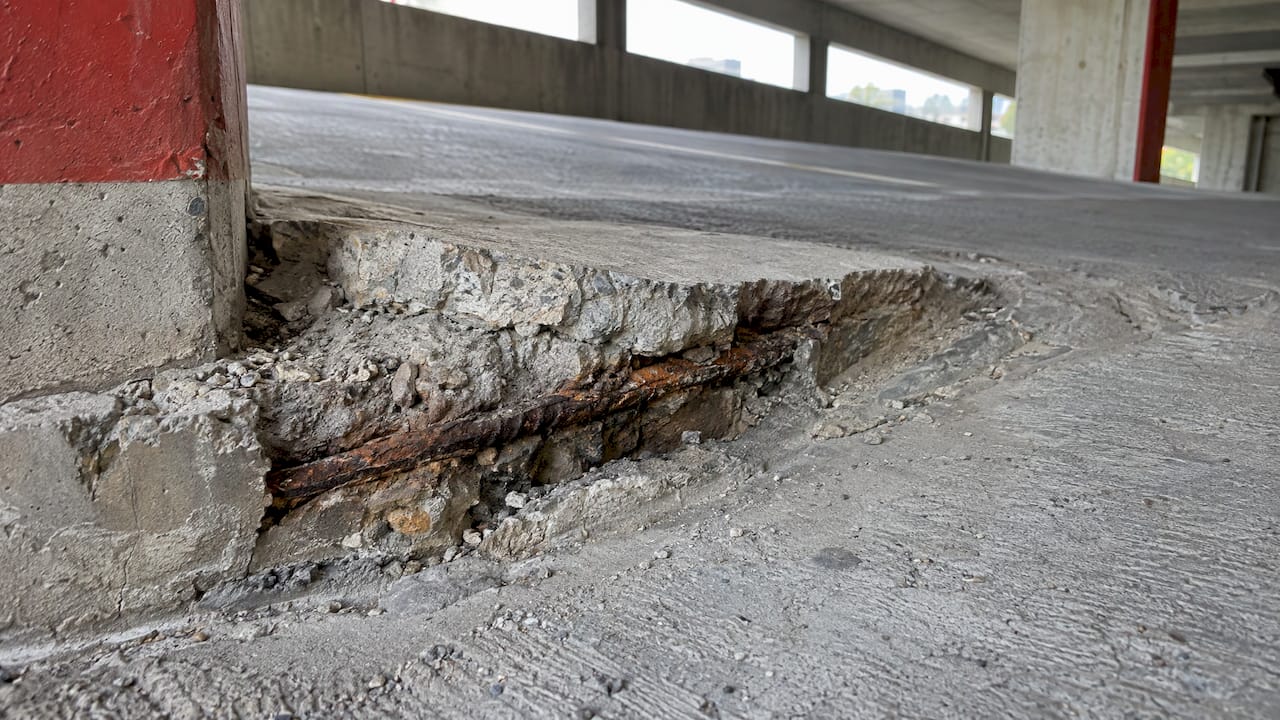
The U.S. Bureau of Reclamation’s Guide to Concrete Repair lists a longer set of causes: freezing and thawing, structural overload, abrasion and erosion, sulfate-bearing water or soils, acids, alkali-aggregate reaction, carbonation and steel corrosion. It also lists construction defects such as poor finishing, poor curing, poor-quality concrete and foundation movement.
Often there is more than one cause at work. The Caltrans Concrete Technology Manual notes that chemical attack such as chloride or sulfate exposure can show up as cracked or broken surfaces, that repairing the surface alone does not remove the underlying cause, and that damage may stem from a mix of structural deficiency, low-strength concrete and improper placement.
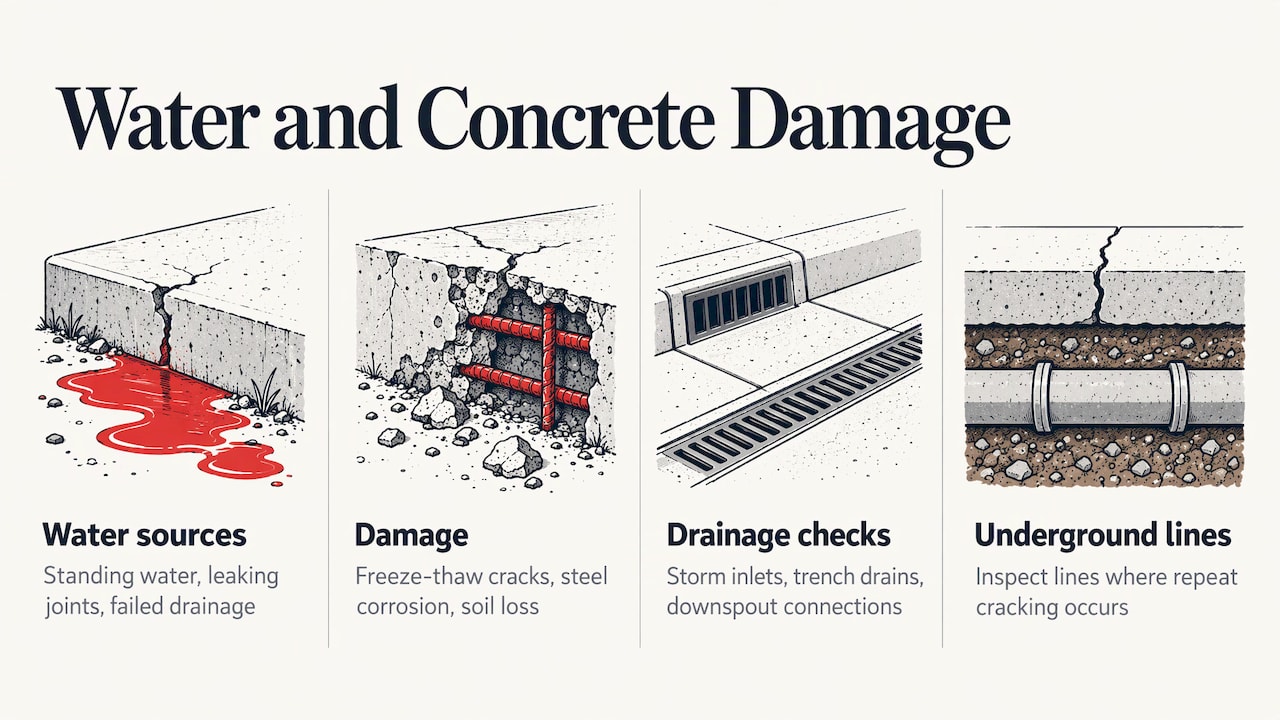
Water is the common thread
Standing water, leaking joints and failed drainage feed nearly every problem above. Water freezes in cracks, carries chlorides to steel and washes soil out from under slabs. If the same corner of a lot keeps cracking, look at where the water goes. Storm inlets, trench drains, downspout connections and underground lines are often part of the answer. That is why a repair plan for a parking lot, garage or loading area should include the drainage system around it.
How damage is assessed and when it is urgent
A proper assessment comes before any quote you should trust. According to ACI’s Concrete Repair Guide 546-23, condition assessment can include a review of design and construction documents, a visual condition survey, an evaluation of corrosion activity, invasive or nondestructive testing, lab analysis and structural analysis. Small jobs do not need every step, but larger or structural problems usually do.
What the assessment should tell you:
- What is damaged and how far it extends.
- What caused it.
- Whether it is still progressing.
- Whether it affects safety or the building’s structural adequacy.
Safety first, schedule the rest
The Bureau of Reclamation’s guide says not all damaged concrete needs immediate repair. Repair is required when damage affects safety or safe operation, or when deterioration is progressing fast enough to reduce future serviceability. It also notes that most damage progresses slowly, and that catching it early lets owners budget repairs in an orderly way instead of reacting to a failure.
In practical terms:
- Act now: spalled concrete that could fall, heaved or sunken slabs that create trip or vehicle hazards, exposed and corroding steel in a structural element, or anything affecting a fire lane or accessible route.
- Plan within the budget cycle: widening but stable cracks, early scaling, failed joint sealant, minor settlement without ponding.
- Monitor: hairline cracks that have not changed. Photograph them, date the photos and measure them again at your next inspection.
ACI 546-23 also notes that conditions posing an immediate safety issue should be reported to the owner for mitigation, and that local building codes may require the licensed design professional to report unsafe conditions to authorities. If you suspect a structural problem in a building or parking structure, bring in a licensed structural engineer before you hire a repair crew.
Repair methods and when each fits
The Caltrans manual lists the main options: doing nothing, partial replacement with dry-packed mortar, conventional concrete or shotcrete, an overlay, surface treatment with a sealant, and total replacement. The size and location of the defect determine the choice.
| Problem | Typical approach | Works best when |
|---|---|---|
| Narrow, stable cracks | Sealing or injection | The base is sound and there is no vertical movement |
| Failed joints | Joint cleaning and resealing | Slab edges are intact |
| Spalls and delamination | Partial-depth patching | Damage is localized and steel is sound or treated |
| Surface scaling | Overlay or resurfacing | The slab below is structurally sound |
| Settled slabs | Slab lifting, then repair | The soil problem is found and corrected |
| Corroded steel | Remove damaged concrete, treat steel, patch | The corrosion source is addressed |
| Widespread failure | Full-depth removal and replacement | Repair would chase damage across most of the slab |
One practical test for repair versus replacement: repair tends to make sense when the base is stable, the damage is localized, cracks are narrow with no vertical displacement and the slab has years of service left, as one commercial concrete guide from a Texas contractor puts it. When the base itself has failed, patching the top is a short-term answer.
The repair process, step by step
The Bureau of Reclamation outlines seven steps that apply to most jobs:
- Determine the cause of damage.
- Evaluate the extent of damage.
- Decide whether repair is needed.
- Select the repair method and material.
- Prepare the existing concrete.
- Apply the repair.
- Cure the repair properly.
Steps 5 and 7 are where cheap jobs fail. Poor surface preparation weakens the bond between old and new material, and poor curing weakens the repair itself. Ask any contractor how they prepare the substrate and how they cure the work.
What drives cost and timeline
Published per-square-foot figures for commercial concrete repair vary widely by region, access and scope, and the numbers circulating online come mostly from contractors’ marketing pages. Rather than quote a number that may not match your site, focus on the factors that move any quote:
- Depth and extent of damage. Surface sealing, partial-depth patching and full-depth replacement are different scales of work.
- Cause. If soil, drainage or steel corrosion is involved, the cause has to be fixed as well as the symptom.
- Access. Occupied buildings, tight loading docks and work around tenants or traffic add staging and phasing.
- Traffic return time. Faster-curing materials and overnight or sectional work can reduce downtime, and they affect the material choice and price.
- Utilities and excavation. Work that requires opening the ground, relocating lines or repairing storm structures adds scope.
- Permits and restoration. Right-of-way, drainage and site restoration needs belong in the budget from the start.
Timing matters as much as the quote. The Bureau of Reclamation’s guide states that an effective maintenance program is usually much more economical than taking no action. Small repairs done early cost less than the replacement that follows when you wait.
How to choose a commercial concrete repair contractor
Compare contractors on what they document, not just on the bottom line. Before you accept a quote:
- Ask for the diagnosis in writing. The quote should say what caused the damage and what the repair does about it. A line that reads “patch and seal” with no cause attached is a warning sign.
- Get the scope itemized. Quantities, depth of removal, materials, surface preparation, curing, joints and cleanup should each appear. Itemized scopes make quotes comparable.
- Check certifications. ACI runs more than 30 certification programs intended as a minimum qualification for concrete personnel. The ICRI Concrete Surface Repair Technician certification covers inspection and testing of repairs and is valid for five years. The International Masonry Institute’s Concrete Repair Certificate Program, built with ICRI, offers at least 28 hours of coursework and can be written into project specifications as a pre-qualification.
- Involve an engineer when the structure is at stake. ACI CODE-562-25 sets minimum requirements for assessing, repairing and rehabilitating existing structural concrete, and is written for use by a licensed design professional.
- Confirm permits and compliance. Excavation, drainage and utility work in Denver involves permits and inspections. A contractor who handles them removes a coordination job from your plate.
- Ask about the whole site. Concrete rarely fails in isolation. A contractor who can also deal with storm drains, underground lines and site restoration can fix the cause and finish the job in one project.
- Ask what happens afterward. Find out how long the repair is expected to last, what maintenance it needs and who to call if the same area shows problems again.
The cheapest patch is rarely the lowest total cost. Wide price ranges mostly reflect how much of the diagnosis and base condition each bidder has accounted for, so a lower number often means a smaller scope.
Making repairs last
The Bureau of Reclamation recommends regularly scheduled inspections, monitoring of suspect areas and keeping dated photos and notes so you can see how damage progresses. For concrete exposed to freeze-thaw damage, reducing the number of cycles while the concrete is saturated extends its life.
Material compatibility matters too. ACI 546-23 notes that new repair materials may shrink and creep at a different rate than the older concrete beneath them. That mismatch can crack the bond line, which is why controlled-shrinkage repair materials and moisture control are design considerations, not afterthoughts.
A few habits protect a repair:
- Keep water moving away from slabs. Clear drains, inlets and trench drains before winter.
- Reseal joints on a schedule so water does not reach the base.
- Walk the property each spring and fall. Photograph and date any new cracking.
- Keep deicing practices consistent and rinse residue off concrete in spring where practical.
- Keep surfaces clean after the work is done. Once a repair has cured, a routine commercial floor maintenance program keeps floors in good shape and makes new wear easier to spot.
One more rule of thumb: if the same areas keep needing repair, the diagnosis was probably incomplete. Go back to the cause, including drainage and the soil under the slab.
Our perspective
In our experience in Denver, concrete problems and water problems are usually the same problem. A cracked apron outside a loading dock, a sunken slab near a storm inlet or a spalled garage deck often traces back to where water goes and what the ground does beneath it.
That is why we approach concrete as part of the whole site. Our work covers excavation, storm drain installation and repair, trench drains, cast-in-place concrete structures, parking garage storm repair, civil work and site restoration. We handle projects from permits to cleanup, so the party diagnosing the cause is also the party fixing it and restoring the property afterward.
Our advice to property owners and managers is simple: do not wait for a failure. Have the problem identified, get the scope in writing and fix the water path along with the concrete. Done in that order, repairs are more likely to last and disruption to your tenants and operations is smaller.
Scott
Concrete, drainage and site work from one Denver team
If your concrete problem involves storm drainage, underground lines or a site that needs reworking, we can handle it as a single project. PipeX provides excavation and land grading, parking garage storm repair and replacement, cast-in-place concrete storm structures and site restoration for commercial, municipal and development clients, with 24/7 emergency response when a failure cannot wait.

To discuss your property, start from our commercial services page or contact us through pipexnow.com for a quote.
FAQ
How do I know if my commercial concrete needs repair or replacement?
Repair usually fits when the base is stable, the damage is localized, cracks are narrow and not offset vertically, and the slab has useful life left. Replacement is more likely when damage is widespread or the base has failed. A written assessment of cause and extent should make the call, not the size of the crack alone.
Is cracked commercial concrete an emergency?
Not always. Per the Bureau of Reclamation, repair is required when damage affects safety or is progressing quickly enough to reduce future serviceability. Falling concrete, trip hazards and exposed corroding steel call for prompt action, and a structural concern in a building or garage calls for a licensed structural engineer.
What should a commercial concrete repair quote include?
It should state the cause of the damage, the areas and quantities involved, how much concrete will be removed, the materials, surface preparation, curing, joint treatment and cleanup. An itemized scope lets you compare bidders on the same work and shows that someone actually diagnosed the problem.
Which certifications matter for concrete repair work?
ACI certifications cover concrete personnel, and ICRI’s Concrete Surface Repair Technician credential covers inspection and testing of repairs. The IMI Concrete Repair Certificate Program can be used as a pre-qualification in project specifications. For structural work, the assessment and design should come from a licensed design professional.
Can concrete repair be combined with drainage and utility work?
Yes, and it often should be. Water is behind much concrete deterioration, so correcting storm drains, trench drains or underground lines while the area is open can protect the repair. Coordinating this under one contractor also simplifies permits and site restoration.
Sources
- Guide to Concrete Repair, U.S. Bureau of Reclamation (2015)
- Concrete Technology Manual, Chapter 6, Caltrans (2013)
- ACI 546-23: Concrete Repair Guide
- ACI CODE-562-25: Assessment, Repair, and Rehabilitation of Existing Concrete Structures
- ACI Certification Programs
- ICRI Concrete Surface Repair Technician Certification
- International Masonry Institute Concrete Repair Certificate Program
- Commercial Concrete Repair and Replacement guide