
If you suspect a water line break, shut off the water at your main valve, call the right party for the pipe that failed, and keep everyone away from the flooded area. In Denver, the utility owns the public main in the street. You own the service line from the tap on the main to your building. That split decides who you call, and the first 60 minutes go better when you know it before the pipe fails.
This guide covers how to confirm a break, how to shut the water off, who pays for which section, what repair looks like, and when tap water is safe to drink again.
Key Takeaways
- Shut off your main water valve first, then work out whether the break is in the public main, your private service line, or your home’s plumbing.
- Denver Water handles the public main. The service line and interior plumbing are the property owner’s responsibility, and repairs go to a licensed plumber.
- Unusual water at the surface, sinkholes, low pressure, or discolored water are the classic warning signs of a buried break.
- Utility main repairs often take 8 to 12 hours when nothing unexpected turns up. Private line repairs depend on depth, access and pipe condition.
- After a main break, follow the local advisory. Boil-water notices call for boiled or bottled water for drinking, cooking and brushing teeth.
Table of Contents
- How a Water Line Break Happens
- Warning Signs of a Broken Water Line
- First Hour: What to Do Right Now
- Public Main, Service Line or Home Plumbing?
- How a Broken Water Line Is Found and Repaired
- How Long Does Repair Take, and What Does It Cost?
- After the Water Comes Back On
- Boil-Water Advisories After a Main Break
- Our Perspective on Water Line Breaks
- When You Need a Plumber, and How We Can Help
- Preventing the Next Break
- FAQ
- Sources
How a Water Line Break Happens
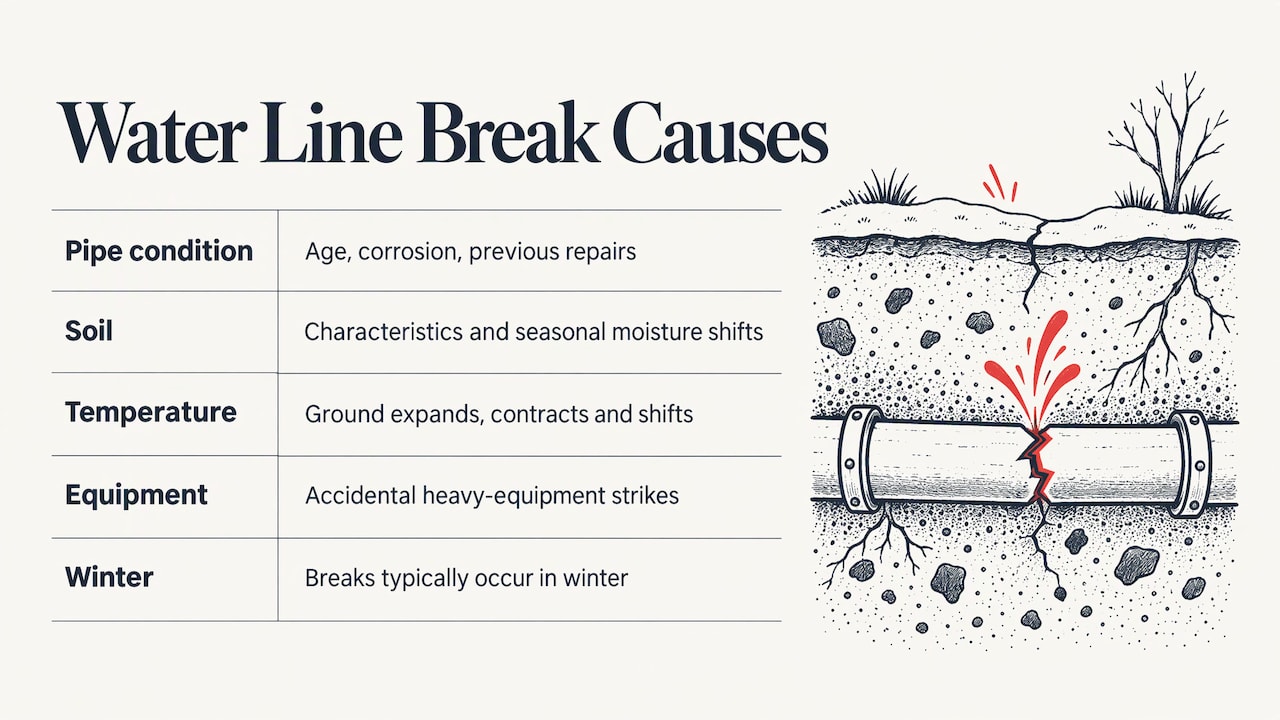
A break is a hole or crack in a pressurized pipe. Water pushes toward the surface, soaks the soil, and sometimes undermines pavement or a foundation. The cause is rarely a single event. Utilities point to a mix of pipe age and condition, soil characteristics, temperature swings in the water and the ground, and accidental strikes from heavy equipment. The same utility notes that breaks typically occur in winter.
Other utilities add corrosion, previous repairs, pressure variations, pipe composition, seasonal soil-moisture changes, installation configuration and nearby tree roots to the list.
Denver gives pipes a hard time. Cold snaps can follow a warm afternoon within hours, and the soil around a buried line expands, contracts and shifts with those swings. An older line with a history of patches has less margin for that movement. A line that has run quietly for decades can fail on the first hard freeze.
Warning Signs of a Broken Water Line
Buried breaks often announce themselves before the water reaches your lawn. Watch for these signs, drawn from municipal guidance on main and service breaks:
- Water flowing or standing somewhere it should not be
- A sinkhole, pothole or unexplained crack in pavement
- Low pressure or no water at all
- Cloudy or discolored water
- Gurgling or groaning sounds in the plumbing
A water-utility list of reportable signs adds seepage from hydrants, caps, pavement or ground in the public right-of-way, and water near a building foundation.
A few things point to your own line rather than the street. A water bill that jumps with no change in habits is one. A wet, soft patch of lawn between the meter and the house is another. A meter that keeps spinning when every fixture is off is a third. None of these proves a break, but each is a reason to get the line checked before the damage spreads.
First Hour: What to Do Right Now
- Shut off the water at your main valve. Most homes have the main shutoff where the water line enters, often in a basement, utility room or garage on the street-facing wall. Turn it fully closed. If the water is flowing outside and you cannot find or close a valve safely, skip to step 3.
- Open a faucet at the lowest point. This drains the remaining water in the house and eases pressure on weak joints.
- Call the right party. If water is coming up in the street, an alley or a shared area, report it to the utility. Denver Water provides 24-hour water emergency response: call 303-893-2444 during business hours, Monday to Friday, 7:30 a.m. to 5:30 p.m., or 303-628-6801 after hours. If the problem is on your side of the property line, call a licensed plumber.
- Protect what you can. Move furniture, electronics and stored boxes away from wet areas. Turn off power to a flooded area only if you can reach the panel without standing in water. If water is near outlets or the panel, stay out and call an electrician or emergency service.
- Do not dig on your own. Before any digging, contact the one-call service so gas, electric and other buried lines can be marked. In Colorado that means calling 811. A shovel through a gas line turns a plumbing problem into a much bigger one.
- Document the damage. Photos and notes help with a homeowner’s insurance claim. Water damage may or may not be covered separately from a typical homeowner’s policy, so ask your insurer what applies to you.
If you want a plumber with excavation crews on the same job, our emergency services line is staffed around the clock.
Public Main, Service Line or Home Plumbing?
The fastest way to cut confusion is to figure out which section failed. The scale of the problem is a clue. One city says a main break typically affects a block, with households on both sides of the street, while a service-connection break typically affects one household or business. If your neighbors also have no water, suspect the main. If only your house is affected, look at your service line or interior pipes.
| Section | What it is | Who typically owns it | Who repairs it |
|---|---|---|---|
| Public water main | Large pipe under the street | The water utility | Utility crews |
| Service line | Pipe from the main to your building | Property owner | Licensed plumber |
| Interior plumbing | Pipes inside the building | Property owner | Licensed plumber |
In Denver, the dividing point is where the property taps into the main, or the discharge side of the valve closest to the main. The service line includes all pipe and fittings up to and including the stop and waste valve for an outside meter, or up to the valve on the downstream side of an inside meter. Denver Water states that it is not responsible for water damage caused by a property’s service line or internal plumbing.
Other cities draw the line the same way. Philadelphia, for example, treats the main as the department’s job and the service pipe and supply pipe as the homeowner’s, and Cedar Rapids requires a licensed plumber for a leaking service line. Some utilities will step in and bill the account if an owner does not act. Des Moines Water Works, for instance, may contract a plumber for stop-box repairs, with the cost depending on the work. Rules vary by utility and by location, so confirm yours with the utility that serves your address.
Not sure which side the leak is on? Call the utility first. They can tell you whether the main is involved, and staff investigate whether the water is drinking water or groundwater, using leak-detection equipment when the source is not visible. If it is on your side, the next call is a plumber.
How a Broken Water Line Is Found and Repaired
Repair follows a predictable order, whether the pipe belongs to a utility or a property owner.
Locating the break
When water is visible, the source is usually near. When it is not, crews use leak-detection equipment. For a private line, a video inspection of the pipe can show cracks, offset joints, roots and corrosion where a line is accessible. Locating the exact point matters because it decides how much digging is needed. Guessing is expensive.
Isolating and exposing the pipe
Crews close valves to stop or reduce flow and isolate the broken section. Before the excavation starts, other buried utilities are located and marked. Then the trench is opened and shored where needed.
Repairing or replacing the pipe
The fix depends on the type and severity of the break. A clean, localized failure may take a repair section. A line with several failures, heavy corrosion or old materials often calls for replacement of a longer run. Replacing the whole run once can cost less over time than patching the same pipe repeatedly, so it is worth asking your plumber what condition the rest of the line is in once it is exposed.
Restoring the site
For a public main, Philadelphia’s process includes flushing the line, disinfecting the main if needed, and patching the road. Roadway breaks usually get a temporary asphalt patch, and permanent paving is typically completed within 6 to 8 weeks. On private property, restoration means backfill, compaction and rebuilding whatever was removed: sod, concrete, asphalt or pavers.
How Long Does Repair Take, and What Does It Cost?
Utility figures give a useful sense of timing. Philadelphia reports an average main-break repair time of 8 to 12 hours when no unforeseen circumstances arise. Another utility says routine leak repairs are normally completed within two weeks, while major transmission-main repairs may take longer because of the engineering and construction involved. Delays have familiar causes: older valves, utility-marking delays, other utilities in the way, weather, equipment problems and crew safety.
Cost has no honest single number, and any quote that arrives without a look at the line is a guess. These factors move the price most:
- Depth and length of the break. A shallow, short repair is a different job than a deep one that spans the yard.
- What is on top of it. Lawn, concrete, asphalt, landscaping and driveways each carry different restoration work.
- Access. Tight side yards, fences and nearby utilities slow the work.
- Pipe material and condition. Old or corroded pipe may need more replacement than the break alone suggests.
- Permits and inspections. Work in the public right-of-way or on larger lines involves permitting.
- Timing. Emergency and after-hours response differs from scheduled work.
We do not publish set prices because each break is different. We quote after we see the line and the site.
After the Water Comes Back On
When service returns, take it slow. Cedar Rapids recommends opening a cold-water faucet without an aerator, such as a bathtub or hose bib, to release air, and says initial cloudiness from air or particles should clear quickly. Denver Water gives similar advice: run cold water from a bathtub or outside spigot once service is restored.
If the cloudiness persists, or water looks or smells off, stop using it for drinking and call the utility.
Boil-Water Advisories After a Main Break
A main break can drop pressure in the distribution system. The EPA explains that pressure below 20 psi creates a high potential for contaminants to enter through backsiphonage and pipe joints and holes, and that a loss-of-pressure boil-water notice may be required. This applies to breaks in the public system. A break on only your private line does not usually trigger an advisory for the neighborhood.
If your utility issues a notice, follow its exact wording. The CDC distinguishes three kinds:
- Boil-water advisory: use bottled or boiled water.
- Do-not-drink advisory: use bottled water, because boiling may not make water containing chemicals or toxins safe.
- Do-not-use advisory: no tap water for any purpose.
During a boil-water advisory, the CDC says to use bottled or boiled water for drinking, preparing and cooking food, and brushing teeth. Bring water to a rolling boil for 1 minute, or 3 minutes above 6,500 feet. Denver sits at about 5,280 feet, so 1 minute applies there, but if you are in the mountains west of the city, use the 3-minute rule.
An advisory stays in place until testing supports lifting it. EPA guidance says to maintain it until two consecutive days of safe total-coliform samples are collected or the utility is told the order can be lifted. Healthcare facilities have extra steps, and CDC guidance covers flushing fixtures and equipment after an alert is lifted.
Our Perspective on Water Line Breaks
We have worked on water lines in Denver for over 20 years, and the pattern is consistent: the break itself is rarely the most expensive part. The delay is. Water keeps moving, soil keeps washing out, and a problem that needed one clean repair becomes a damaged driveway or a flooded basement.
That is why we run emergency response around the clock and handle the job from permit to cleanup. A water line repair involves locating the pipe, pulling permits where required, excavating, repairing or replacing the line, and restoring the surface. When one team handles those steps, there is less to coordinate for you and less time with the water off.
Our approach is built around Denver’s conditions: freeze and thaw cycles, shifting soil and older lines. We use video inspection to see what the pipe looks like, and we explain what we find in plain terms before any work starts. When a line is failing in several places, we say so, because a longer-lasting replacement is sometimes the better answer than another patch.
For homeowners, that means one call. For businesses, property managers and developers, it means the plumbing and excavation sides are not handled by two firms who each point to the other.
Scott
When You Need a Plumber, and How We Can Help
A break on your service line or inside your building is your responsibility, and it calls for a licensed plumber with excavation capability. We handle water line repair and replacement for homes and businesses, and our water main and fire line repair work covers larger systems. We start with a video inspection when the source is not obvious, then repair or replace the line, handle permits, and restore the site.

If water is already running, call us through our emergency services page. If the break is not urgent but you have seen the warning signs, our plumbing services page lists the full range, including video inspection, hydro jetting and sewer line work. For a line that keeps failing, our guide on sewer line repair versus replacement explains the same repair-or-replace thinking for the other side of your property.
Preventing the Next Break
You cannot freeze-proof the ground, but you can lower the odds.
- Know your shutoff. Find the main valve now and make sure it turns. A valve that is stuck is no help during a break.
- Watch your water bill. A steady rise with no change in use is a common sign of a hidden leak.
- Check the yard. Soft, wet or unusually green spots along the line’s path are worth a look.
- Mind your trees. Roots near buried pipes are one of the causes utilities list for service line damage.
- Inspect older lines. If your home is old and the line has been patched before, a video inspection shows its condition before it fails.
- Plan replacement on your terms. A scheduled replacement is calmer and often cheaper than an emergency dig.
For commercial and municipal properties, the same logic applies at scale. Valves, vaults, meter pits and fire lines all need to be accessible and in working order. Our municipal and industrial services cover those systems.
FAQ
Who pays to fix a broken water line in Denver?
The property owner pays for the service line and interior plumbing. Denver Water maintains the public main. The dividing point is where the property taps into the main, or at the valve closest to it, so confirm the exact point with the utility for your address.
How do I know if the break is on my property?
Check whether your neighbors have low pressure or no water. If they do, the main is likely involved. If only your property is affected, or you see wet ground between the meter and the house, the service line is the likely culprit. The utility can help you tell the difference.
Is it safe to drink the water after a water line break?
It depends on where the break was and whether an advisory was issued. After a public main break, follow the utility’s notice. Boil-water advisories call for boiled or bottled water for drinking, cooking and brushing teeth. A private line break alone typically does not affect the wider system.
How long does it take to repair a broken water line?
A utility main repair averages 8 to 12 hours in Philadelphia when nothing unexpected arises. Private line repairs depend on depth, access, pipe condition and permits. Many are finished the same day or within a few days, but a complex replacement takes longer.
Should I call the utility or a plumber first?
Call the utility if water is coming up in the street or a shared area, or if you are unsure. Call a plumber when the break is on your service line or inside the building. In both cases, shut off your main valve first.
Sources
- Denver Water: Homeowner Responsibility
- Denver Water: Report a Problem or Emergency
- Denver Water: Water Outage FAQs
- Philadelphia Water Department: Damaged Water Mains & Pipes
- City of Regina: Report a Water Main Break
- Georgetown Divide PUD: Water Main and Service Line Break
- Prince William Water: Water Main Breaks FAQ
- Cedar Rapids Water Division: Outages/Main Breaks
- Des Moines Water Works: Service Lines
- EPA: Emergencies and Security, Loss of Pressure
- EPA: Loss of Pressure in Drinking Water Systems
- CDC: Drinking Water Advisories Overview
- CDC: Healthcare Water System Repair and Recovery