
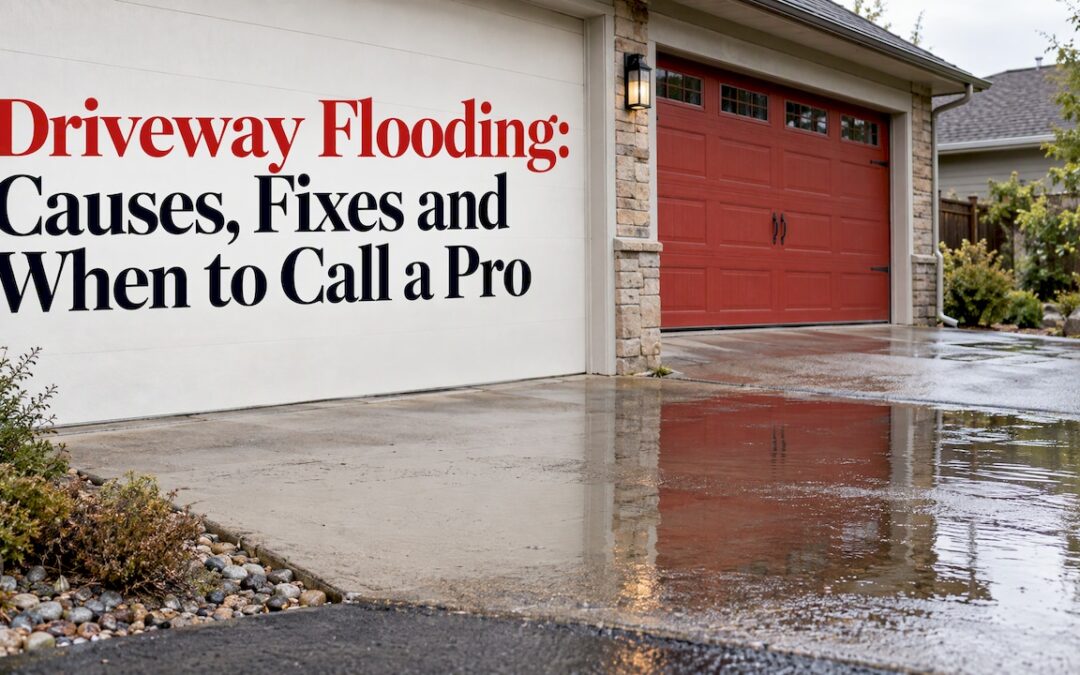
Driveway flooding almost always comes down to one thing: the water has no working path off the pavement. The slope is wrong, a section has sunk, a downspout is dumping onto the surface, or a drain is blocked. Find which one applies, and the fix follows. Surface water usually calls for a trench (channel) drain or regrading. Water seeping up from the ground calls for a subsurface drain. A blocked culvert or buried line calls for cleaning, a camera inspection or repair.
This guide walks you through the common causes, a simple way to diagnose yours during the next rain, the main drainage options and what they cost, and the Denver-specific rules to know before you dig.
Key Takeaways
- Most pooling traces back to slope, settling, downspouts, runoff from the street or a higher yard, or drains that no longer work.
- Diagnose first: watch where the water enters, where it slows, and where it ends up during an ordinary rain, and photograph it.
- A trench drain at the low edge of the driveway is the simplest surface fix, while a French drain suits water coming from underground.
- Drainage work should never push the problem onto a neighbor, and in Denver some systems need a permit and a licensed plumber or drain layer.
- If the water source is buried, clogged or beyond a quick fix, a video inspection and a professional plan save you from guessing twice.
Table of Contents
- Why Your Driveway Floods or Water Pools on It
- Why Is My Driveway Wet When It Has Not Rained?
- How to Find the Cause Before You Spend Anything
- Fixes That Match the Cause
- What Driveway Drainage Costs
- Culverts, Neighbors and Denver Rules
- Our Perspective
- Get Help With Driveway Drainage in Denver
- Frequently Asked Questions
- Sources
Why Your Driveway Floods or Water Pools on It
Pooling happens when rain or runoff collects on pavement with no working route off of it. HomeExteriorLab lists six main causes: a slope that is too flat or runs the wrong way, a section that has settled, downspouts feeding the surface, the street or curb sending water back, a yard sitting higher than the driveway, and drains that are not working.
Slope that was never right
The same source calls a flat or backward slope the number one cause, often built in on pour day. Concrete crews sometimes pour a drive nearly level to make the garage transition smooth, and it looks fine until the first heavy storm. If your driveway has pooled since you bought the house, this is the first suspect.
Settling and sunken sections
A slab that has sunk over the years creates a bowl. Water that used to run off now sits there after every storm. The puddle forms in the same spot each time, which is the clearest sign.
Downspouts, yards and streets
A downspout that empties onto the pavement adds the whole roof’s runoff to the driveway. A neighboring or higher yard can send water across your property line. Traditionally, driveways were built to send runoff straight to the street, and the USDA’s Natural Resources Conservation Service notes that concentrating large volumes of water at a street outlet raises the chance of potholes, flooding and erosion.
Drains that stopped draining
An existing channel drain, catch basin or culvert fills with leaves, sediment and debris. Then it overflows exactly when you need it most. This is the one cause that cleaning, rather than construction, can solve.
Why Is My Driveway Wet When It Has Not Rained?
If the pavement is wet after a dry day, the water is not coming from the sky. The U.S. Geological Survey describes a case where groundwater seeped out of the hill above a driveway the day after a downpour. Rain soaked into the slope, traveled along permeable soil layers, and the driveway had been cut deep enough to intersect that layer, so water surfaced.
Two other explanations are worth ruling out. UF/IFAS Extension notes is not the right source for this, so we point you to the extension’s own guidance instead: misaligned or damaged sprinkler heads are a common reason pavement stays wet without rain, because they spray onto hard surfaces. Check your irrigation zones before assuming a plumbing problem.
If the wetness persists in dry weather, appears in the same place, and the sprinklers are off, a leaking water service line is possible. That is a job for a plumber, not a drainage contractor, and a video inspection or a line locate can tell you which it is.
How to Find the Cause Before You Spend Anything
Guessing is expensive. Drainage guides agree on one method: trace the water. DrainageHelper recommends mapping where water enters, how it crosses the pavement, where it slows or pools, and what lies downhill. The useful clue is the repeatable pattern, not the mere presence of water.
During a safe, ordinary rain, do this:
- Stand at the top of the driveway and note whether a broad sheet of water runs toward the garage.
- Look at the roof lines. Does a downspout discharge onto the pavement or just beside it?
- Check the sides. Does water enter from a neighbor’s yard or from a higher landscaped bed?
- Mark the low point with chalk where the puddle forms, and photograph it or take a short video.
- Follow the water to its end. Does it reach the street, a lawn, a drain or your garage door?
- Inspect any existing drain for debris after the storm passes.
One more useful test: the University of Connecticut’s NEMO program says the best way to learn whether your driveway is connected to the storm system is to watch where runoff goes during a rainstorm. If it drains to your lawn and stays on your property, it is not connected to the stormwater system.
A caution from Oklahoma State University Extension, as cited by DrainageHelper: drainage problems reflect a mix of grading, slope, soil and runoff, and the fix should not simply move the problem to a downhill neighbor.
Fixes That Match the Cause
| Cause | Typical fix | Notes |
|---|---|---|
| Water crosses the driveway toward the garage | Trench (channel) drain across the low edge | Catches sheet flow over a wide area |
| Water seeps up or sits in soil beside the drive | French drain or underdrain | Best for subsurface water |
| Downspout empties on pavement | Extend or pipe the downspout to a proper outlet | Cheapest fix on the list |
| Settled or flat slab | Regrading, repaving or replacing the section | Fixes the root cause |
| Culvert or drain clogged | Cleaning, hydro jetting, repair | Restores what you already have |
| Hard surface sheds too much water | Permeable pavers | Lets water pass through to soil |
Trench drains
The NEMO bulletin calls a trench drain at the bottom of the driveway the simplest method: it catches water before it leaves your property and redirects it to a pervious area such as a lawn. Bob Vila’s drainage expert explains that channel drains are linear, so they capture water over a wide area and suit places where surface water collects fast. The grate is set into the concrete or asphalt itself.
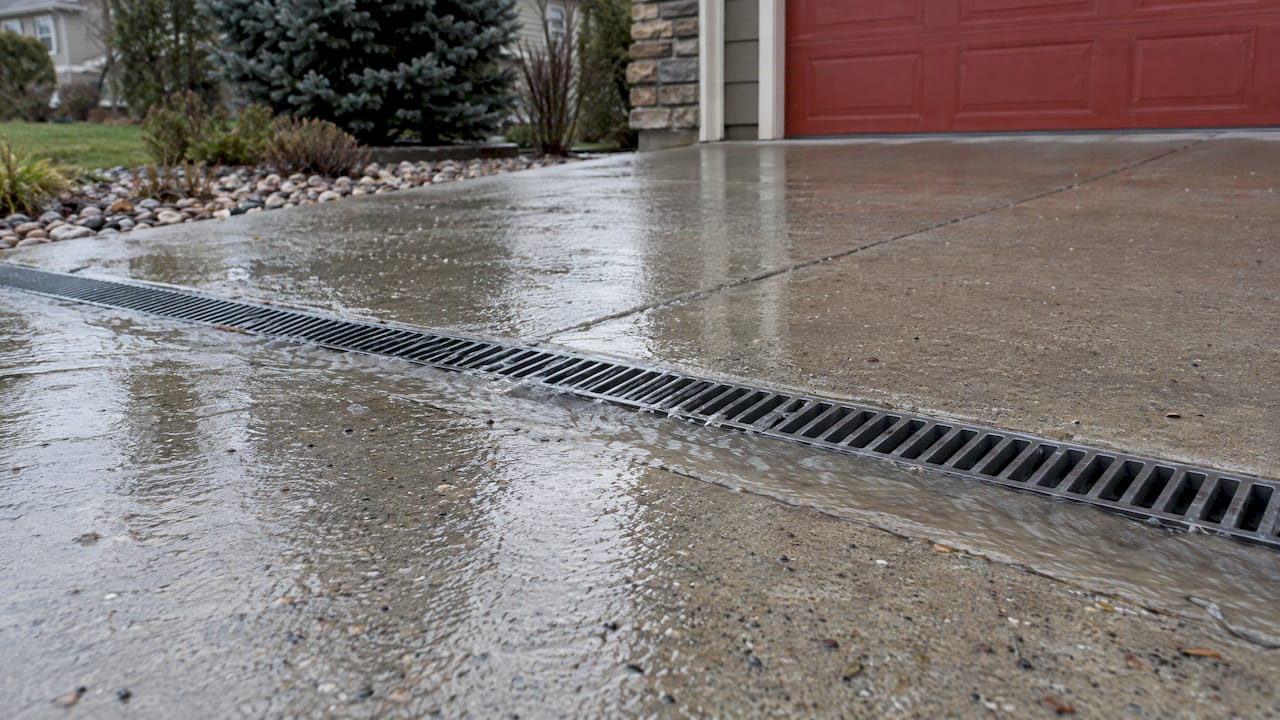
Two specs matter. DrainageCalculators notes that residential driveways need grates rated for at least 2,000 pounds (Class A), and that underground pipe must slope at least 1 percent (1/8 inch per foot) toward the discharge point, because flat or backsloping pipe clogs and fails.
French drains and underdrains
A French drain is a trench with perforated pipe and gravel. Per Bob Vila’s article, it lets water seep slowly into the ground and works best on subsurface water rather than standing surface water. That is why it fits the seepage case above and not the flat-slab case. The Westmoreland Conservation District adds that underdrains should be installed with at least a 2 to 3 percent slope and carry water to a designated outlet.
Permeable pavers
The NEMO bulletin says permeable interlocking concrete pavers are perhaps the most practical option for residential driveways, since water passes through into the soil below. This is a replacement project, so it fits best when the driveway is due for rebuilding anyway.
Regrading
When the slab itself is flat or has sunk, no grate fixes the cause. Reshaping the surface, or the ground around it, so water leaves the pavement is the lasting answer. This is excavation and grading work, and the sub-base and outlet need planning together.
What Driveway Drainage Costs
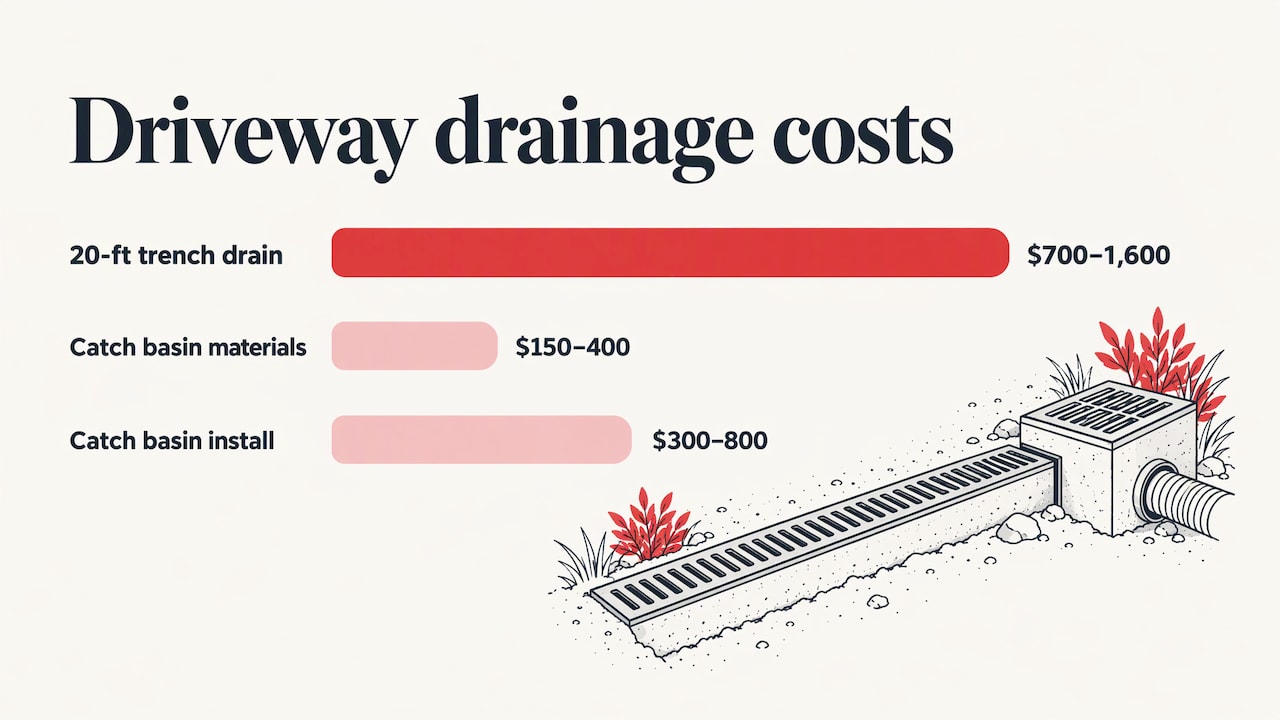
Prices vary by site, so treat published ranges as ballparks. DrainageCalculators estimates a typical 20-foot driveway crossing with a trench drain at $700 to $1,600 installed. A catch basin runs $150 to $400 for materials, plus $300 to $800 for installation including underground piping. Those are national estimates published in 2026, not quotes from us.
The things that move a price are the length of the run, whether the drain must be cut through existing concrete, how far the water has to travel to a legal outlet, and the depth of excavation. Written quotes from licensed contractors are the only way to get a real figure for your property.
The cheapest way to handle a muddy driveway
For gravel or dirt drives, the lowest-cost steps are the ones that stop water at the source: redirect downspouts, keep the surface crowned so water sheds to the sides, and clear any ditch or culvert at the edge. These cost little compared with new drains. If mud returns after every storm, the grade or the subsurface water is the cause, and that is when a drain or regrade pays for itself.
Culverts, Neighbors and Denver Rules
If your driveway crosses a roadside ditch, the pipe underneath is usually yours to maintain. Municipal rules differ. For example, Chattanooga states that the property owner is responsible for installing and maintaining driveway culverts, and that owners must keep downspout and sump water from damaging neighbors or the street, including by creating ice hazards. Other jurisdictions set their own permit thresholds, so check with your local authority before replacing one.
In Denver, the city’s homeowner guide to runoff warns against landscaping that pushes water onto or blocks water on a neighbor’s lot. It also says certain drainage systems need to be permitted by Denver Public Works, that piping must daylight properly at least 10 feet from the front property line, and that a licensed plumber or drain layer is required for that work. Confirm current requirements with the city before you start, because rules change.
The practical takeaway: a trench in the driveway that discharges toward the street or a neighbor is not a DIY afternoon in Denver. Permits and outlet location are part of the design.
Our Perspective
Most driveway flooding calls we hear about start the same way: someone tried a quick patch, the water came back, and the real cause was underground or at the outlet. We have spent over 20 years on plumbing and excavation in Denver, and the lesson is consistent: look at the whole path the water takes, not only the puddle.
That is why we like to start with a video inspection when the source is unclear. A camera shows whether a line is broken, a drain is blocked or the water is simply surface runoff. From there, the fix is usually one of three things: a trench drain at the low edge, regrading so the slab sheds water, or repair of the buried line feeding the problem. Hydro jetting clears out drains and lines that have filled with debris, which often restores the system you already own.
Our turnkey approach covers the permit, the excavation, the drain or storm structure and the cleanup, so you deal with one crew from the first look to the finished surface. Denver weather swings from dry spells to hard downpours, so we design for the storm, not the average day.
Scott
Get Help With Driveway Drainage in Denver
If your driveway keeps flooding, PipeX handles the diagnosis, the permits, the digging and the cleanup. For surface water, learn how trench drains for Denver properties are used to manage runoff. For regrading and site work, see our excavation and land grading services. If a drain or line is clogged, our drain cleaning and hydro jetting service can clear it, and a video inspection shows what is underground.

Water coming into a garage or a flooded driveway in a storm is urgent. Reach our crew through the emergency services page, and we respond around the clock.
Frequently Asked Questions
How do I keep water from flooding my driveway?
Trace the water first, then match the fix. A trench drain across the low edge catches surface water and sends it to a lawn or other permitted outlet. Redirecting downspouts, clearing existing drains and regrading a flat or sunken section address the other common causes. Underground seepage needs a French drain or underdrain.
Why does my driveway flood when it rains but only in one spot?
A puddle in the same place after each storm points to a low point, often a settled slab or a slope poured too flat. Mark that spot during a rain and note where the water goes next. If a drain sits nearby, check whether it is blocked with debris.
Am I responsible for the culvert under my driveway?
In many places, yes. Some cities and counties treat driveway culverts as private and put maintenance and replacement on the landowner, and permits may be required for repairs. The rules vary by jurisdiction, so check with your city or county before work. In Denver, contact the city about drainage permits first.
Why is my driveway wet when it has not rained?
Common causes are groundwater seeping out of a slope after earlier rain and sprinkler heads spraying onto pavement. If neither fits and the area stays wet in dry weather, a leaking buried water line is possible, and a plumber can confirm it.
Sources
- Why Does Water Pool on My Driveway? Causes and Fixes (HomeExteriorLab)
- Slow it. Spread it. Sink it! Home Drainage Guide (USDA NRCS)
- Groundwater Flows Underground (U.S. Geological Survey)
- Driveway Drainage Problems and Solutions (Drainage Helper)
- NEMO Bulletin on driveways (University of Connecticut)
- 7 Driveway Drainage Solutions (Bob Vila)
- Best management practices for your driveway (Westmoreland Conservation District)
- Driveway Drainage Solutions (DrainageCalculators)
- Stormwater Department (City of Chattanooga)
- Homeowner guide to runoff (Denver)