

You can confirm a suspected water line leak in about two hours with your water meter, then narrow it down to the underground pipe by closing your home’s main valve. Pinpointing the exact spot usually takes listening equipment that finds the sound of escaping water through soil, which means the yard often stays intact until the repair itself. This guide walks through the warning signs, the tests you can run today, how professionals locate a leak, and who is responsible for fixing it in Denver.
Key Takeaways
- A meter test is the fastest first check: stop all water use, record the reading, wait two hours and compare. Any change suggests a leak.
- Closing the home’s main valve separates the indoor plumbing from the underground line. If the meter keeps moving, the leak is between the meter and the house.
- Acoustic tools such as ground microphones and correlators locate leaks by sound, so a pro can mark a spot before anyone digs.
- In Denver, the property owner is responsible for the service line from the main to the building, so a confirmed leak on that stretch is yours to repair.
- Significant leaks should be repaired right away. Call a licensed plumber and have underground utilities located before any excavation.
Table of Contents
- Signs of an Underground Water Line Leak
- How to Check for a Leak Yourself
- How Professionals Pinpoint a Leak Without Digging
- Water Main vs. Service Line: Know Which One You Have
- Who Pays for the Repair in Denver
- What Happens After the Leak Is Located
- Our Perspective on Leak Detection
- Get a Suspected Leak Checked
- Preventing the Next Leak
- FAQ
- Sources
Signs of an Underground Water Line Leak
Underground leaks hide, but they rarely stay silent. Small ones can go unnoticed for a long time and still add up to a large loss, while big ones tend to surface quickly and get fixed sooner, according to Georgia’s Environmental Protection Division. That is why the first clues are usually on the bill or in the yard.
Portland’s water bureau lists the signs that most often point to a buried line:
- Water use that climbs with no change in habits
- Reduced pressure or flow
- Wet, pooled or unusually soft ground
- Patches of grass that are greener or mossier than the rest
- Rusty or dirty water, or air spitting from the taps
- Irrigation that stops working properly
- Cracked or lifted pavement, sinkholes, uneven floors or leaning structures
Georgia’s guidance adds heaving or cracked paved areas, potholes, and water use that rises steadily across several billing cycles.
In Denver, two local factors make these signs easy to misread. Dry summers mean a patch of green lawn in August stands out for a reason, but a soggy spot in January may be mistaken for snowmelt. And a bill that creeps up through the irrigation season can hide a leak behind sprinkler use. Compare winter usage month to month, when the sprinklers are off, for the cleanest read.
How to Check for a Leak Yourself
These checks take no tools beyond a pencil and a phone. They tell you whether a leak exists and roughly where it sits, which is exactly what a plumber will want to know when you call.
Step 1: Run the meter test
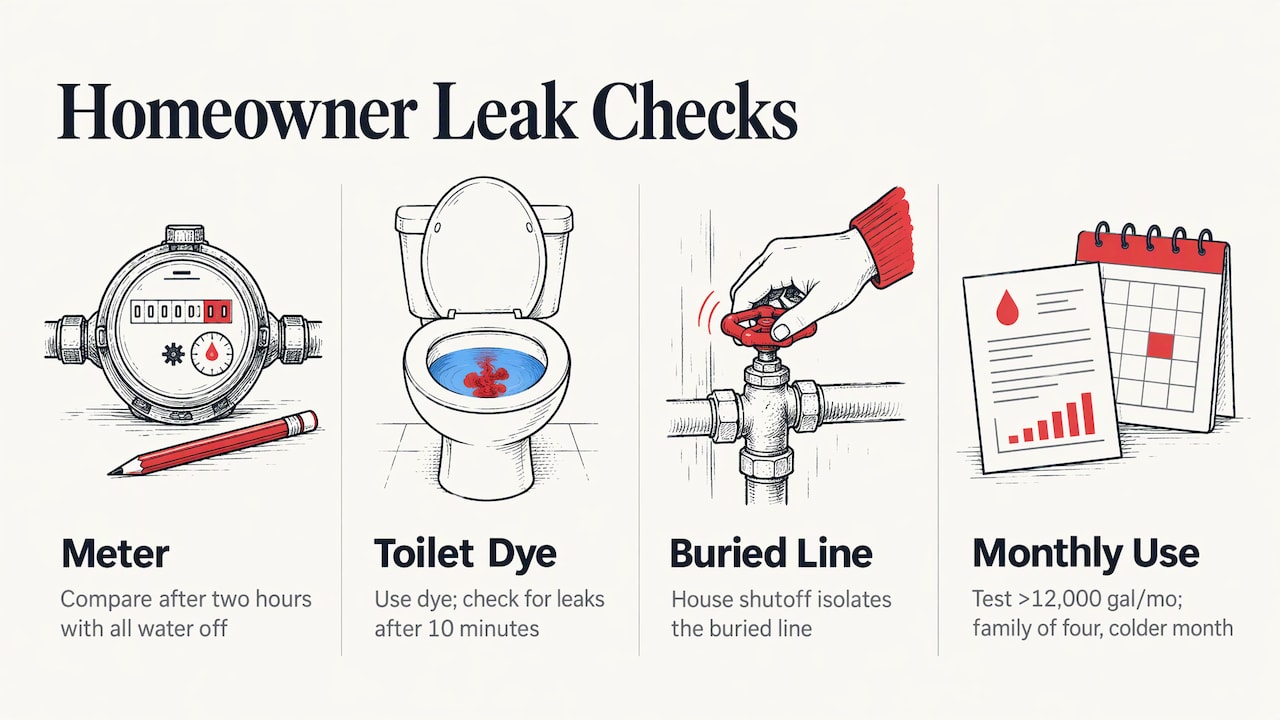
The EPA’s WaterSense program says to stop all water use, note the meter reading, and compare it after two hours. If the reading changed, you probably have a leak. Turn off the dishwasher, washer, ice maker and irrigation first, and make sure nobody flushes.
Portland’s procedure adds a useful detail: watch the leak-indicator dial or sweep hand on the meter, and wait several hours if you need to catch a slow leak. A very small leak may not move the dial in a short window.
Step 2: Rule out the toilets and fixtures
Toilets are the most common indoor culprit. EPA suggests adding food coloring to the tank and waiting 10 minutes: if color shows up in the bowl, the flapper is leaking. Also look at faucet gaskets and pipe fittings for outside water. If you find a dripping fixture, fix it and repeat the meter test.
Step 3: Separate indoor plumbing from the buried line
If the meter still moves after you have ruled out fixtures, close the main shutoff valve at the house. Portland explains what happens next: if the meter keeps moving, water is flowing somewhere between the meter and the house shutoff, which is the underground segment. If the meter stops, the leak is probably inside the building.
That single step often saves a plumber’s first hour and tells you which kind of specialist you need.
Step 4: Check your own usage against a benchmark
EPA WaterSense notes that a family of four using more than 12,000 gallons per month in a colder month may have serious leaks. Treat that as a prompt to run the meter test, not as a diagnosis.
How Professionals Pinpoint a Leak Without Digging
The goal of a leak survey is to turn “somewhere under the lawn” into “this spot, this depth.” The U.S. Department of Energy makes the distinction clearly: an audit quantifies how much water is lost, while a leak-detection survey pinpoints locations so repairs can be targeted.
Sound-based methods
Escaping water under pressure makes noise in the pipe, and acoustic equipment is built to hear it. Georgia’s guidance describes three common tools:
- Listening devices that touch valves and hydrants
- Geophones that listen directly at the ground surface
- Correlators that listen at two points at once to pinpoint the leak
The Department of Energy notes that a correlator paired with a ground microphone can determine a leak’s exact location. According to Austin Water’s loss-program review, a correlator compares when the leak sound arrives at two contact points and calculates the position from pipe details entered by the operator. The same review says correlators are highly accurate but depend on an experienced operator and accurate inputs, which is why they suit pinpointing and complex verification better than a first sweep.
Other methods, depending on the pipe
Not every pipe talks. The EPA’s guide on drinking water losses lists several approaches beyond sound:
| Method | What it looks for |
|---|---|
| Acoustic | Leak noise in the pipe |
| Electromagnetic | Defective reinforcing steel in prestressed concrete pipe |
| Thermal | Ground-temperature differences caused by saturation |
| Chemical | Added substances such as chlorine or fluoride escaping |
| Tracer gas | Gas introduced into a dewatered line and detected at the surface |
Utah’s water resources division names visual inspection, acoustic detection and flow measurement as the three primary ways to locate utility leaks, and stresses matching the method to the system’s conditions. For a typical residential service line, that usually means flow measurement to confirm, then acoustic tools to locate.
Where video inspection fits
Sound and meter tests find water loss. A camera shows pipe condition. When a drain or sewer line is suspected, video inspection lets a crew see cracks, offsets, root intrusion and corrosion from the inside. We offer video inspection as part of our plumbing services, and it is often how we confirm what a pipe needs before recommending a repair method.
Water Main vs. Service Line: Know Which One You Have
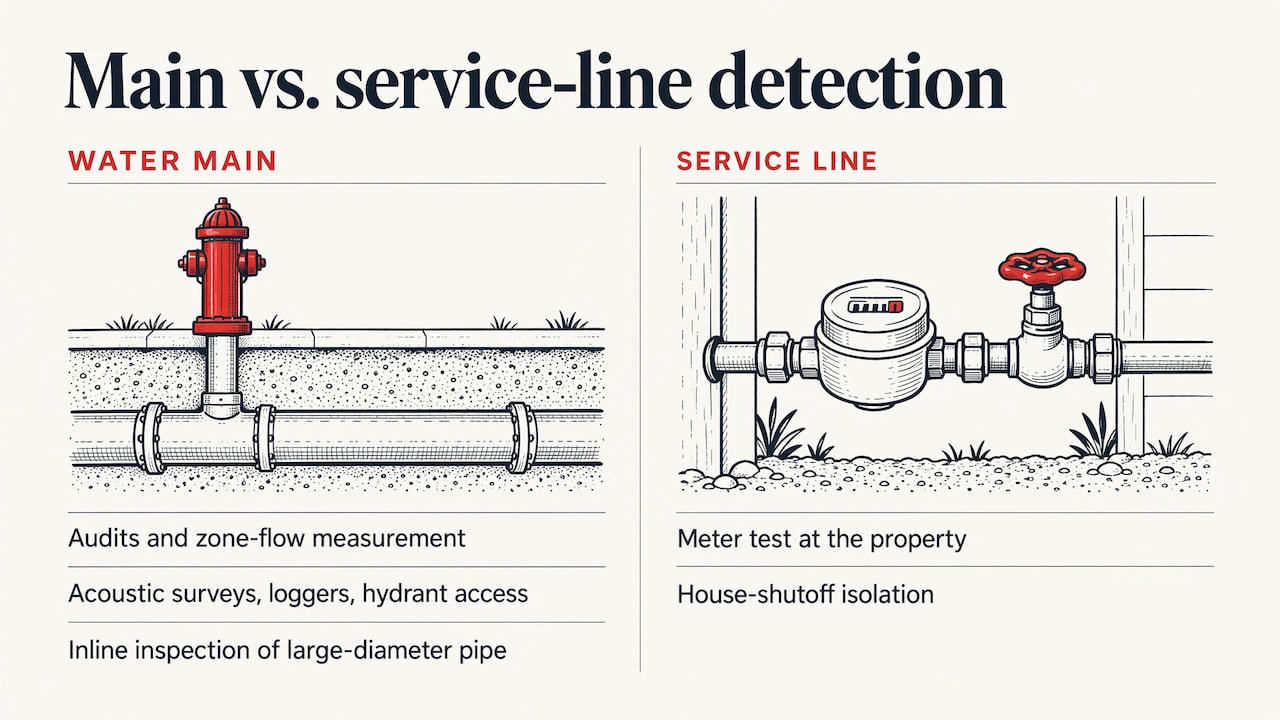
Searches for water main leak detection and service line leaks overlap, but the two are different jobs. Main-level detection is generally a utility-scale process: audits, zone flow measurement, acoustic surveys, loggers and access through hydrants and valves, and sometimes inline inspection of large-diameter pipe. A property’s service line can start with your own meter test and house-shutoff isolation.
If you see water bubbling up in the street, flowing along the curb or soaking the area near the pavement edge, Milwaukee’s water utility advises reporting it, because it may be a service-line leak. In Denver, call Denver Water for anything that looks like a main or street-side problem.
Private-property water mains matter too. Commercial sites, fire lines, hydrants, vaults and meter pits are privately maintained in many cases, and our water main and fire line repair work covers those systems.
Who Pays for the Repair in Denver
Ownership boundaries differ by city, so always check locally. In Milwaukee, for example, the city owns the line from the main to the curb stop and the owner takes over from there. Denver draws the line differently. Denver Water’s homeowner responsibility page says the service line is owned and installed at the expense of the property owner, and the dividing point sits where the property taps into the main or at the discharge side of the valve closest to the main. It also states that Denver Water is not responsible for water damage caused by a property’s service line or internal plumbing.
In practical terms: if the meter test and the main-valve test point to the buried line between the main and your building, plan on the repair being yours. If the leak looks like it is on the main itself, report it to Denver Water. When you are unsure which side of the line the leak sits on, a plumber with locating equipment can document where it is, and Denver Water can confirm the boundary.
One more point from Denver Water: it will replace a customer-owned lead service line with copper at no direct charge to the customer when one is discovered during a project. If your home is older, ask about that before you commit to a repair plan.
What Happens After the Leak Is Located
Once the spot is marked, the clock matters. The Department of Energy says significant leaks should be repaired immediately, and that pipe sections with many leaks should be considered for replacement. The EPA lists repair clamps and wrapping among the repair approaches for a located leak, which suit a single, clean failure.
The decision between spot repair and replacement usually comes down to the pipe, not the leak:
- One failure on otherwise sound pipe: a targeted repair at the marked point may be enough.
- Repeated leaks, corrosion or a pipe near the end of its life: replacing the run is typically the better long-term fix, so you are not reopening the yard every few years.
- Pipe under a driveway, patio or mature landscaping: the access method affects cost and disruption, and it is worth discussing options before the work starts.
Bob Vila’s 2024 guidance says underground repair generally needs professional excavation to reach the damaged section, remove it and install new piping, and that homeowners should have a pro confirm the cause and location, verify underground utility locations before digging and follow applicable permits. In Colorado, call 811 before any dig so buried lines are marked. Milwaukee’s guidance also notes that owner-side repairs call for a licensed plumber, which is a good rule of thumb anywhere.
For a deeper look at the repair itself, our guides on water line repair and replacement in Denver and on what to do in the first hour of a water line break cover the next steps in detail.
Our Perspective on Leak Detection
We see the same pattern in Denver homes and businesses again and again: the leak itself is rarely the expensive part. Guessing is. A crew that digs on a hunch opens a trench across the lawn, finds nothing, and the owner pays for the damage twice.
That is why we start with diagnosis. A meter test, an isolation test and a camera inspection where it applies give us a clear picture of what is failing before any ground is broken. Then the repair method follows the evidence, not the other way around.
We also handle the whole job. Permits, excavation, the pipe work, inspection and site cleanup sit under one project, which means no handoffs between a detection company, a plumber and an excavator. For owners dealing with a leak, fewer handoffs means a shorter disruption and a clearer line of accountability.
Denver’s climate adds its own pressure. Freeze and thaw cycles and shifting soil are hard on aging pipe, and a fall check before the first hard freeze is cheaper than a winter emergency. If a leak does turn into a crisis, our 24/7 emergency response is there for it.
Scott
Get a Suspected Leak Checked
If your meter test says water is moving when nothing is running, or the yard is telling you something, the next step is a professional assessment. We handle water line repair and replacement, water main and fire line work, video inspection, excavation and site restoration for homeowners, businesses, developers and municipalities across Denver, with permits to cleanup managed as one project.
Start with our water line repair and replacement services, or reach us through emergency services if water is already surfacing or the line has failed.

Before you call, have these details ready: your meter reading before and after the test, whether the meter kept moving with the main valve closed, where you noticed wet ground or pressure loss, and roughly how old the home or the pipe is. It shortens the first conversation considerably. If winter is close, our fall plumbing checklist for Denver lists what to check before the freeze.
Preventing the Next Leak
Leakage control works best as a cycle rather than a one-time scramble. Utah’s guidance describes it as auditing, intervening through detection and repair, then evaluating and repeating until losses fall to an economic level. At home scale, that translates into a simple routine:
- Read your meter once a month and write it down, so a change shows up early.
- Compare winter use against the benchmark above.
- Walk the yard and the foundation after thaws and heavy irrigation, looking for soft or unusually green areas.
- Check exposed pipes, outdoor spigots and irrigation zones, which Georgia’s guidance also recommends inspecting.
- Schedule a camera inspection if the pipe is old or if you have had more than one leak on the same run.
Businesses with larger sites can add a routine inspection program. Our commercial plumbing maintenance guide outlines a practical one.
FAQ
How do I know if the leak is underground or inside my house?
Close the main shutoff valve at the house after confirming the meter is moving. If the meter keeps turning, the leak is on the underground line between the meter and the house. If it stops, the problem is inside the building. A plumber can confirm either result.
Can a leak be found without digging up the yard?
Usually, yes. Acoustic tools such as ground microphones and correlators locate leaks by the sound of escaping water, so the spot can be marked before excavation. Digging is typically needed only for the repair, when the damaged section has to be reached, removed and replaced.
Will my water bill tell me if I have a leak?
Often it is the first clue. Water use that rises steadily over several billing cycles with no change in habits is a recognized warning sign. Compare cold-month usage, since the EPA notes a family of four above 12,000 gallons per month in a colder month may have serious leaks.
Who is responsible for a leaking water line on my Denver property?
Denver Water says the service line is owned and paid for by the property owner, from the point where the property taps into the main. A leak on the main itself is different, so report water surfacing in the street to Denver Water.
How fast should a located leak be repaired?
The U.S. Department of Energy says significant leaks should be repaired immediately. Even a smaller leak keeps wasting water and can undermine soil, pavement and foundations, so schedule the repair promptly and call 811 before any digging.
Sources
- Georgia EPD: Water Leak Detection and Repair Program
- Portland Water Bureau: How to check for leaks
- US EPA: Fix a Leak Week
- U.S. Department of Energy: Best Management Practice #3, Distribution System Audits, Leak Detection and Repair
- Austin Water: Water Loss Program Review, Analysis & Optimization
- US EPA: Control and Mitigation of Drinking Water Losses
- Utah Division of Water Resources: Detecting Leaks in Utah
- City of Milwaukee: Repair of service line to property, owner’s leak
- Denver Water: Homeowner Responsibility
- Bob Vila: How to Find a Water Leak Underground