

When a pipe leaks or bursts, do these things in order: shut off the water, make the area safe, call your insurer, photograph everything, and get a plumber to stop the source while you start drying. Water damage grows by the hour, so the order matters more than speed on any single step. This guide walks through each stage, explains how homeowners insurance usually treats plumbing leaks, and shows when a leak is a job for a licensed plumber and when it needs a full dry-out. It is written for Denver-area homeowners and property managers, where cold snaps and aging lines make this a regular problem.
Key Takeaways
- Stop the water first: close the fixture valve or the main shutoff, then open faucets to relieve pressure.
- Photograph and video the damage before you move or discard anything, and call your insurer promptly.
- Insurance generally responds to sudden, accidental discharge, not slow leaks that went unaddressed, so catching a drip early protects your claim.
- Wet materials should be dried within 24 to 48 hours, or mold becomes likely.
- A plumber needs to find and repair the source. Camera inspection can locate hidden leaks without opening walls or digging up the yard.
Table of Contents
- What to do in the first hour
- Signs of a leak before it becomes a flood
- Why pipes leak and burst
- How a plumber finds the leak
- Does homeowners insurance cover plumbing water damage?
- Drying out: the 48-hour window
- When to call a plumber, and when you need more
- How to reduce the risk
- Our perspective on plumbing water damage
- Need help with a leak now?
- FAQ
- Sources
What to do in the first hour
The first hour decides how much of the house you keep. Insurance guidance is consistent on the sequence, and it matches what we see on emergency calls.
- Shut off the water. Close the valve at the fixture if the leak is local. If you cannot find the source or it is a supply line at full pressure, close the home’s main shutoff. The Hanover Insurance Group advises locating the main supply, shutting it off, then leaving faucets open to drain the pipe and relieve remaining pressure, and flushing toilets.
- Think about electricity. Water and power do not mix. The same Hanover guidance notes that, depending on where the leak is, you may need to shut off electricity. If water is near outlets, panels or ceiling fixtures and you cannot reach the breaker without stepping in water, stay out and call an electrician or emergency plumber.
- Call your insurer. The Hartford recommends reporting the loss promptly and having your policy number, a description of the event and the damage, a reachable phone number and any contractor contacts ready.
- Call an emergency plumber. Allstate’s burst-pipe guidance lists calling a plumber or water-removal professional as an early step, alongside safe water removal.
- Protect and contain. Move furniture, electronics and rugs to dry rooms. Lift small items off wet floors. Use towels, a mop or a wet/dry vacuum on standing water only where it is safe to do so.
- Document everything. Take photos and video of the damage, the source and your belongings before you clean up.
If the failure is on the line that feeds your property rather than inside the house, our guide to what to do in the first hour of a water line break covers that case.
Signs of a leak before it becomes a flood
Not every plumbing water damage event starts with a burst. Many begin quietly. Progressive lists several warning signs: hissing, whistling or banging in the pipes, new stains on ceilings, walls or floors, reduced water pressure, and the sound of running water when nothing is turned on.
A few more habits catch problems early:
- Check the water meter. With every fixture off, a meter that keeps moving points to a leak somewhere downstream.
- Watch the bill. A sudden rise with no change in use deserves a look.
- Smell and look. Musty odors, bubbling paint, warped baseboards and soft spots in flooring all suggest moisture behind the surface.
- Check under sinks and around the water heater whenever you are nearby.
Catching a leak this way is also better for your coverage, as the insurance section below explains.
Why pipes leak and burst
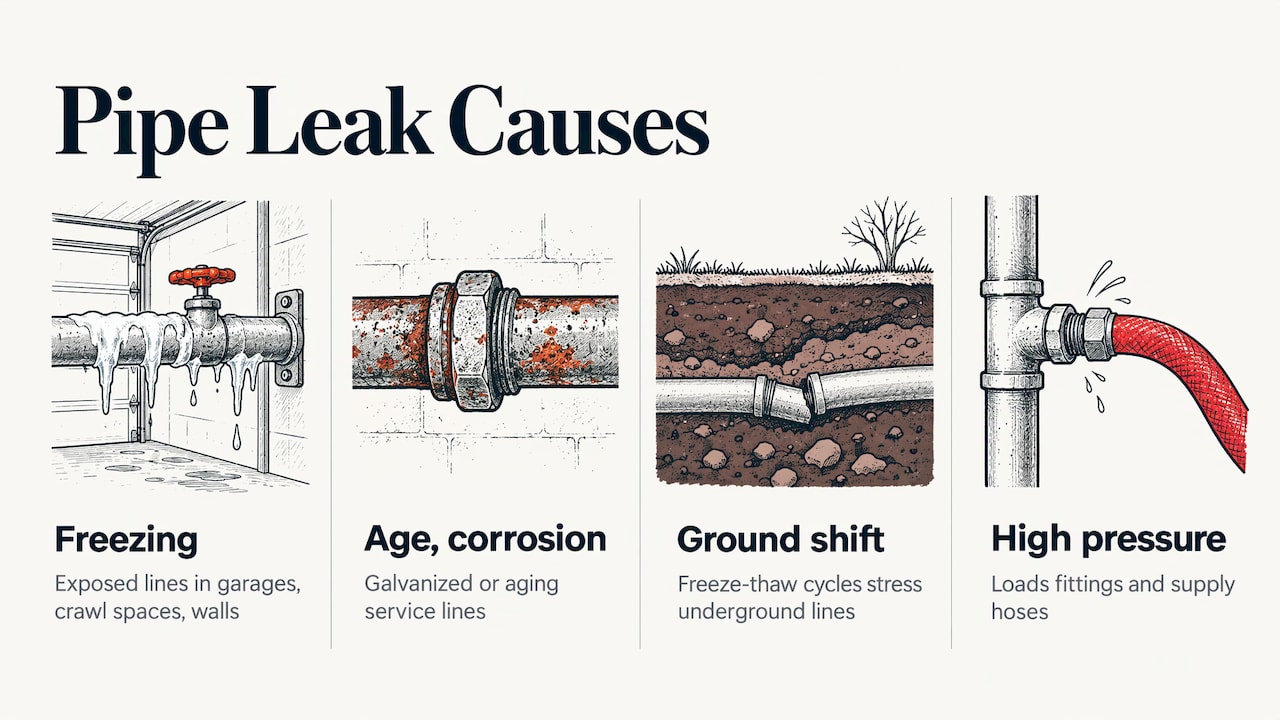
In Denver the causes cluster around a few things. Freezing is the obvious one: a sharp overnight drop after a mild stretch catches exposed lines in garages, crawl spaces and exterior walls. Corrosion and age come next, particularly in older neighborhoods where galvanized or aging service lines are still in the ground. Ground movement from freeze and thaw cycles stresses underground lines, and high water pressure puts a constant load on fittings and supply hoses.
Pressure is the cause homeowners can most easily control. The Hartford recommends keeping pressure at no more than 60 psi, and a simple gauge on an outdoor hose bib will tell you where you stand. If the reading is high, a plumber can check or replace the pressure-reducing valve.
How a plumber finds the leak
With water damage, the wet spot is rarely where the leak is. Water travels along joists, down wall cavities and across slabs before it shows. The U.S. Department of Energy’s Building America Solution Center identifies these leak-detection methods:
| Method | What it does | Best for |
|---|---|---|
| Video-camera inspection | A camera travels through the pipe to show cracks, breaks, roots or offsets | Drain and sewer lines |
| Hydrostatic pressure testing | Pressurizes a section of line and watches for a drop | Confirming whether a line is losing water |
| Electronic listening | Picks up the sound of escaping water | Pressurized lines behind walls or under slabs |
| Isolation | Closes off sections to narrow down where the loss is | Narrowing a leak to one branch |
| Digital testing | Uses instruments to measure and confirm findings | Verifying results |
For underground drain and sewer problems, a camera avoids guesswork, and guessing is expensive when the alternative is an excavated yard. Our video inspection service records the inside of the line so you and your insurer can see what is happening, and our article on what sewer camera inspection reveals explains when it makes sense.
Does homeowners insurance cover plumbing water damage?
Often yes, with an important condition: the water has to have been released suddenly and accidentally.
The National Association of Insurance Commissioners explains that homeowners policies cover damage from a sudden and accidental discharge from a plumbing system, but coverage may be denied if you neglected preventive steps, such as keeping pipes from freezing. The Washington State Office of the Insurance Commissioner adds that most policies do not cover gradual leaks that continue for a long time, including damage that develops over more than a couple of days. Travelers says a burst pipe is often covered, including cleaning, repair or replacement of items such as wood flooring, drywall and furniture, while ignoring a known leak may mean no coverage.
Two practical points follow:
- The damage and the pipe are usually treated differently. Policy language commonly covers the water damage to the home but excludes the failed pipe or appliance itself, so expect to pay for the pipe repair. The details depend on your policy.
- Speed helps your claim. A leak you spotted, reported and had repaired promptly looks very different to an adjuster than one that dripped for months.
Working with your insurer in Colorado
The Colorado Division of Insurance advises contacting your insurer as soon as possible, mitigating further damage but getting the company’s instructions before making repairs, and submitting an inventory of damaged property with the claim, since missing inventories often delay claims. It also notes that if the home is uninhabitable after a covered loss, additional living expenses may be claimable. If a claim stalls, the Division’s consumer services team takes questions and complaints.
A plumber’s written findings, photos and camera footage of the failure are useful records to attach. Ask your policy’s wording or your agent about sewer backup, which is often a separate endorsement rather than part of the standard policy.
Drying out: the 48-hour window
Once the water is off and the source is controlled, drying is the race. The EPA says that after a flood, mold exposure can trigger hay-fever-like reactions and asthma attacks, and recommends drying water-damaged areas and items within 24 to 48 hours and discarding absorbent items that cannot be cleaned and dried. A University of Massachusetts Boston water-intrusion procedure likewise says mold becomes likely when materials stay wet beyond 48 hours, and calls for air movers or dehumidifiers on wet materials.
The EPA’s water-damage guidance table gives material-by-material direction:
| Material | What to do |
|---|---|
| Carpet and backing | Dry within 24 to 48 hours using extraction, lower humidity and fans |
| Drywall | Dry in place only if there is no obvious swelling and seams are intact; otherwise remove and replace, venting wall cavities if possible |
| Ceiling tiles and insulation | Generally discard and replace |
While you wait for help, run fans and dehumidifiers, open windows when outdoor air is dry, and keep undamaged items out of the wet zone. The same UMass Boston procedure classes water from a fresh supply pipe as clean (Category 1), while sewage or highly contaminated water is a different category that calls for specialized handling. That is why a sewer backup is never a mop-and-towel job.
When to call a plumber, and when you need more
Some situations are clear:
- Call an emergency plumber immediately if water is flowing and you cannot stop it, if the main shutoff does not work, if water is near electrical equipment, or if the leak is in a ceiling.
- Call a plumber the same day for any leak you have stopped but not repaired, a repeat leak, or a wet area with no visible source.
- Call about the line, not just the fixture, if you see soggy ground, a sinkhole-like dip, low pressure across the whole house, or sewage odors in the yard. Those point to buried water or sewer lines.
- Add professional drying and remediation when a lot of material is wet or mold has appeared. The EPA’s mold cleanup guidance says most small mold problems can be handled yourself, but a lot of water damage or mold covering more than 10 square feet calls for its more detailed remediation guide.
A plumber and a restoration crew do different jobs. The plumber stops the water at its source and repairs the line. The restoration side dries and rebuilds. Fixing the source first matters, because drying a house that is still taking on water accomplishes nothing.
How to reduce the risk
Most plumbing water damage is cheaper to prevent than to repair. The Hartford’s prevention list is practical:
- Know where your main shutoff is and make sure every adult in the house can find it.
- Inspect visible plumbing for cracks, corrosion and leaks.
- Insulate pipes in cold areas such as garages, crawl spaces and exterior walls.
- Keep water pressure at or under 60 psi.
- Consider smart leak detectors, which send smartphone alerts and, in some systems, shut the water off remotely.
For Denver, add a seasonal habit: look over exposed lines and your underground service before the first hard freeze. Our fall plumbing checklist walks through what to inspect on both water and sewer lines. If you are leaving for a trip in winter, keep the heat on and have someone check the house.
Our perspective on plumbing water damage
Most of the water damage we are called to started small. A weeping joint, an aging service line, a drain that backs up a little more each month. The homeowner usually did the right thing once they saw water on the floor. The harder part is what happens next: finding the real source, not just the wet drywall.
That is why we run the job from one end to the other. Our video inspection shows what is happening inside a line before anyone cuts into a wall or opens a trench. Our water line and sewer line crews repair or replace the failed section. When excavation is needed, we handle permits through cleanup, so the property is not left half finished. Emergency calls are answered 24/7, because a pipe does not wait for business hours.
If you take one thing from this article, take this: shut the water off, document the damage, and get the source fixed quickly. Everything else, from the insurance claim to the dry-out, goes more smoothly when the leak is stopped properly the first time.
Scott
Need help with a leak now?
If you have an active leak or a line you suspect is failing, PipeX provides 24/7 emergency plumbing in Denver, along with water line repair and replacement, sewer line repair, hydro jetting and video inspection for residential, commercial and municipal properties. We handle the project from permits to cleanup. Start with our emergency services or browse our plumbing services to request a quote.

If the problem is underground, our water line repair and replacement page explains how we approach leaks, breaks and aging pipes. For general home plumbing, see our guide to residential plumbing services.
FAQ
How does a plumber check for water leaks?
A plumber may use video-camera inspection, hydrostatic pressure testing, electronic listening, isolation of line sections and digital testing, according to the Building America Solution Center. The method depends on whether the line is pressurized, a drain or buried. Camera inspection is common for drains and sewers because it shows the pipe’s condition directly.
What should I do first if my house has water damage from a pipe?
Stop the water at the fixture valve or main shutoff, and turn off electricity only if you can do it safely. Then call your insurer, call a plumber, move belongings out of the wet area and photograph everything. Begin removing standing water and drying the area as soon as it is safe.
Does homeowners insurance cover water damage from a burst pipe?
Often, when the discharge is sudden and accidental, according to the NAIC. Gradual leaks and neglected maintenance are commonly excluded, and the pipe itself is typically not covered. Your policy and the facts of the loss decide, so ask your insurer or agent.
How long do I have to dry out water damage?
Aim for 24 to 48 hours. The EPA recommends drying water-damaged areas and items within that window, and discarding absorbent items that cannot be cleaned and dried. Beyond roughly 48 hours of wetness, mold becomes likely.
Is a slow leak covered the same way as a burst pipe?
Generally no. Most homeowners policies treat gradual leaks, seepage and long-running damage differently from sudden bursts, per the Washington State Insurance Commissioner’s office. Repairing a small leak as soon as you find it protects both the house and a future claim.
Sources
- Your Guide to Protecting Your Home From Water Damage, The Hartford
- What to do when a pipe bursts, The Hanover Insurance Group
- What to Do if a Pipe Bursts in your Home, Allstate
- What to Do When a Pipe Bursts, Progressive
- Types of Plumbing Leak Detection Tests, Building America Solution Center
- Will my homeowners insurance cover water damage from a burst pipe, NAIC
- Leaks, water damage, and mold, Washington State Office of the Insurance Commissioner
- Does Homeowners Insurance Cover Burst Pipes, Travelers
- Consumer Advisory: Insurance tips on burst pipes claims, Colorado Division of Insurance
- Protecting Children in Aftermath of Hurricanes and Floods, EPA
- Water intrusion procedure, UMass Boston
- Mold Remediation in Schools and Commercial Buildings, water damage table, EPA
- Mold Cleanup in Your Home, EPA