

A main sewer line clog shows up as trouble in more than one place at once: several drains slow down or gurgle, a toilet flush pushes water into the shower, or sewage rises at the cleanout. If that is happening, stop running water, keep people away from the backup, and call a licensed plumber. A clog in the main line does not clear on its own, and every flush or load of laundry sends more water toward your floor drain.
This guide explains how to tell a main line clog from a single stubborn drain, what usually causes one, the safe first steps, what clearing it typically takes and costs, and how to decide whether the line needs repair rather than another cleaning.
Key Takeaways
- Several fixtures backing up together, gurgling, or sewage at the cleanout points to the main line, not one drain.
- Stop all water use first. If the backup stops, the clog is likely in your house line; if it continues, the city main may be plugged.
- Clearing a main line typically takes one to four hours, and snaking, hydro jetting and camera inspection are priced differently.
- Chemical drain openers are a poor answer for a main line clog and can damage pipes and septic systems.
- Repeat clogs usually mean a defect in the pipe, such as roots or a belly, and a camera inspection shows which.
Table of Contents
- How to Tell a Main Line Clog From a Single Clogged Drain
- What Causes a Main Sewer Line to Clog
- What to Do the Moment You Suspect a Main Line Clog
- Who Is Responsible: Your Line or the City’s
- How Plumbers Clear a Main Sewer Line Clog
- How Long It Takes and What It Costs
- Why Chemical Drain Openers Are Not the Answer
- When a Clog Means the Pipe Needs Repair
- How to Prevent the Next Main Line Clog
- Need Help With a Main Sewer Line Clog in Denver?
- FAQ
- Sources
How to Tell a Main Line Clog From a Single Clogged Drain
The main sewer line is the one pipe every drain in the building feeds into. A kitchen sink clog affects the kitchen sink. A main line clog affects everything downstream of the blockage, and the lowest fixtures in the house suffer first.
Watch for these patterns:
- Multiple drains are slow or backing up. If the toilet, tub and a sink all drain badly, the problem is past the branch lines.
- Gurgling. Air pushed back through traps makes toilets and drains burble when another fixture runs.
- One fixture reacts to another. Water coming up in the shower or tub when you flush a toilet or run the washing machine is a classic sign.
- Water or sewage at the cleanout. The cleanout is the capped access pipe on your sewer line, often outside near the foundation or in a basement or crawl space. Standing water in it means the line downstream is blocked.
- Sewage in a floor drain. In a basement, the floor drain is the lowest opening and often the first place a main line backup appears.
- Odors. A persistent sewer smell that you cannot trace to a dry trap suggests a line that is not carrying waste away.
In Colorado, many homes have basements, which puts the lowest drains right where a backup shows up. Do not wait for a slow drain to become a flooded floor.
One more distinction matters: your private line versus the public main under the street. Utility guidance describes it this way: continuous, significant sewage flow into a building while no water is being used points to a plugged sewer main, while small or intermittent flow and slow drainage more often point to a plugged private lateral. That test is useful, and it is why the first step below is to turn the water off.
What Causes a Main Sewer Line to Clog
Most main line clogs are not sudden. They build slowly, then a single load of laundry or a few flushes tips the line over. The causes cluster into a few groups.
Grease, wipes and things that should not be flushed
The EPA lists fats, oils and grease, some household products including some wipes, and tree roots entering sewer-line defects among the causes of sanitary sewer overflows. Cities say the same thing to residents. One municipal utility notes that hardened cooking grease, wipes, diapers and sanitary products are common causes of private-line blockages. Another explains that grease bonds to pipe walls and can ultimately cut off service.
The wipes labeled “flushable” are a frequent culprit. They do not break down like toilet paper, so they snag on rough spots and collect grease.
Tree roots
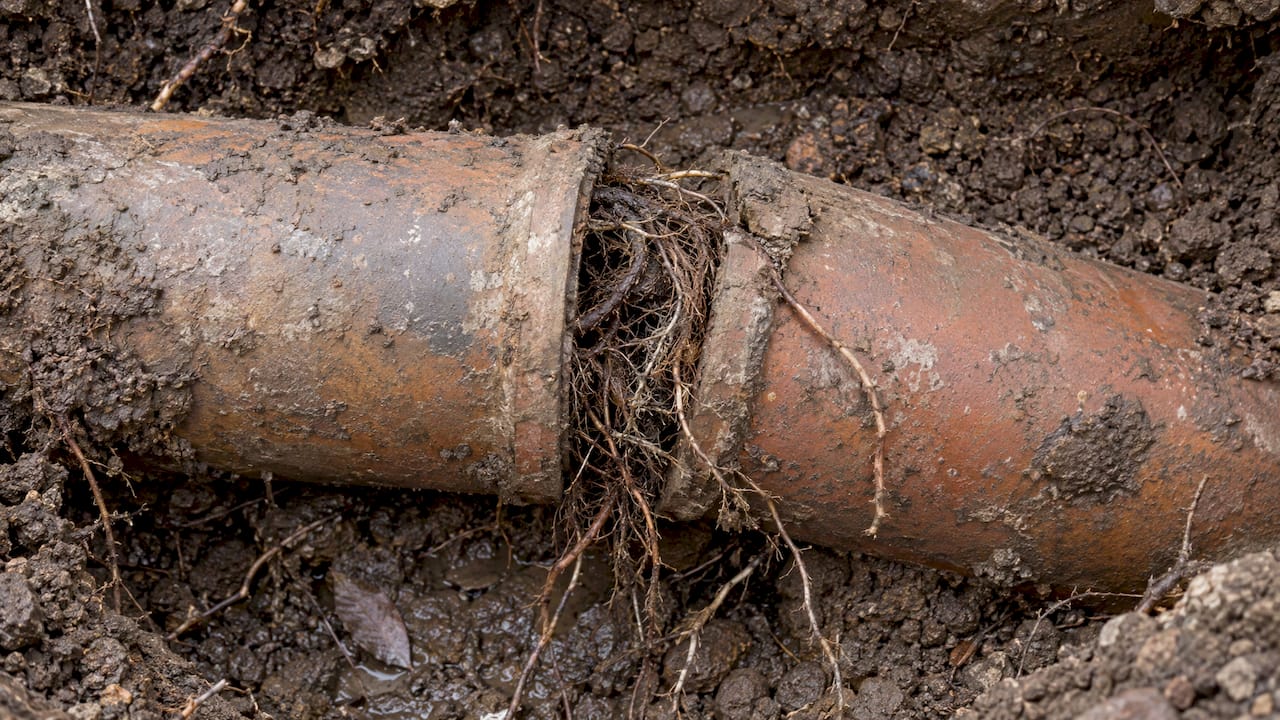
Roots go looking for moisture and nutrients, and a sewer line is both. They enter through small cracks and loose joints, then thicken into a mat that catches paper and waste. Mature trees, older clay and cast iron lines, and joints that have shifted are the usual combination. If your block has large trees and your home is older, roots deserve to be the first suspect.
Damaged, shifted or aging pipe
The same city guidance points out that aging, shifting soil, settlement and deteriorated pipe materials can crack, break or collapse a building sewer. Denver’s clay soils expand and contract, and that movement can pull joints apart or create a low spot, often called a belly, where waste settles instead of flowing. A belly is a repeat-clog machine: you clear it, and it fills again.
Groundwater and stormwater
The EPA also lists stormwater, groundwater or snowmelt entering through cracks or faulty joints as a cause of overflows. Extra water in a damaged line carries sediment and loosens the surrounding soil, which can make a small defect larger over time.
What to Do the Moment You Suspect a Main Line Clog
The first ten minutes decide how much damage you have to clean up. Public works guidance is consistent: stop running water and immediately close drain openings with stoppers or plugs, and keep people away from the sewage.
- Stop all water use. No flushing, laundry, dishwasher, showers or sink use. Tell everyone in the house.
- Plug low drains with stoppers or plugs if water is rising, especially a basement floor drain or tub.
- Watch what happens. One city utility explains that if the backup stops once the water is off, the house sewer is likely plugged, while a backup that continues with no water use suggests the city main may be plugged.
- Keep people and pets out. Contaminated water can carry bacteria and pathogens. If you must enter the area, wear rubber gloves, boots and a mask.
- Call a licensed plumber. If you suspect the public main, also contact your sewer utility. Some utilities ask residents to call them first, and that advice can differ by district.
- Take photos of any water damage for your insurance record before cleanup begins.
If it is night, a weekend or a holiday, a backup is the kind of problem emergency plumbing exists for. Our emergency services run 24/7 in Denver.
Who Is Responsible: Your Line or the City’s
This question decides who you call and who pays. The general rule across U.S. utilities is that the property owner maintains the private line from the building to the public main, and the utility maintains the main itself. One district states plainly that property owners are responsible for maintaining and repairing pipes from their property to the sewer main. Where the property line sits, and where private responsibility ends, varies by municipality, so confirm the rule for your address with your sewer utility.
In practice, the sorting goes like this. Municipal guidance says to have a plumber inspect the private line from the house to the city main, and if the blockage is on the city’s main, the plumber contacts the utility, which clears it. Another utility says that if it has cleared the line from the cleanout to the public main and the stoppage continues, the blockage is in the private line and a plumber is needed. A plumber who can run a camera down the line can tell you exactly where the blockage sits, which makes that conversation with the utility short.
One caution from a utility in Texas: if a plumber finds that the blockage lies under a street, contact the district before the plumber takes action. Work in the public right of way is not something to start on your own.
How Plumbers Clear a Main Sewer Line Clog
There are three common tools, and which one fits depends on what is blocking the line.
Cable machine (snaking)
A motorized cable with a cutting head goes in through the cleanout and breaks through the blockage. It restores flow quickly and works well on a soft or paper-based clog. It does not always remove grease buildup from the pipe walls, and it can leave a root mass ragged rather than gone. Municipal crews use the same approach: a steel snake helps determine whether a blockage is private or public and removes it.
Hydro jetting
Hydro jetting sends high-pressure water through a nozzle that scours the inside of the pipe, clearing grease, sludge and roots and washing the debris downstream. It cleans the whole pipe wall instead of poking a hole through the middle. If your line has had grease or recurring slow drains, it is often the better fit. We explain how it works in our guide to hydro jetting in Denver.
Camera inspection
A waterproof camera on a flexible rod travels the line and shows roots, cracks, offset joints, bellies and buildup in real time. It answers the question the cleaning alone cannot: why did this clog form? See what it shows in our page on sewer camera inspection.
How Long It Takes and What It Costs
The time depends on what is in the line and how easy it is to reach. One cost guide reports that unclogging a main sewer line typically takes one to four hours, although more severe clogs can take several days to fix.
National price ranges give a sense of scale. A 2026 pricing guide puts a main line cleanout snake job at $225 to $475 and 60 to 120 minutes on site, hydro jetting a main building sewer at $600 to $1,500 and 90 to 180 minutes, and a camera inspection alone at $200 to $500 and 45 to 75 minutes. Another national figure puts the average cost at $475, with plumbers charging $45 to $200 per hour in the period it covers.
These are national averages, not quotes. Denver pricing depends on access, depth, the length of the line, whether there is a working cleanout, and whether the call is an emergency. The honest way to get a number is a plumber who sees the line. We do not publish flat prices because a main line job is only priced correctly once the cause is known.
| Method | Best for | Typical national range | Typical time on site |
|---|---|---|---|
| Cleanout snake | Soft clogs, paper, a first-time backup | $225 to $475 | 60 to 120 minutes |
| Hydro jetting | Grease, sludge, roots, recurring slow drains | $600 to $1,500 | 90 to 180 minutes |
| Camera inspection | Finding the cause, repeat clogs, pre-purchase checks | $200 to $500 | 45 to 75 minutes |
Source for all three rows: ContractorRanks drain cleaning cost guide.
Why Chemical Drain Openers Are Not the Answer
It is tempting to pour a drain opener down the toilet or tub at midnight. For a main line, it rarely helps and can create new problems. The product has to reach the blockage in a line that may be full of standing water, so it dilutes and spreads instead of working.
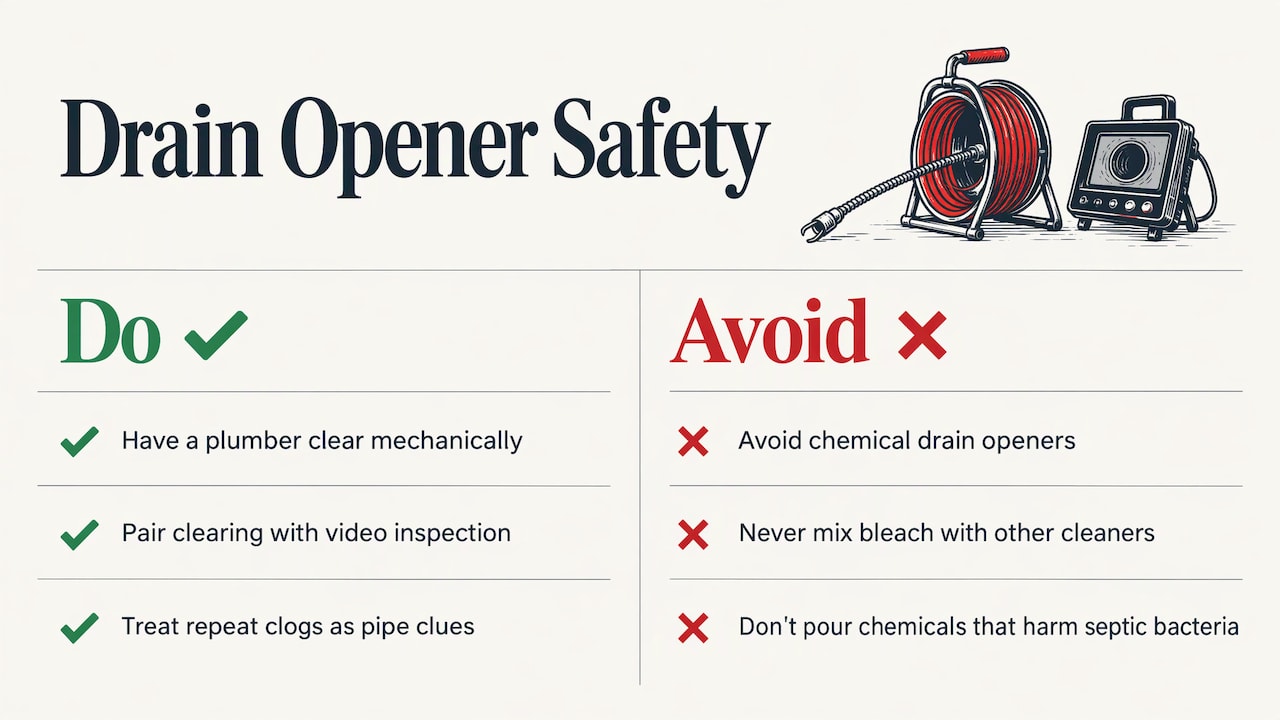
There are safety reasons too. According to EPA guidance on septic products, strong acids or alkalis marketed to open clogged drains can cause structural damage to pipes and septic system components. If your home is on a septic system, the EPA’s SepticSmart program also tells homeowners to avoid pouring chemicals down the drain that harm the beneficial bacteria in the system. And a plumber who then opens the line has to work around caustic standing water.
Also never mix cleaners. The CDC warns that mixing bleach with ammonia, vinegar or other drain cleaners creates gases that damage lung tissue when inhaled. Switching products mid-backup is how that happens. Mechanical clearing, by a plumber with the right equipment, is the safe route.
Our Take on Main Line Clogs
Most calls we get about a main line clog begin the same way: the homeowner cleared it once, it came back, and now they want to know why. Our view is that a main line backup is a diagnosis problem before it is a cleaning problem. Clearing the blockage restores flow today. Seeing the pipe tells you whether it stays clear.
That is why we pair cleaning with a video inspection. A cable or a jetter opens the line, the camera shows what caused the clog, and then you decide with real information: a periodic cleaning schedule if the pipe is sound, a spot repair if one section is damaged, or trenchless replacement if the line is failing. Guessing is expensive, especially when the line runs under a driveway or a mature tree.
We handle the job from permit to cleanup, and we answer emergency calls around the clock because sewage in a basement does not wait for business hours. Denver’s freeze-thaw cycles and shifting soils are hard on older sewer lines, so we treat a repeat clog as information about the pipe, not an inconvenience to be patched.
Scott
When a Clog Means the Pipe Needs Repair
A single clog after years of trouble-free service is usually a maintenance event. A pattern is different. Consider repair or replacement when:
- The line backs up again within weeks or months of being cleared.
- The camera shows cracks, offset or separated joints, or a belly holding water.
- Roots return quickly, which usually means there is an entry point in the pipe.
- The pipe is old clay, cast iron or Orangeburg and shows collapse or heavy scaling.
- You see sinkholes, wet patches or damp spots in the yard above the line.
Spot repairs are often enough when damage is limited to one section. When the line is deteriorated along its length, replacement is the lasting fix. Trenchless methods can replace the line without tearing up your yard, and where the layout calls for open excavation, we manage the excavation and restoration ourselves. For a fuller comparison of signs, methods and when each makes sense, read our guide to sewer line repair versus replacement in Denver.
How to Prevent the Next Main Line Clog
Prevention is mostly habit, plus the occasional professional check.
- Keep grease out of drains. Let cooking fat cool, then put it in the trash. Wipe pans before washing.
- Flush only toilet paper. Wipes, diapers, napkins, paper towels and sanitary products belong in the trash, whatever the packaging says.
- Know where your cleanout is. Make sure it is accessible and the cap is not buried, so a plumber can reach the line quickly.
- Watch your trees. If you are planting near the sewer line, ask where it runs first.
- Respond to early signs. A slow drain or an occasional gurgle is the cheapest time to act.
- Schedule periodic cleaning if you have an older line, large trees or a history of backups. Our sewer cleaning service is designed for exactly that.
Owners of restaurants and multi-unit properties face higher grease loads and heavier use, and we also handle commercial sewer lines and grease traps.
Need Help With a Main Sewer Line Clog in Denver?
PipeX clears main line clogs with drain cleaning, hydro jetting and video inspection, and we are available around the clock for emergencies. We handle the whole job, from diagnosis and permits through repair and cleanup, so you deal with one team instead of coordinating three.

If sewage is already coming up, start with emergency service. If your drains are slow and you want to catch it early, see our drain cleaning and hydro jetting page or explore all our plumbing services.
FAQ
How do I know my main sewer line is clogged and not just one drain?
If more than one fixture drains slowly, gurgles or backs up, the main line is the likely cause. Water rising in a tub or shower when you flush, or standing water at the cleanout, confirms it. A single slow sink is usually a local clog.
Can I unclog a main sewer line myself?
Homeowners sometimes try a basic cable, but the main line is long, deep and often full of standing water, which makes it hard to reach and easy to damage. Chemical openers are not a safe substitute. A licensed plumber can clear the line and show you the cause with a camera.
How long does it take to clear a main sewer line?
One cost guide reports that clearing a main line typically takes one to four hours, with severe cases taking longer. Access to the cleanout, the length of the line and the type of blockage all affect the time.
Is a main sewer line clog my responsibility or the city’s?
Usually the property owner maintains the private line from the building to the public main, and the utility maintains the main. Where the dividing point sits depends on your municipality. A camera inspection shows which side the blockage is on, and a plumber can contact the utility if it is the main.
What causes a main sewer line to keep clogging?
Repeat clogs usually point to a defect in the pipe: roots entering at a joint, a belly where waste collects, or cracked or collapsed sections. Grease and wipes add to it. A camera inspection identifies the cause so you can decide between periodic cleaning and repair.
Sources
- South Davis Sewer District: Sewer Emergencies
- US EPA: Sanitary Sewer Overflow Frequent Questions
- Nashua, NH: What Causes a Sewer to Backup
- City of La Crosse: Sewer Backup Prevention
- Fairfax County: Wastewater FAQ
- Muscatine, IA: What to Do When You Have a Sewer Problem
- City of Calgary: Sewage Backups
- Trophy Club MUD: Wastewater Service
- Springfield, TN: Sewer Cleaning
- Norfolk: FOG Residential Brochure
- Fixr: Cost to Unclog Main Sewer Line
- ContractorRanks: Drain Cleaning Cost
- Boone County, Iowa: EPA Septic Tank Additives Fact Sheet
- SepticMind: Can You Use Drano With a Septic System
- HandymanCan: How to Unclog a Drain
Recommended
- Sewer Line Repair vs. Replacement in Denver: Signs, Costs, Methods & When to Call the Pros
- Hydro Jetting in Denver: The Most Effective Way to Clear Stubborn Drains and Sewer Lines
- Sewer Line Repair & Replacement in Denver: Fast, Reliable Solutions from PipeX Plumbing
- Professional Sewer Cleaning in Denver: Keep Your Pipes Clear and Your Property Protected