

A good asphalt repair contractor does more than fill what you can see. They find out why the pavement failed, choose the repair that fits that cause, and fix it so the same spot does not fail again next season. Cracks, potholes, alligator patterns and sunken areas each call for a different fix. This guide covers what contractors handle, how a commercial repair project runs, what drives cost and timeline, and what to check before you sign.
Key Takeaways
- The cause of the damage decides the repair. Water getting into the pavement or the base is often the culprit, so a patch over an unaddressed drainage problem tends to fail again.
- Cracks are sealed or filled. Potholes and structural failures need patching, with partial-depth or full-depth methods. Widespread failure may call for milling and an overlay.
- A commercial project runs in a clear order: assessment, scope and quote, traffic and access planning, repair, cleanup and a follow-up plan.
- Depth of repair, base condition, site access and traffic control drive cost more than surface area alone.
- Ask for proof of license and insurance, written scope with repair depth, and references from sites like yours before you hire.
Table of Contents
- What an Asphalt Repair Contractor Handles
- Match the Damage to the Repair
- How a Commercial Asphalt Repair Project Proceeds
- What Affects Cost and Timeline
- What Businesses Should Plan for During the Work
- What to Check Before You Hire
- Our Perspective
- When Water Is Behind the Damage
- Pavement and Site Work From PipeX
- Keeping Repaired Asphalt in Good Shape
- FAQ
- Sources
What an Asphalt Repair Contractor Handles
The work falls into a few groups, and most property owners need more than one over the life of a lot or driveway:
- Crack treatment: cleaning and sealing or filling cracks to keep water and debris out.
- Patching: removing and replacing failed pavement, from shallow surface patches to deep dig-outs.
- Rehabilitation: milling the worn surface and placing a new asphalt overlay.
- Base and subgrade correction: excavating soft or wet areas, replacing poor material and rebuilding the support under the asphalt.
- Drainage and grading corrections: reshaping the surface or adding drains so water leaves the pavement instead of sitting on it.
- Restoration after utility work: returning trenches and cuts to a finished, level surface.
The last three are where a contractor with excavation and utility experience earns its keep. Pavement sits on a base, and the base is dirt work and water management. That is why the best repair contractors treat asphalt as part of a larger site, not as a surface layer alone.
Match the Damage to the Repair
Pavement agencies sort failures into three broad families. The British Columbia ministry’s maintenance guide describes cracks, surface deformations and surface defects, and it stresses that the cause of failure should be identified and addressed before any repair, with water entering the asphalt or base courses often to blame.
The table below summarizes how common problems map to repairs, based on the agency guidance cited in this article.
| Problem you see | What it usually means | Typical repair |
|---|---|---|
| Narrow working cracks | Movement from temperature or loading | Crack sealing |
| Wider, random cracks on worn pavement | Aging surface, no longer moving much | Crack filling |
| Potholes | Water and traffic have broken out the surface | Patching, partial or full depth |
| Alligator (fatigue) cracking | Loss of support underneath | Dig-out of the area and base repair, or an overlay if widespread |
| Raveling, weathering, block cracking | Surface wearing out | Partial-depth patching or overlay |
| Ruts, shoving, depressions | Deformation of the surface or base | Patching, leveling, sometimes milling |
Crack repair: sealing, filling and routing
Cracks are the cheapest problem to fix and the most expensive to ignore. The Minnesota DOT’s maintenance handbook lists three methods: clean and seal, saw and seal, and rout and seal. Each cleans the crack, and in the last two cuts a reservoir in the pavement, before filling it with sealant. The same handbook notes that sealing is effective for only a few years and must be repeated, yet it is very effective at prolonging pavement life.
The SJSU repair manual draws the distinction contractors use in the field: crack sealing for working cracks, crack filling for non-working cracks. A working crack opens and closes with the seasons and needs a flexible sealant placed properly. A non-working crack is stable and can be filled more simply.
Patching: partial depth versus full depth
Patching replaces pavement that has failed. California’s Department of Transportation separates the two main types by thickness: partial-depth patches under 4 inches within the asphalt surface, and full-depth patches at least 4 inches thick that remove additional material beneath the asphalt. Caltrans lists potholes, alligator cracking, settlement, rutting, slippage cracks and corrugations among the problems patching addresses.
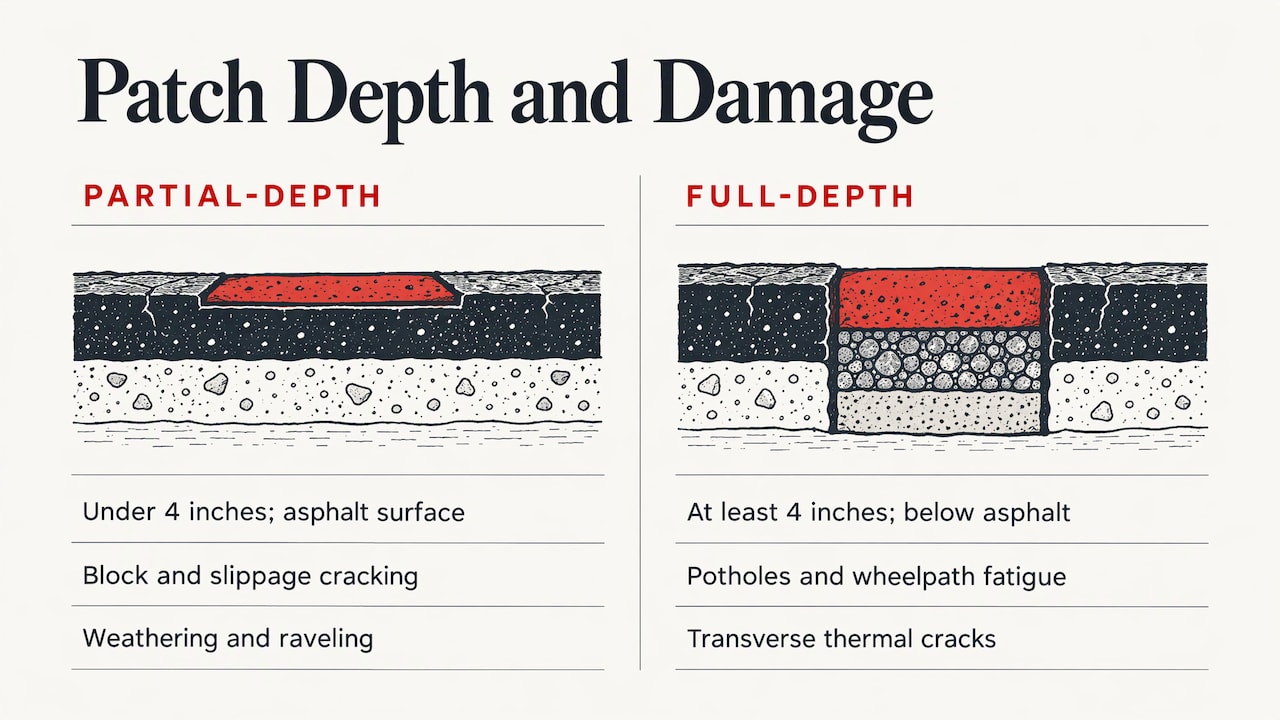
The NCHRP rehabilitation guidance adds which method goes where: full-depth patching for potholes, fatigue cracking in wheelpaths and transverse thermal cracking, partial-depth for block cracking, slippage cracking, weathering and raveling.
The practical lesson: a thin patch over a failing base is a short-term cosmetic fix. If your contractor proposes a surface patch for a spot that keeps coming back, ask what they found underneath.
Alligator cracking needs more than sealant
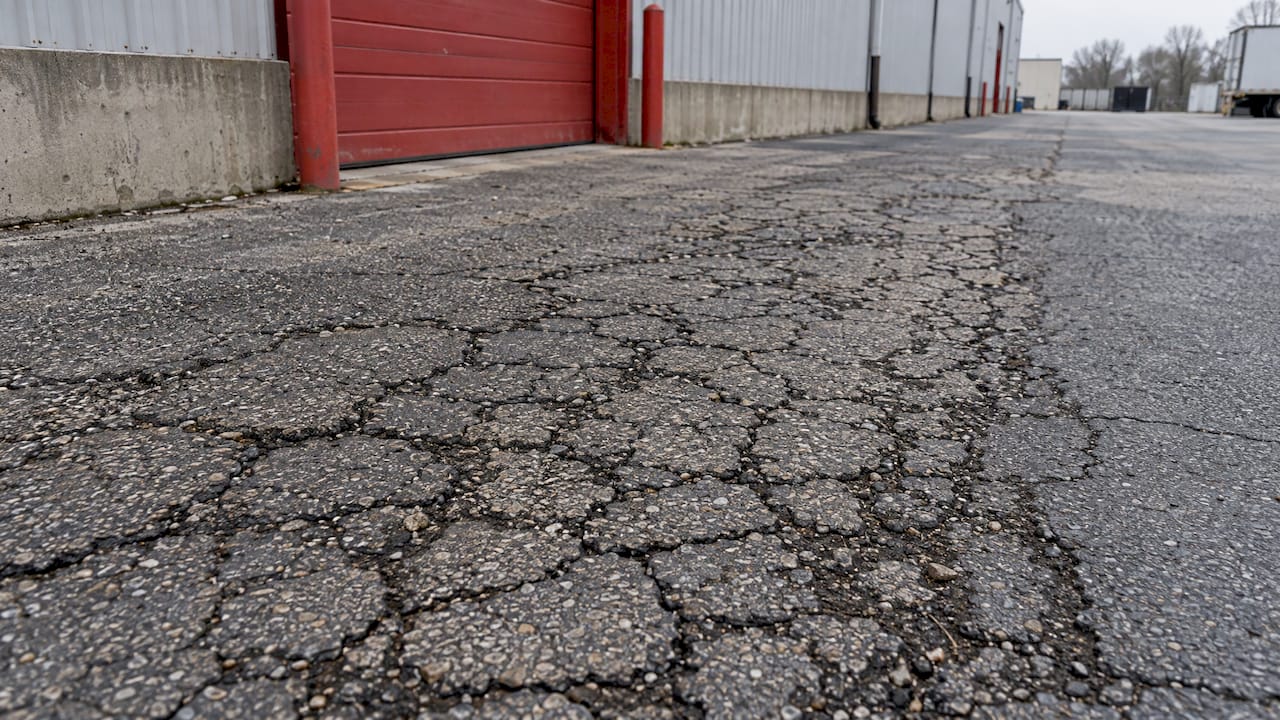
Alligator cracking looks like the skin of a reptile and signals the pavement has lost support. Pavement Interactive explains that crack sealing is generally ineffective for fatigue cracking. Small localized areas call for removing the cracked pavement, replacing the poor subgrade and improving drainage. Large fatigued areas point to a hot mix asphalt overlay across the whole pavement surface.
Milling and overlay
When wear is widespread but the base is sound, a contractor mills off the damaged top layer and places new asphalt. The Texas Asphalt Pavement Association notes that patching, milling and overlays are cost-effective ways to repair damage while limiting traffic disruption and extending service life. The SJSU manual adds that crack treatments and patching are critical pre-treatments for a resurfacing job to succeed, so a good overlay quote includes the prep work, not just the new surface.
How a Commercial Asphalt Repair Project Proceeds
Businesses, property managers and developers usually want predictability above all. A well-run commercial repair follows a sequence you can expect to see in the proposal.
- Site assessment. The contractor walks the lot, marks failures, photographs them and notes drainage patterns, standing water and areas of heavy truck traffic. Cores or test digs may be taken where the base is in question.
- Diagnosis and scope. Each problem area is tied to a repair method, with depth and square footage written down. This is the step that separates a repair from a cover-up.
- Quote and schedule. You receive a written scope. For commercial lots, scheduling around tenants, deliveries and customers is part of the quote.
- Permits and utility locates. Work that cuts into the ground needs utility locates, and some jurisdictions require permits, especially in right-of-way areas. A contractor who handles this removes a major source of delay.
- Preparation. Failed pavement is cut and removed, soft base is excavated and replaced, cracks are cleaned out, and edges are squared.
- Repair. Patches are placed and compacted, cracks sealed, and surfaces milled and overlaid where planned.
- Cleanup and handover. Debris is hauled away, the area is swept, striping and signage are restored, and you receive a note on when the pavement can take traffic.
- Maintenance plan. The contractor tells you what to inspect and when to reseal cracks so the repair lasts.
What Affects Cost and Timeline
No honest contractor quotes a number without seeing the site. These are the factors that move the price and the schedule:
- Depth of repair and base condition. A shallow surface patch and a deep dig-out that rebuilds the base are different jobs with different material, equipment and time.
- Total area and how it is grouped. Many small patches across a large lot cost more per square foot than one continuous repair zone.
- Site access. Tight loading docks, narrow drives and limited staging space slow crews down.
- Traffic control and working hours. Active lots, multi-lane drives and night work add labor and equipment.
- Utility conflicts. Water, sewer, storm and fire lines under the pavement can change the plan. Contractors who also work with underground utilities handle these conflicts with fewer handoffs.
- Weather. Asphalt placement depends on temperature and dry conditions, so the season shapes the schedule. In Colorado, freeze and thaw cycles are a major reason pavement cracks open in winter and spring.
- Permits. Public right-of-way work can add review time.
Published per-square-foot figures vary widely by region and repair type, so treat any online range as a starting point for a conversation, not a budget. Get written quotes that break out the repair method, depth and area for each location.
What Businesses Should Plan for During the Work
A parking lot repair affects customers and staff, so plan the logistics before the crew arrives:
- Phasing. Ask whether the lot can be repaired in sections so entrances and accessible spaces stay open.
- Notice. Tell tenants, delivery drivers and employees which areas close and for how long.
- Cure and reopening. Newly placed asphalt and fresh sealant need time before they take traffic. The contractor should state when each area reopens.
- Accessibility and fire access. Keep accessible routes and emergency lanes clear or provide marked alternatives.
- Drainage during work. Open excavations and cut pavement can change where water flows. Ask how the contractor will manage runoff if rain arrives mid-project.
- Striping and signage. Confirm restriping is in the scope so the lot returns to its original layout.
What to Check Before You Hire
A short checklist protects you from the most common problems:
- License and registration. Confirm the company holds the licenses your city or state requires for the work. Check with your local building or public works department.
- Insurance. Ask for a current certificate showing general liability and workers’ compensation coverage, and request to be named as certificate holder on commercial jobs.
- Written scope. The quote should state repair method, depth, area, materials, base treatment, traffic control, cleanup and who pulls permits.
- References on similar sites. A contractor who repaired a warehouse yard can speak to different demands than one who does residential driveways. Call two references and ask about schedule, communication and how the repair held up.
- Diagnosis, not just a bid. Ask what is causing the failure and how the proposed repair deals with it.
- Warranty terms in writing. Ask what is covered, for how long, and what maintenance you must perform.
- Capability beyond asphalt. When the problem involves drainage, base failure or buried utilities, one team that handles excavation, grading and drainage reduces gaps in responsibility.
Our Perspective
Most pavement that fails early was never really a pavement problem. It was a water problem, or a base problem, that someone covered with fresh asphalt.
That is why we approach asphalt and concrete infrastructure as part of the whole site. At PipeX we are a plumbing and excavation contractor in Denver, and our work includes excavation, land grading, concrete and asphalt infrastructure, storm drainage and utility work. When a lot is failing, we want to see where the water goes, what is under the surface and what the repair has to support before anyone picks a patch.
Our turnkey approach is designed to handle the job from permits to cleanup, so property owners deal with one team instead of coordinating several. Denver’s freeze and thaw swings, summer storms and heavy utility corridors make that coordination matter. Clear communication, regulatory compliance and minimal disruption are how we set out to run every project, from a small commercial lot to a municipal site.
If your pavement keeps failing in the same place, start with the cause. The repair that lasts is the one built on a sound base with water moving away from it.
Scott
When Water Is Behind the Damage
Standing water, a failing storm line or poor grading will undo even a well-made patch. Before repaving a problem area, it is worth checking drainage. Surface drains help on lots and drives: our guide to trench drains for Colorado properties explains how they collect surface water, and our piece on storm sewer repair covers signs of underground failure. Homeowners with water collecting at the end of the drive can read about driveway flooding causes and fixes. For structures with parking decks, see our page on parking garage storm repair and replacement.
Pavement and Site Work From PipeX
PipeX provides plumbing and excavation services for residential, commercial and municipal clients in Denver. For pavement-related projects, that includes excavation and land grading to prepare or correct the base and drainage, and civil work for construction and development sites. Commercial property owners can also see our commercial services, including site restoration and parking garage storm repair.

We offer 24/7 emergency response, and we handle permits through cleanup. To talk through a failing lot, drive or utility cut, contact PipeX through our site and describe what you are seeing.
Keeping Repaired Asphalt in Good Shape
Repairs last longer when you follow up on them. Three habits do most of the work:
- Inspect after winter and after heavy storms. Look for new cracks, low spots and water that lingers more than a day after rain.
- Reseal cracks on schedule. Crack sealing is a repeating treatment; Minnesota DOT’s handbook notes it must be repeated every few years, as covered above. Small cracks sealed early cost far less than potholes later.
- Keep water moving. Clear drains and trench drains of debris, keep downspouts from discharging onto pavement and fix grading that sends water across the surface.
Two more habits help on commercial sites: keep heavy trucks off thin or recently repaired areas, and route delivery traffic along the strongest parts of the lot. Photograph problem areas each year so you can track how fast they change and plan budget before an emergency forces it.
FAQ
How do I know whether I need a patch or a full replacement?
Look at how widespread the damage is and what it looks like. Isolated potholes and cracks usually call for patching and sealing, while widespread alligator cracking points to structural failure that may require removal and base repair or an overlay. A contractor should diagnose the cause on site before recommending either.
How long does asphalt repair take?
Crack sealing and small patches can often be done in a day, while larger dig-outs, base work and overlays take longer and depend on weather and permits. Commercial projects are often phased to keep part of the lot open. Ask for a written schedule that includes when each area reopens to traffic.
Can a contractor repair asphalt in winter?
Seasonal temperature limits what can be placed, and Colorado winters often restrict full-quality hot mix work. Temporary cold-mix patches can keep a pothole safe until conditions allow a lasting repair. Ask your contractor which work they recommend now and which should wait for warmer weather.
What should a commercial asphalt repair quote include?
It should list each repair location with method, depth and area, plus base treatment, traffic control, permits, restriping, cleanup and warranty terms. Written detail makes bids comparable and prevents surprises when conditions change.
Why does the same spot keep failing after repair?
Usually something under or around the pavement was never fixed, such as a soft base, poor drainage or water entering through cracks. Agency guidance says to find and address the cause before repairing, which often means excavating and correcting the base.
Sources
- NCHRP Web Document 37: Rehabilitation Strategies
- Minnesota DOT Best Practices Handbook on Asphalt Pavement Maintenance
- Caltrans guidelines for asphalt concrete pavements
- SJSU Manual for Asphalt Pavement Repair and Resurfacing Preparation
- Pavement Interactive: Pavement Distresses
- Texas Asphalt Pavement Association Design and Construction Guide