
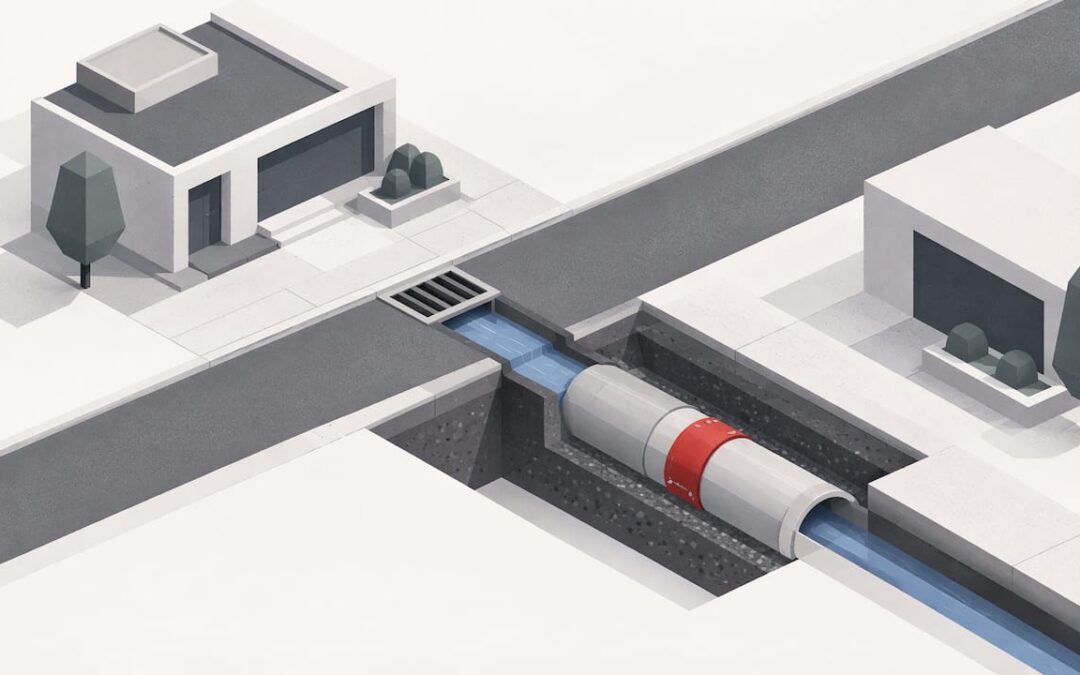
Storm sewer repair starts with a camera inspection to find where the pipe has cracked, separated, collapsed or clogged. Then comes a choice between a trenchless fix such as lining or pipe bursting and open-cut excavation, depending on depth, pipe material and what sits above the line. Cost follows from that choice, so a diagnosis comes before any quote. This guide covers each step for Denver property owners, developers and facility managers, and explains what a good contractor handles from permit to cleanup.
Key Takeaways
- A storm sewer carries only rain and snowmelt runoff, separate from the sanitary sewer that carries wastewater, so repairs, permits and responsibility can differ between the two.
- Standing water, sinkholes, recurring backups at inlets and cracked or separated joints are the usual signs a storm line needs attention.
- A video inspection should come first. It shows the defect, its location and the right repair method before anyone digs.
- Trenchless methods protect pavement and landscaping, while open-cut excavation suits deep failures, collapses and jobs that need a change in grade or size.
- Colorado law requires a locate request at least three business days before you dig, and work in the public right-of-way has licensing requirements in Denver.
Table of Contents
- What a storm sewer does and how it differs from a sanitary sewer
- Signs your storm sewer needs repair
- How storm sewer damage is inspected and diagnosed
- Storm sewer repair methods and when each fits
- What storm sewer repair costs
- Permits, utility locates and restoration
- Perspective: why one crew for the whole project matters
- How to choose a storm sewer contractor
- Get a storm sewer inspected and repaired in Denver
- FAQ
- Sources
What a storm sewer does and how it differs from a sanitary sewer
A storm sewer is a network of pipes that collects runoff from street inlets, catch basins, parking-lot drains and roof leaders. The Wisconsin DNR describes storm sewers as separate pipes that gather runoff, and notes that most storm water does not go to a wastewater treatment plant. It flows overland or through storm sewers into nearby waterways or treatment devices.
The U.S. Geological Survey names three types of sewer systems in the United States: storm sewers, sanitary sewers that carry raw sewage from homes and businesses to treatment facilities, and combined sewers that carry both. Knowing which line you have matters for two reasons. First, the repair crew, the permit path and the inspection standard differ. Second, a storm line must never receive anything but runoff. A University of Kentucky fact sheet points out that disposing of chemicals or hazardous substances through the storm sewer is illegal and can end up in drinking water supplies.
In Denver, storm drainage is a big deal for a simple reason: intense summer thunderstorms and fast snowmelt can send a lot of water through a pipe in a short time. A line that is cracked, partly collapsed or choked with sediment cannot move that water, and the result is ponding in parking lots, wet foundations and washed-out soil.
Signs your storm sewer needs repair
Storm lines are out of sight, so the first signs show up at the surface. Look for these:
- Water backing up at inlets or catch basins after moderate rain, or standing water that does not drain in a day or two.
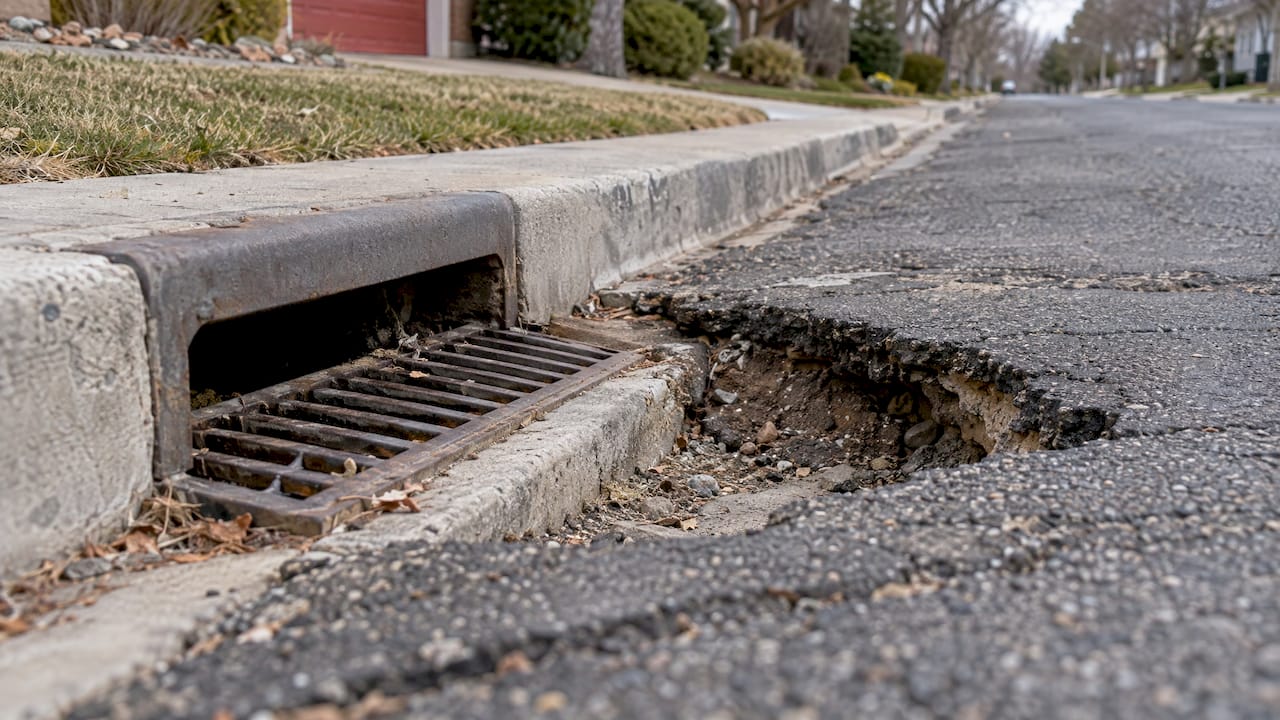
- Soil settlement, depressions or sinkholes along the path of a buried pipe. These suggest soil is washing into a broken joint or crack.
- Catch basins filling with leaves, trash and silt, which cuts the capacity of the system.
- Erosion around outfalls or at the end of a discharge pipe.
- Visible cracks or separated joints in accessible concrete pipe, and corrosion in metal culverts.
- Roots growing into pipes you can see or reach.
Municipal Sewer and Water Magazine lists many of these same warning signs, including corroding metal culverts and concrete with cracks and joint separation. It also notes that high-velocity flow on steep grades creates turbulence that speeds up wear, which is relevant on Front Range sites with real slope.
Small problems are cheap to fix. The City of Warrenton’s stormwater maintenance toolbox says regular inspection lets crews deal with clogged inlets in short order, before they cause serious damage. Larger issues, like heavy silt build-up or erosion, need further study to find the source. If you see a sinkhole or a collapsing surface, keep people and vehicles off it and call a plumbing and excavation contractor right away.
How storm sewer damage is inspected and diagnosed
Guessing is expensive. A camera inspection tells you what is wrong, where, and how far it extends. The Warrenton toolbox notes that most agencies use TV cameras for pipes six inches or larger, and walk-through inspections for pipes 36 inches or larger. The Delaware DOT’s pipe inspection guide says pipes at 48 inches and above are inspected manually and smaller sizes by video.
How often should lines be checked? Public agency guidance gives a useful benchmark:
| Item | Suggested interval | Source |
|---|---|---|
| Inlets, ditches, channels | At least annually, before the rainy season | Warrenton toolbox |
| Catch basins | At least every six months | Warrenton toolbox |
| Pipes and culverts | Every three to five years | Warrenton toolbox |
| Pipe cleaning | Every three years, more often if CCTV records justify it | Grants Pass maintenance plan |
| CCTV inspection | Every five to ten years, depending on condition | Grants Pass maintenance plan |
These are municipal programs, not a rule for your property, but they show a sensible rhythm for owners with large paved sites. Grants Pass also recommends annual cleaning for lines with heavy root intrusion, and notes that sediment build-up reduces capacity and raises the potential for flooding.
A good inspection report includes video, a measured distance to each defect, the pipe material and diameter, and a recommended repair. Our video inspection service is built around exactly that: see the line first, then decide. When a line is clogged with sediment or roots, cleaning with hydro jetting usually comes before the camera goes in.
Storm sewer repair methods and when each fits
There is no single best method. The right one depends on the defect, depth, pipe material and what is on the surface.
Spot repair and cleaning
A clogged line with sound pipe may only need cleaning. A single cracked section or failed joint can be fixed by replacing that segment. Spot repairs keep the work small and the disruption short.
Trenchless lining and bursting
The Delaware DOT video inspection specification lists chemical grouting, CIPP lining, fold-and-form lining, slip lining, pipe bursting and spiral winding among trenchless repair techniques. In pipe bursting, according to the EPA fact sheet, a bursting device pushes the old pipe outward until it breaks apart, while pulling the new pipe in behind it so the void is filled immediately.
The Delaware DOT’s inspection guide says that whenever practical, trenchless techniques should be prioritized, especially once the final surface course has been placed. That is the case under parking lots, driveways and landscaped areas. The old way meant a trench across the lawn or the lot. Our guide to trenchless sewer repair in Denver explains how replacing a line without opening the whole surface works.
Open-cut excavation
Sometimes the pipe has to come out. The Federation of Canadian Municipalities’ sewer rehabilitation guide says open cut gives a longer expected life than most trenchless methods, and lets you change the alignment, size and grade. It also allows other infrastructure to be rehabilitated at the same time. Open cut makes sense for collapsed pipe, deep failures, undersized lines and sites where grading or other utilities are being reworked. Our excavation and land grading crews handle this kind of work.
Some defects need a combination of methods. The Delaware DOT guide says as much, and requires reinspection by camera after repair to confirm the work. Any contractor you hire should offer the same closing step.
What storm sewer repair costs
We do not publish prices, because the cost depends on the line, and a fair number only comes after inspection. What we can give you is public data on how pipe work is priced, so a quote makes sense when you get it.
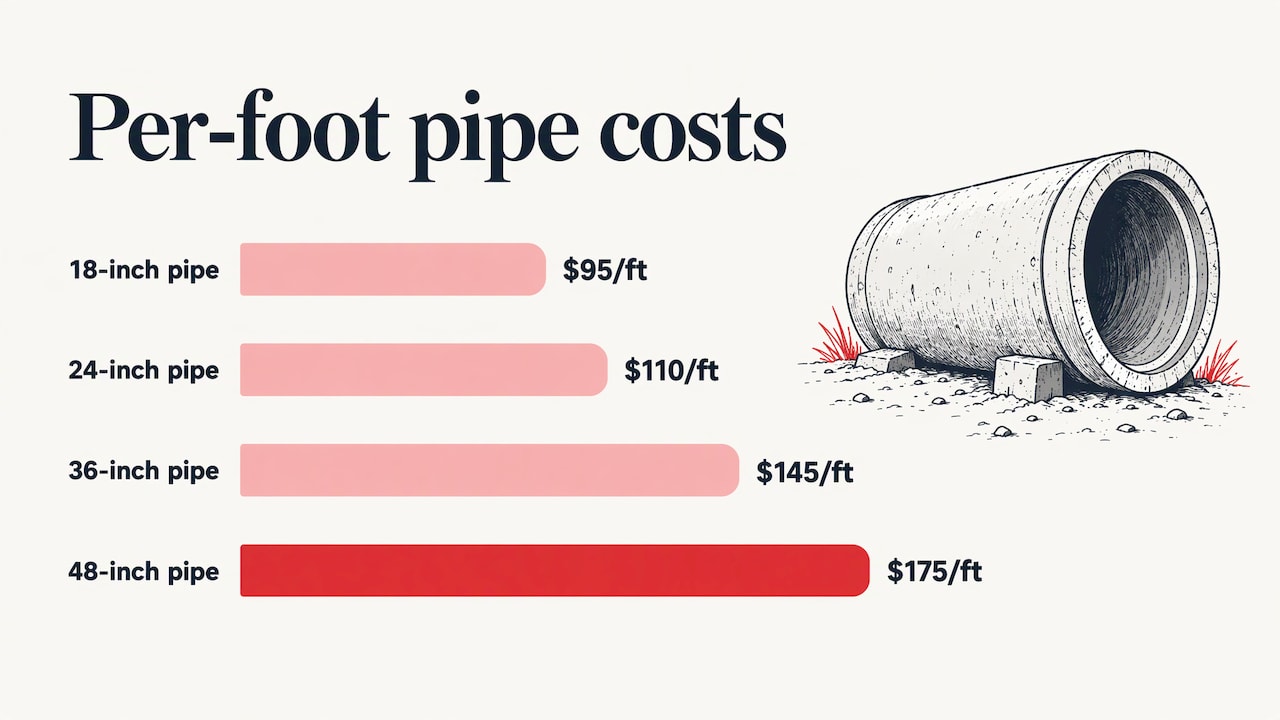
Public agency cost schedules show per-foot pricing that rises with pipe size:
| Pipe size (reinforced concrete) | Unit cost | Source |
|---|---|---|
| 18-inch | $95 per linear foot | City of El Centro, CA unit cost schedule |
| 24-inch | $110 per linear foot | City of El Centro |
| 36-inch | $145 per linear foot | City of El Centro |
| 48-inch | $175 per linear foot | City of El Centro |
The City of Ames, Iowa’s 2025-26 bid tab shows 18-inch spot repair by pipe replacement at $150 per linear foot and 48-inch manholes at $12,000 each. These are other cities’ public unit prices, not Denver quotes, and they exclude many project-specific items. Still, they show the pattern.
Factors that move a real estimate:
- Depth. Deeper pipe means more excavation, shoring and time.
- Pipe size and material. Larger diameters and concrete cost more to handle and replace.
- Access. Tight sites, buildings and heavy traffic limit equipment.
- Method. Trenchless can cost more per foot on paper but save surface restoration; open cut includes paving, curb and landscape work.
- Structures. Manholes, catch basins and inlets are priced separately.
- Permits and traffic control when work touches the public right-of-way.
Ask for an itemized scope: inspection, repair, structures, restoration and permits. That is how you compare two bids on equal terms.
Permits, utility locates and restoration
Before any digging, the law in Colorado is plain. Colorado 811 states you must request a locate at least three business days before you dig, regardless of project size. The locate is free and marks public underground utilities including gas, electric, water, sewer and communications lines.
If the line or the work reaches the public right-of-way, the City and County of Denver has licensing rules. Its right-of-way license page says a sewer contractor license covers opening, uncovering or laying public or private sanitary or storm sewers in the right-of-way. It requires five years of verifiable experience and a Colorado licensed master plumber or a Denver certified drain layer supervisor on staff. It also requires street patch repairs to carry pavement markers.
Restoration is part of the job, not an afterthought. Standard public specifications, such as the Hartford School District storm sewer spec, require contractors to locate affected underground utilities, notify utility companies before construction, and restore paving, curbs, sidewalks, fences, sod and topsoil to their prior condition. Expect the same from any contractor you hire. On a commercial lot, that can include re-marking the surface afterward. If an old layout has to be removed before restriping, line and stripe removal is a separate surface-prep trade worth planning for.
Perspective: why one crew for the whole project matters
We see the same pattern on storm drainage jobs. A property owner calls about a pond in the parking lot or a dip in the lawn, and the real problem is a joint that separated years ago. The repair itself is rarely the hard part. The hard part is everything around it: the locate, the permit, the traffic plan, the pavement patch, the grading that sends water where it should go.
That is why we run storm work as a turnkey project, from permits to cleanup. The crew that inspects the line also excavates, repairs, backfills and restores, so nothing falls between two contractors. Denver’s climate adds its own demands, with hard freezes, fast snowmelt and short, heavy storms, so we plan repairs for how water actually moves on your site, not just for the day the pipe is open.
Our advice is simple. Get a camera on the line before you make decisions. Choose the least disruptive method that solves the defect for the long term. And hire a team that stays on the job until the surface is back to usable condition. We offer 24/7 emergency response for the times a collapse or backup cannot wait.
Scott
How to choose a storm sewer contractor
A storm sewer contractor does plumbing, excavation and civil work in one job, so check each piece.
- Licensing. Ask whether the company holds the Denver right-of-way license if work touches the street, alley or sidewalk, and who the licensed master plumber or drain layer supervisor is.
- Inspection first. The proposal should rest on camera footage and a defect log, not a guess.
- Method reasoning. The contractor should explain why they chose lining, bursting, spot repair or open cut, and when a combination applies.
- Complete scope. Look for locates, permits, traffic control, restoration and a post-repair camera check in writing.
- Range of work. Storm repair often involves storm inlets and detention systems, grading and paving. One company covering them reduces handoffs.
- Emergency capacity. Pipes fail during storms. A company that answers 24/7 matters when water is rising.
- Communication. You should know the schedule, who is on site and what disruption to expect.
Commercial owners with underground garage or lot drainage can see how we approach parking garage storm repair and replacement.
Get a storm sewer inspected and repaired in Denver
PipeX has more than 20 years of experience in plumbing and excavation for residential, commercial and municipal clients in Denver. We handle video inspection, hydro jetting, sewer and storm line repair and replacement, excavation, grading and site restoration, including permits and cleanup.

If you have standing water, a sinkhole or a line you suspect is failing, start with an inspection. Request a quote through our plumbing services page, or call for emergency service if a backup or collapse cannot wait. For related reading on sewer work, see our guide to sewer line repair vs. replacement.
FAQ
Is storm sewer repair the same as sanitary sewer repair?
The tools overlap, but the systems are separate. A storm sewer carries runoff from streets, lots and roofs, while a sanitary sewer carries wastewater to a treatment facility. The permits, inspection standards and sometimes the responsible party differ, so confirm which line you have before you call.
How do I know if the problem is the pipe or just a clogged inlet?
A clogged inlet or catch basin usually clears with cleaning, and water drains afterward. If water keeps backing up, the ground settles, or a sinkhole appears along the pipe path, the pipe may be damaged. A video inspection settles the question.
Can a storm sewer be repaired without digging up my property?
Often, yes. Trenchless methods such as lining and pipe bursting work from small access points. Collapsed, very deep or misaligned pipe may still need open-cut excavation, and an inspection shows which applies.
Do I need to call 811 for a storm sewer repair?
Yes. Colorado 811 says a locate request is required at least three business days before you dig, whatever the project size. Your contractor will normally handle the request as part of the scope, but confirm it in writing.
Sources
- Wisconsin DNR: What is Storm Water Runoff?
- USGS: Urban Water Quality, Sewage Overflows
- University of Kentucky: Sanitary and Storm Sewers fact sheet
- Municipal Sewer and Water Magazine: Stormwater Pipe Inspection
- DelDOT: Pipe Inspection and Remediation Guide
- Delaware DOT: Storm video inspection specification
- EPA: Pipe Bursting Fact Sheet
- Federation of Canadian Municipalities: Selection of Technologies for Sewer Rehabilitation
- City of El Centro: Unit Cost Schedule
- City of Ames: 2025-26 bid tab
- Colorado 811
- City and County of Denver: Right-of-Way Licenses
- Hartford School District: Storm Sewer Standard Specification