

The right asphalt repair depends on why the pavement failed, not only on how it looks. A pothole patched over a wet, weak base returns within a season, and a crack sealed too late lets water do the damage underneath. For property owners, developers and managers in Denver, the surest result comes from one contractor who reads the whole site: surface, base, pipes and drainage. PipeX handles excavation, concrete and asphalt infrastructure and storm drainage together, from permits to cleanup.
Key Takeaways
- Match the repair to the damage: crack seal for narrow cracks, a full-depth dig-out when the base has failed, and an overlay or replacement when failure is widespread.
- Water is behind most failures. Fix drainage and failing pipes first, or the repair will not last.
- Cold-mix patches are a temporary or emergency fix. Hot-mix is the preferred material for lasting work.
- Sealing on a regular schedule slows oxidation, but it cannot stand in for repair once potholes and heavy cracking appear.
- One contractor covering excavation, drainage and paving avoids repairing the same spot twice.
Table of Contents
- What Damages an Asphalt Parking Lot
- Choosing the Right Repair Method
- Repair, Overlay or Replace
- Maintenance That Extends Pavement Life
- What Affects the Price
- Getting the Work Done in Denver
- FAQ
- Sources
What Damages an Asphalt Parking Lot
Common distress includes potholes, failed joints, raveling (the surface breaking down into loose stone), rutting and slippage. The Asphalt Institute’s repair guide ties these to missing maintenance, poor drainage, inadequate thickness and accumulated wear. It links alligator cracking, the interconnected pattern that looks like reptile skin, to repeated traffic loading, a weak subgrade, thin pavement or excessive loads.
Potholes usually grow out of something smaller. The same guide explains that they commonly form when raveling, alligator cracking or failed joints and patches progress into localized breakup. Maryland’s repair guidelines describe the mechanism: water enters cracks or joints, weakens the subgrade, and freezing expands it. Denver lots go through many freeze-thaw cycles, so that mechanism applies here.
A facilities-management review adds heavy vehicles, UV exposure, oil and chemical spills, and improper installation to the list.
Depressions often point underground
A sunken area is not always a paving problem. Maryland’s guidelines name settlement, poor compaction, and collapsed or failing pipes as typical causes of localized depressions. If a low spot keeps returning after patching, a storm line or catch basin below it may be failing. A video inspection of the line answers that question before any asphalt is placed.
Choosing the Right Repair Method
The method follows the damage. Here is how the main options compare.
| Damage | Typical repair | Why it fits |
|---|---|---|
| Cracks 1/8 to 1 inch wide | Crack seal | Keeps water out of the base |
| Cracks 1 to 3 inches wide | Mastic fill | Handles wider movement |
| Pothole or failed base | Dig-out and patch | Replaces the weak layers |
| Widespread cracking, rutting | Overlay or replacement | Surface-only fixes will not hold |
| Recurring low spots | Investigate pipes and drainage | Cause sits below the pavement |
The crack widths come from Maryland’s guidelines. Sealing also works better when the crack edges are routed, which the Minnesota Bituminous Roadways owners’ guide says improves rubberized sealant adhesion.
What a proper dig-out involves
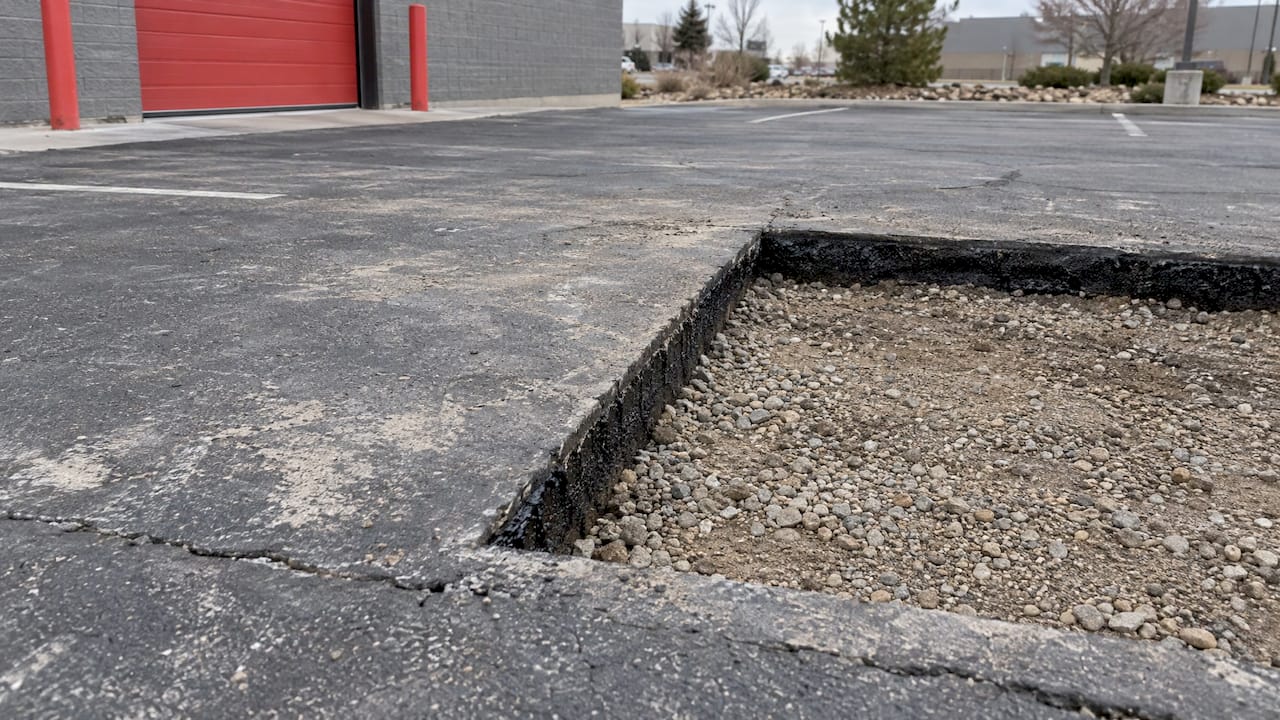
When a localized failure has compromised the base, Caltrans patching guidance calls for removing the failed layers, replacing and compacting the support material, applying tack coat at the repair edges, then placing and compacting new asphalt. Skipping the base work is how a patch sinks again.
Temporary or permanent
The same Caltrans chapter says method selection depends on traffic, season, time until planned rehabilitation, and equipment and crew availability. It describes cold-mix asphalt as a temporary or emergency material and hot-mix as preferred. In practice, a cold patch is useful to make a lot safe in winter. Plan the hot-mix repair for when the weather allows.
The mix itself matters too. The Colorado Asphalt Pavement Association design guide recommends fine-graded Superpave mixes for parking lots, with 1/2-inch nominal maximum aggregate preferable for standard lots. It notes that coarse-graded mixes are harder to hand-work and cool faster, which makes compaction harder on the small, irregular patches typical of lot repair.
Repair, Overlay or Replace
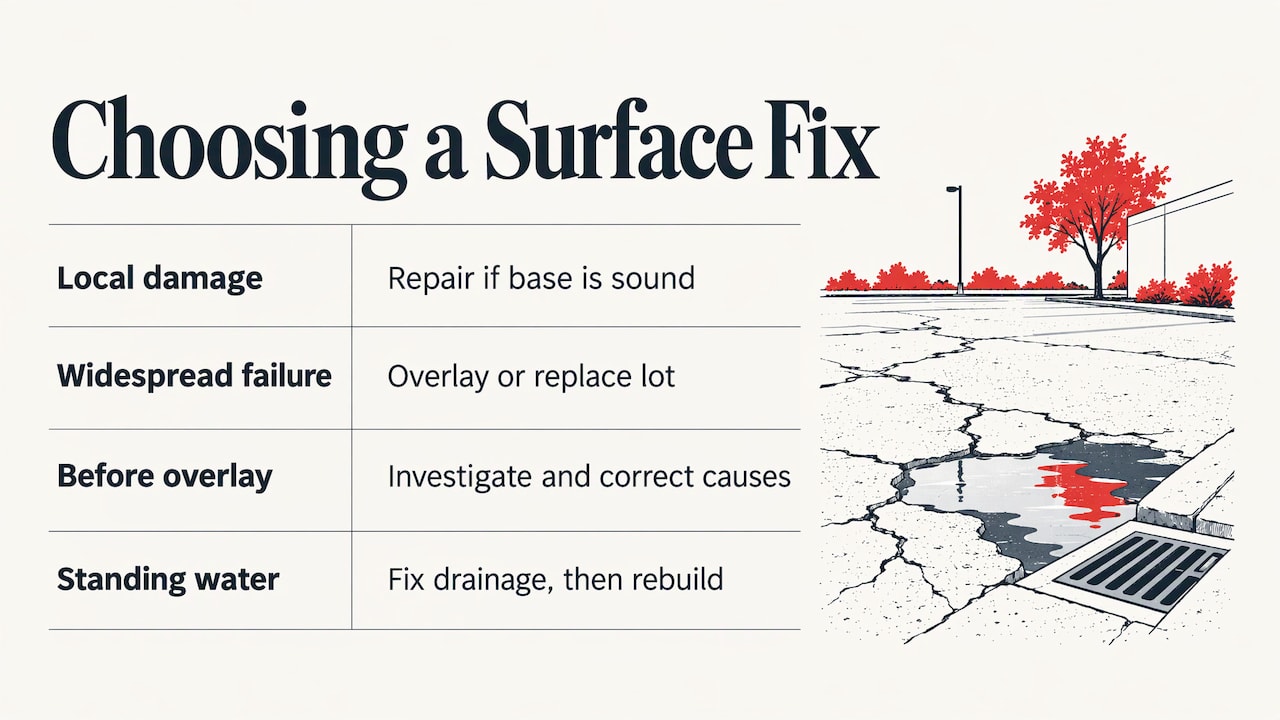
Repair makes sense when damage is local and the base underneath is sound. Overlay or replacement makes sense when failure is spread across the lot. The deciding question is whether the cause of failure has been found. The National Concrete Pavement Technology Center’s 2022 overlay guide says the causes of existing deterioration, including age, drainage, traffic, subgrade, pavement section and materials, should be investigated and corrected before an overlay is designed. It is written for concrete overlays, but the principle holds for any new surface: a new layer over unresolved drainage or support problems inherits the old failure.
This is where a site-wide view saves money. If standing water collects in one corner, the answer may be a trench drain, a new inlet or a repaired catch basin rather than more asphalt. Our pages on trench drains for Colorado properties, storm inlets and detention systems and catch basin repair explain those fixes. For the general principle of drainage correction for flooding, the logic is the same on any property: move the water away, then rebuild the surface.
Maintenance That Extends Pavement Life
Properly installed asphalt can last 20 years or more, according to a facilities expert quoted in the FacilitiesNet article, who also stresses that installation and maintenance quality drive that result. Three habits help:
- Seal cracks early. Crack sealing keeps water out of the aggregate base, according to the Minnesota owners’ guide.
- Seal the surface on a schedule. The same guide says sealing every 3 to 7 years can slow oxidation and water penetration and reduce repair costs. That is guidance, not a guarantee, and sealing suits sound pavement. Once potholes and heavy cracking appear, repair comes first.
- Walk the lot after winter and after heavy storms. Look for pooling water, new cracks, loose stone and sunken spots near drains.
If you manage several properties, a written routine helps. This commercial preventive maintenance plan shows how to turn a checklist into a recurring schedule.
What Affects the Price
Repair cost per square foot swings widely with the method. A patch costs far less than a tear-out and replacement. Depth of the failed section, base repair, drainage work, equipment access, haul-off of old material and the size of the lot all move the number. Because a surface patch and a full-depth repair can differ so much in scope, a quote based on an on-site look is worth more than a regional average. Our guide to hiring an asphalt repair contractor walks through what a good quote should list.
We repair a lot’s problems in the order they cause them. Water first, then base, then surface.
Most parking lot failures we are asked about in Denver trace back to water: cracks that let it in, drains that do not carry it away, or buried pipes that have settled. Because PipeX does excavation, storm drainage, concrete and asphalt infrastructure, and video inspection under one roof, we can look at the whole site rather than only the surface. We handle permits to cleanup, so the owner deals with one team and one schedule, and our 24/7 emergency service is there when a failure cannot wait. Our aim is a repair that lasts, with as little disruption to your tenants and customers as the job allows.
Scott
Getting the Work Done in Denver
PipeX has more than 20 years of experience in plumbing and excavation for residential, commercial and municipal clients. For parking lots that means we can open the ground, inspect and repair the storm lines, restore the base, and finish the surface. We manage permitting and site cleanup as part of the project.
If your lot has recurring potholes, pooling water or sunken areas, start with a conversation about the cause. See our commercial services and excavation and grading pages, or for storm damage to structures, our parking garage storm repair service.

For an urgent failure, our emergency services line is staffed around the clock.
FAQ
What type of asphalt is used for parking lots?
Hot-mix asphalt is preferred for lasting repairs. The Colorado Asphalt Pavement Association recommends fine-graded Superpave mixes for parking lots, with 1/2-inch nominal maximum aggregate for standard lots. Cold-mix is a temporary or emergency material.
How often should a parking lot be sealed?
Guidance from Minnesota Bituminous Roadways suggests every 3 to 7 years, depending on the pavement and its use. Sealing is for sound asphalt. Lots with many potholes or heavy cracking need repair first.
Why do the same potholes keep coming back?
Usually the base or drainage was not fixed. Water weakens the subgrade, and freezing expands it, so a surface patch over a wet base fails again. A failing buried pipe can also cause settlement.
Can I just overlay a damaged lot?
Only after the causes of the damage are found and corrected. Overlay guidance stresses investigating age, drainage, traffic, subgrade and materials first, because an overlay alone will not cure a drainage or support problem.
Sources
- Asphalt Institute: Repair of Asphalt Parking Lots and Driveways
- Maryland Asphalt Pavement Distress Repair Guidelines
- Caltrans Chapter 5: Patching and Edge Repair
- FacilitiesNet: The Challenges of Parking Lots
- Minnesota Bituminous Roadways owners’ guide
- Guide to Concrete Overlays of Asphalt Parking Lots, 2nd edition (2022)
- Colorado Asphalt Pavement Association parking lot design guide