

Concrete settles when the ground under it moves, washes out or compresses. The slab is rarely the problem. Before you pay to lift, patch or replace uneven concrete, find out why the soil moved. If a leaking pipe, a drainage failure or poorly compacted backfill is the cause, a repair on the surface will fail again. We handle that whole chain at PipeX, from locating the underground cause to excavation, grading and concrete work, for homeowners, businesses, developers and municipalities across Denver.
Key Takeaways
- Settling is a soil problem first. Washout, loose fill, shrinking clay and leaking pipes all remove support from under a slab.
- Water is the most common trigger, so a settled slab near a downspout, drain or buried line deserves an underground check before any repair.
- Uneven concrete is a trip hazard, and on commercial and public walkways it can also be an accessibility issue.
- Repair works only when the cause is fixed. Lifting or replacing a slab over a continuing leak or washout wastes the money.
- A single contractor who can inspect, excavate, repair the line and rebuild the concrete keeps the job to one schedule and one permit trail.
Table of Contents
- What concrete settling actually is
- The most common causes underneath
- Is it serious? How to read what you see
- Repair, lift or replace: how to decide
- What to ask before you hire
- Our perspective
- Get the cause and the concrete handled together
- FAQ
- Sources
What concrete settling actually is
Concrete is heavy, rigid and strong when it is pushed down, but it depends entirely on the ground below it. When that support shrinks, the slab either sags into the void or bridges it until it cracks. What you see on the surface is the result: a sidewalk panel lower than its neighbor, a driveway that slopes toward the garage, a patio that now drains toward the house, or a gap along an edge where the slab has pulled away.
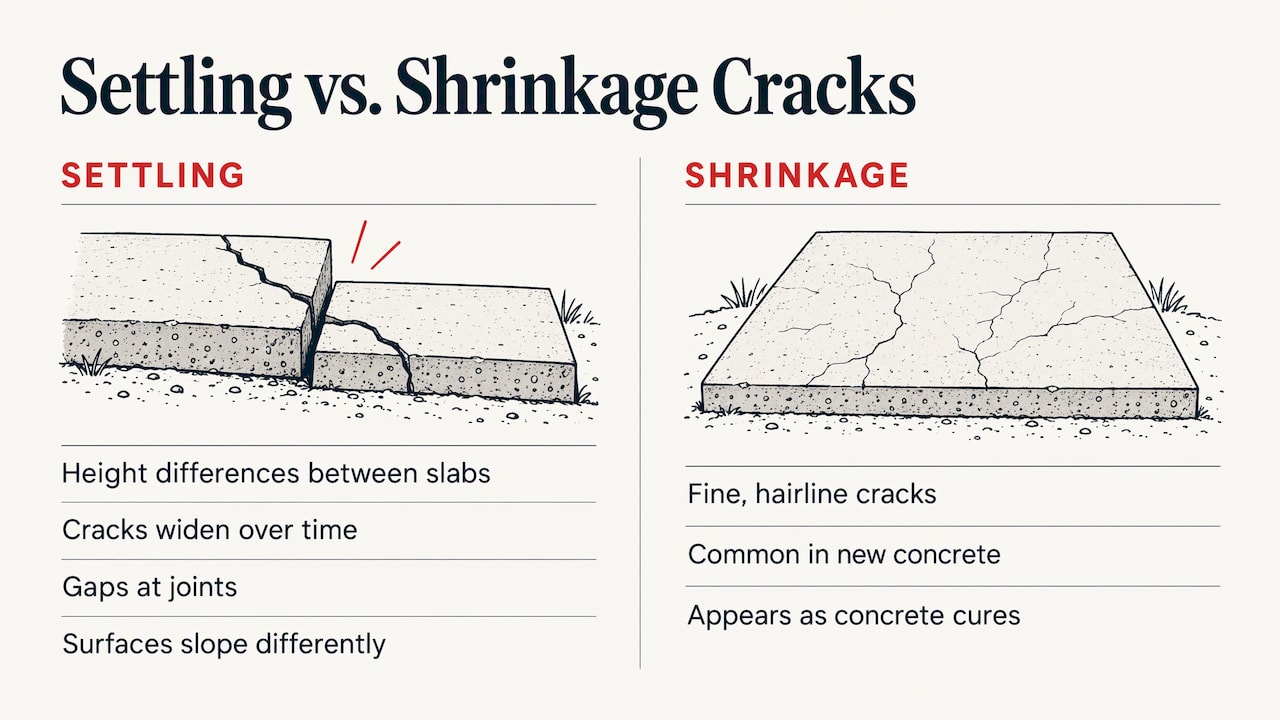
Settling is different from ordinary shrinkage cracking. Fine, hairline cracks are common in new concrete as it cures. Settling shows up as height differences between slabs, cracks that widen over time, gaps at joints and surfaces that no longer slope the way they were built.
The most common causes underneath
Water moving the soil
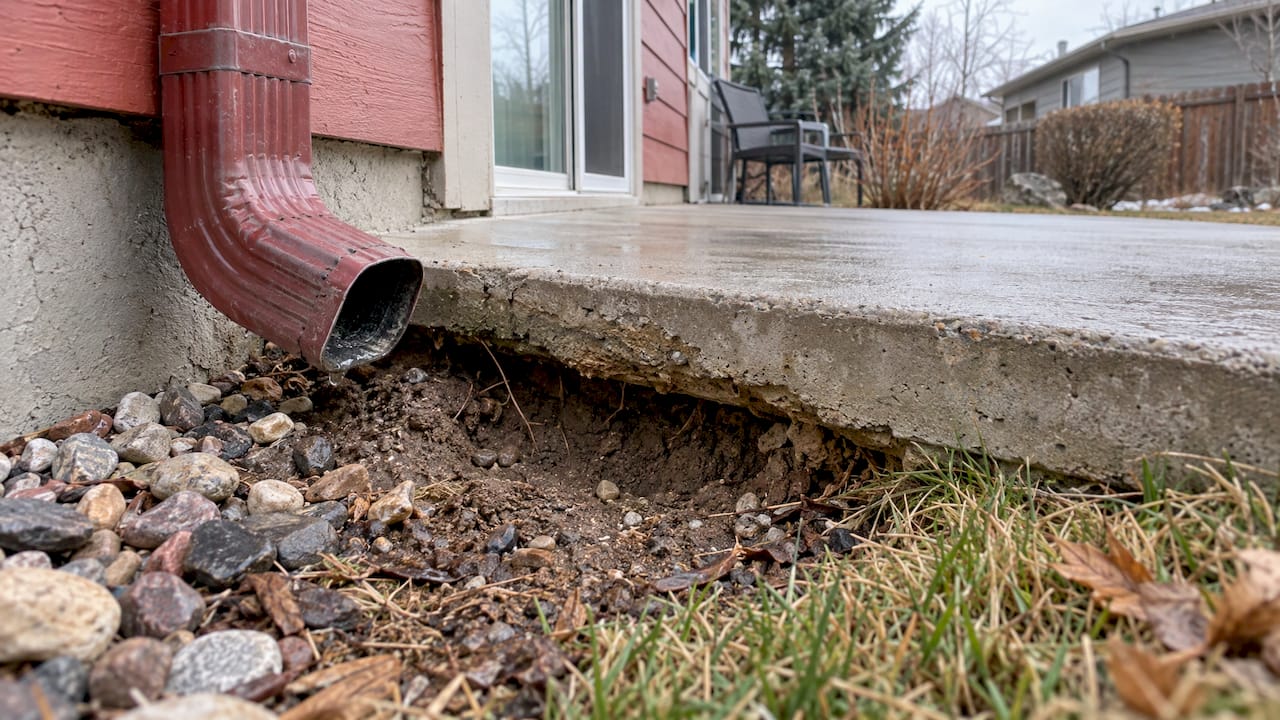
Water is the usual culprit. A downspout that dumps beside a patio, a driveway that floods, or a failing storm drain can wash fine soil out from under the slab. The surface looks fine until a void opens and the slab drops. If your property collects water after storms, our guide to driveway flooding causes and fixes explains what to look for, and a clogged or broken catch basin can send runoff exactly where you do not want it.
Leaking buried lines
A cracked water service line, a broken sewer line or a leaking joint saturates the soil around it and carries it away. Slabs that sit over a buried line often settle in a pattern that follows the pipe. If a settled stretch runs in a straight line toward the house or street, treat the pipe as a suspect. A video inspection shows the inside of the line without digging, and our sewer camera inspection guide covers what the camera finds.
Loose or poorly compacted fill
When soil is dug up for construction, utility work or a previous slab replacement, it is loose. If it was not compacted in layers before the concrete went down, it keeps compacting under the weight of the slab for years. That is why new concrete poured over a trench or around a foundation is a common place to see settling. The prep work matters as much as the pour, which is why we cover it in site preparation excavation.
Clay soil that swells and shrinks
Many Front Range properties sit on clay soil that swells when wet and shrinks when dry. That repeated movement can leave slabs unevenly supported, especially where irrigation or drainage soaks one side of a slab and not the other.
Grade that sends water the wrong way
Ground that slopes toward a slab instead of away from it keeps feeding water under the edges. Regrading is often part of the permanent fix, not an extra.
Is it serious? How to read what you see
Start with a simple walk-through after rain or a hard irrigation cycle.
| What you see | What it often points to | Next step |
|---|---|---|
| One slab lower than its neighbor | Soil loss or compaction under that slab | Find the water source, then repair |
| Slab tilting toward the building | Drainage or grade problem | Regrade and fix water paths |
| Settling in a line | Buried pipe or old trench | Camera inspection of lines |
| Gap along an edge | Soil washed out at the perimeter | Check downspouts and grade |
| Cracks that keep widening | Ongoing movement | Inspect before repairing |
| Puddles on the slab | Slab has lost its slope | Correct grade, then concrete |
A slab that dropped once and has stayed put for years is a different case from one that keeps moving. Mark the end of a crack with a pencil and a date, and check again in a few weeks. If it keeps growing, the cause is still active.
Why a trip hazard matters
Uneven concrete injures people, and for owners of businesses, apartment properties and public walkways it can also be a compliance question. Under the federal accessibility standards, vertical changes in level on accessible routes are limited to a small fraction of an inch, with larger changes needing a ramp. If a walkway at your property has shifted more than a lip or two, treat it as a priority. Commercial owners can read our commercial concrete repair guide for methods and what to ask a contractor.
Outdoor structures tied to the same soil can suffer too. Deck footings and posts set near a sinking patio often show the same movement, and the homeowner guide on rotted deck post repair helps you judge when that damage needs a professional.
Repair, lift or replace: how to decide
There are three broad routes, and the right one depends on the cause and the slab’s condition.
- Fix the cause, then level the slab. If the slab is mostly intact and the soil loss has stopped, the void can be filled and the slab brought back to grade.
- Replace the slab. Where concrete is badly cracked, broken into pieces or too thin, replacement with properly compacted base is usually the lasting answer.
- Repair around the slab. Drainage, grading, trench drains and catch basins stop the water that caused the movement. A trench drain along a driveway or loading area, for example, moves surface water away before it reaches the slab edge.
Whichever route you choose, the order stays the same: stop the water, correct the base, then rebuild or level the surface. Reverse that order and the settling returns.
What to ask before you hire
- Did anyone check for leaking pipes or drainage failures, or only look at the slab?
- What will happen to the soil under the slab, and how will it be compacted?
- Who pulls the permits if the work touches the right-of-way, a utility line or a storm system?
- Does the plan include grading so water leaves the area?
- Who restores the site when the work is done?
A contractor who only treats the surface cannot answer the first two. One who handles inspection, excavation and concrete can answer all five on one quote.
Our perspective
When someone calls us about sinking concrete, the first question we ask is where the water goes. Nine times out of ten the slab is telling you something about the ground, a downspout, a grade or a line underneath.
That is why we do not treat concrete as a stand-alone job. We run video inspection on buried lines, do the excavation and grading, and take care of the concrete and asphalt work, handling permits through cleanup. Denver’s climate is hard on soil and pipes, and a repair that ignores either one is a repair you will pay for twice.
Our approach is to find the cause, fix it once and leave the site clean, so you are not coordinating three trades and hoping they agree.
Scott
Get the cause and the concrete handled together
PipeX is a Denver plumbing and excavation company with over 20 years of experience, serving residential, commercial and municipal clients. For settled concrete, that means video inspection of suspect lines, excavation and land grading, and concrete and asphalt infrastructure work, managed from permits to cleanup. If a burst line or flooding is making things worse right now, our 24/7 emergency service is available.

To have a settled slab looked at, contact PipeX through our site and tell us where the concrete is moving.
FAQ
How long does it take for concrete to settle?
There is no fixed timeline. Slabs poured over loose or recently disturbed soil can keep moving for years as the soil compacts, while slabs on well-compacted base may never move. If a slab keeps sinking or a crack keeps widening, the cause is probably still active and worth inspecting.
Can I just patch uneven concrete?
A patch or grinding can smooth a small lip, but it does not restore support under the slab. If the soil is still washing out or compacting, the slab will drop again. Find the cause first, then choose a patch, a lift or a replacement.
Can a leaking pipe make concrete settle?
Yes. A leaking water or sewer line saturates and carries away the soil around it, which removes support from slabs above. If settling follows a line from the house toward the street, a camera inspection of the pipe is a sensible first step.
Is settled concrete a safety problem?
It can be. Raised edges cause trips and falls, and on commercial or public walkways, uneven surfaces can raise accessibility concerns. Mark and address the worst spots quickly, and have the underlying cause checked so the repair holds.
How do I prevent concrete from settling?
Keep water away from slabs with working gutters, downspout extensions and a grade that slopes away. Make sure fill is compacted in layers before any pour, and have buried lines checked if you see wet spots or sinking in a line.