
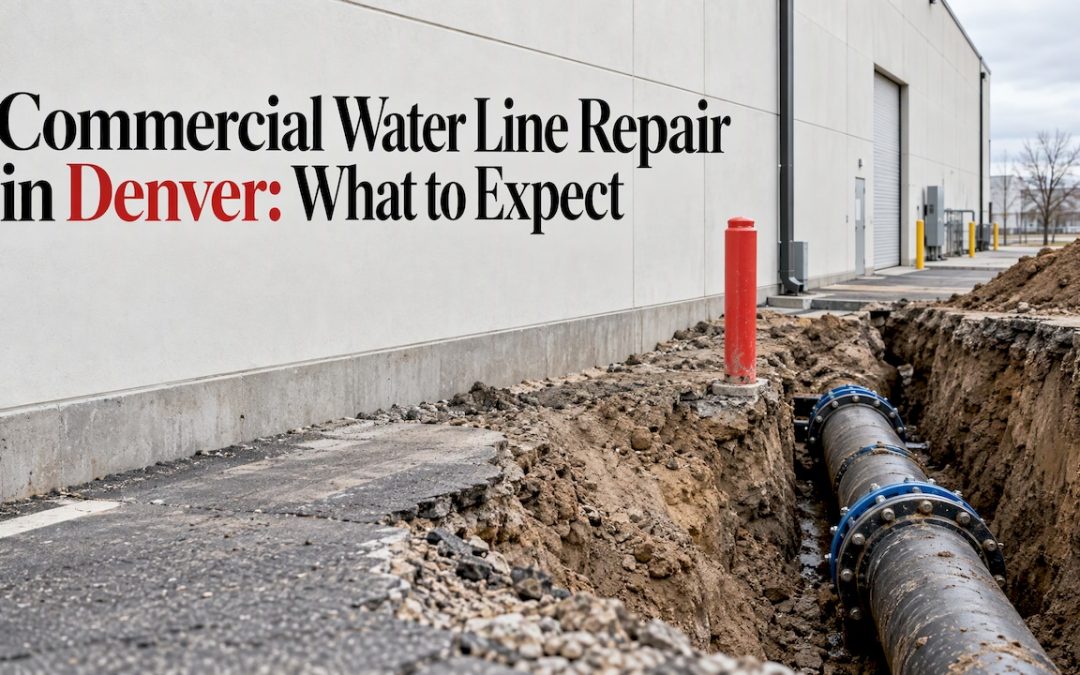
A failing commercial water line rarely stays small. It can flood a basement, close a parking lot, interrupt fire protection and shut a business down for days. The fastest way through it is one contractor who finds the leak, pulls the permit, coordinates utility locates, repairs or replaces the line and restores the site. That is how PipeX works: water line repair and replacement for commercial, developer and municipal clients in Denver, with 24/7 emergency response.
Key Takeaways
- Early signs are a steadily climbing water bill, heaving or cracked pavement and a water meter that moves when everything is off.
- A leak has to be located before it can be repaired, usually with acoustic equipment and, on sewer and drain lines, a camera.
- Repair or replacement depends on pipe material, the length affected and how much of the site can be opened.
- Permits, utility locates, disinfection and restoration are part of the job. Missing one can delay reopening.
- One contractor handling permits through cleanup keeps the schedule, and your downtime, under control.
Table of Contents
- Signs your commercial water line is failing
- How leaks are located before anyone digs
- Repair or replace: how the decision is made
- What a commercial repair costs
- Permits, locates and the rules that cost time
- Why one contractor for the whole job
- Perspective
- Get a commercial water line repair scheduled
- FAQ
- Sources
Signs your commercial water line is failing
The water line is the pipe that carries water from the utility main to your building. It is buried, so problems show up indirectly. The Georgia Environmental Protection Division lists warning signs of distribution leaks: heaving or cracking of paved areas, and sudden or steadily rising water use across several billing cycles.
In practice, watch for:
- A water bill that climbs with no change in occupancy or operations.
- Soft, sunken or unusually green ground over the line’s path.
- Low pressure at fixtures, or discolored water.
- A water meter that keeps registering when every fixture is off.
The meter test is simple. The EPA’s WaterSense at Work guidance says to read the meter during off-peak hours with all water uses shut off, then read it again an hour later. A significant change points to a leak in the facility or its distribution piping. If the reading moves, you have a repair job. Our water line leak detection guide covers the next steps.
If the leak is inside a mechanical room rather than underground, rule out equipment first. This water heater leak guidance shows how to tell a tank failure from a supply-line problem.
How leaks are located before anyone digs
Guessing is expensive. Digging in the wrong spot costs pavement, time and money, so locating comes first.
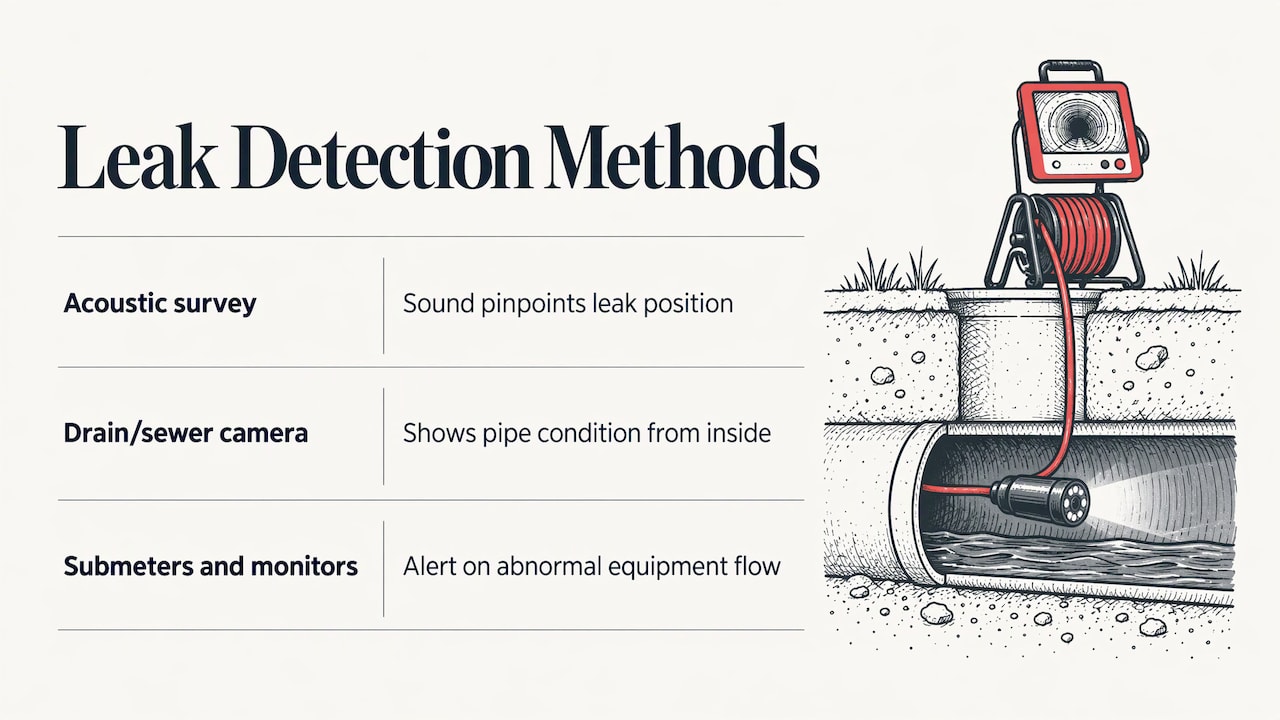
The U.S. Department of Energy explains that a leak survey pinpoints leaks using acoustic technology. Different pipe materials carry sound differently, so crews pair a correlator with a ground microphone to narrow down the position. Once the leak is located, the repair itself is ordinary utility work, as the Georgia program notes.
On drain and sewer lines, a camera shows the pipe’s condition from the inside. PipeX offers video inspection for that, so the decision to repair a section or replace a run rests on what is actually in the ground.
For ongoing protection, WaterSense recommends submeters on major water-using equipment and flow-monitoring devices that alert on abnormal flow, tied into a building automation system. These are worth considering for large facilities.
Repair or replace: how the decision is made
Three questions drive it: what is the pipe made of, how much of it is damaged, and what sits on top of it.
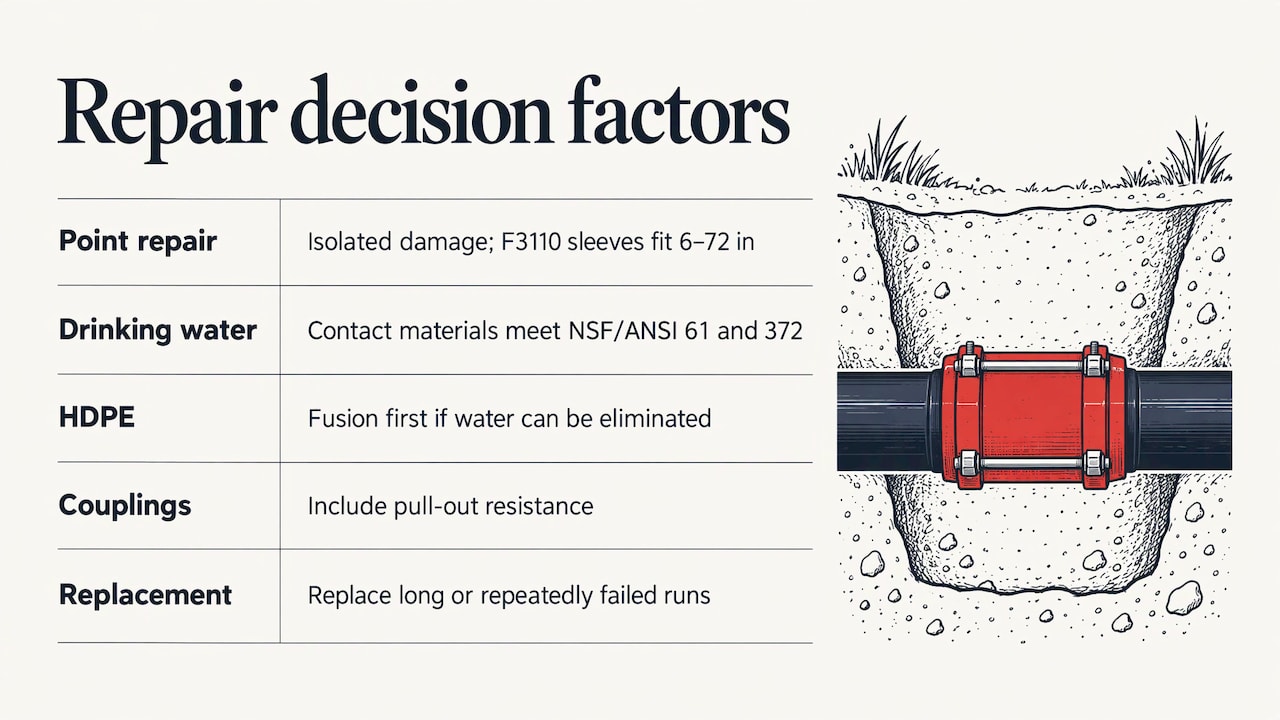
Point repair. Where damage is isolated, a section can be fixed. ASTM F3110 covers mechanical trenchless point-repair sleeves for pipes 6 to 72 inches in diameter, including potable water pipes, for cracks, leaking joints, corrosion and root penetration. Materials touching drinking water must meet NSF/ANSI 61 and 372.
Plastic pipe. For HDPE pipe, the Plastics Pipe Institute recommends that fusion be the first choice of repair where water can be eliminated, that mechanical couplings include pull-out resistance, and that underground metallic fittings get corrosion protection.
Replacement. When damage runs along a long stretch, or the line has failed repeatedly, replacing the run is usually the better value than paying for repeat call-outs. Where the property allows, trenchless methods cut down on tearing up pavement. See our overview of trenchless repair in Denver, which covers underground lines without a long open trench.
For lines serving fire suppression or hydrants, we also service water main and fire line systems.
What a commercial repair costs
Price depends on depth, length, surface (grass versus asphalt or concrete), access and permits. It is not a single number, and we do not publish one: scope is set by a site assessment and a quote.
Published municipal programs show how the factors stack up. The City of South Bend, Indiana, set 2026 flat rates of $590 for a stop box repair in grass and $714 where hard surface must be removed, and $1,828 to $1,945 for a basic service leak repair, with plumber labor at $106 per hour. Those are one Indiana city’s residential-scale service-line rates, not a Denver commercial quote. They do show that hard-surface removal raises the bill, and that large commercial lines, bigger equipment and longer runs cost more.
A 2026 cost guide on trenchless pipe bursting reports total projects from $8,000 to $60,000, with permits and inspections from $200 to $5,000 depending on region and agencies involved. Treat it as a rough range for planning.
Permits, locates and the rules that cost time
The paperwork is where schedules slip. Requirements differ by city, so check your local utility and building department. Examples show the pattern:
- Spearfish, South Dakota requires the owner to obtain a repair permit and begin contracting within five days of the utility’s leak notification, with work starting within 10 days unless a waiver applies.
- Northbrook, Illinois lets contractors make a small point repair after hours and restore service, but the permit must be obtained by the next business day.
- South Bend requires a licensed plumber, a performance bond, liability insurance, a 3-year warranty and utility-locate compliance before and during all excavation.
Disinfection and restoration also matter. In Northbrook, a replacement longer than 20 feet requires chlorination with 24- and 48-hour samples and a two-hour 150 PSI pressure test, roadway repairs are backfilled with flowable fill, and lines feeding fire suppression need a fire flush scheduled with the Fire Department. Each is a separate step, and each can hold up your reopening if nobody owns it.
Why one contractor for the whole job
A commercial repair touches the utility, the city, the fire department, the pavement and your tenants. Split among several vendors, each handoff is a place for delay. PipeX takes the project from permits to cleanup, which keeps the sequence in one set of hands: locate, permit, excavate, repair, test, restore. We cover excavation and site restoration alongside the plumbing, so the pavement and landscaping are put back by the same team that opened them.
We also build around Denver’s climate and infrastructure, and our focus is clear communication, regulatory compliance and minimal disruption on small and large projects alike.
Perspective
Most commercial water line calls start with a symptom: a wet spot, a bill that jumped, low pressure on the third floor. The costly mistakes come after, when the leak is not pinned down or the permit is an afterthought.
Our view is simple. Find the problem exactly, tell the owner plainly what the options are, and handle everything from the permit to the cleanup so the business is back to normal quickly. That is why we do plumbing and excavation under one roof, and why our emergency line is staffed around the clock.
If your meter is moving when nothing is running, do not wait for the pavement to tell you.
Scott
Get a commercial water line repair scheduled
PipeX provides water line repair and replacement for commercial, residential and municipal properties in Denver, backed by more than 20 years of experience. For an active leak, loss of pressure or a break, use our 24/7 emergency services. For planned work such as a line replacement, a new service or a fire line, request a quote through our commercial services page.

FAQ
How do I know if the leak is in the water line or inside the building?
Shut off every fixture and read the meter, then read it again an hour later. If the number moves, water is escaping somewhere between the meter and your fixtures. Soft ground or pavement damage outside points to the buried line, and a technician can confirm the location with acoustic equipment.
Can a commercial water line be repaired without digging up the whole property?
Often, yes. Point repairs and trenchless methods limit how much pavement is opened, depending on the pipe, depth and damage. A site assessment determines which approach fits your property.
Do I need a permit for a commercial water line repair?
Usually. Cities set their own rules, and some require the permit within days or even by the next business day after an emergency repair. A contractor that handles permitting for you keeps this from delaying the work.
What should I do if the water line breaks after hours?
Shut off the water at your main valve if you can do so safely, and call an emergency line right away. PipeX runs 24/7 emergency service, so a break at night or on a weekend still gets a response.
Sources
- Water Leak Detection and Repair Program, Georgia EPD
- Best Management Practice #3: Distribution System Audits, U.S. Department of Energy
- WaterSense at Work Section 2.2: Leak Detection and Repair, EPA
- ASTM F3110-14R24
- Municipal Advisory Board MAB-4, Plastics Pipe Institute
- 2026 Water Works Utility Service Line Program, City of South Bend
- Trenchless Pipe Bursting Cost Guide 2026
- Water heater leak guidance