

A clogged storm drain means water has nowhere to go during rain or snowmelt, so it pools on your pavement and works toward your foundation. Light debris on a street grate is something you can clear safely from the sidewalk. A blockage in the pipe, a drain on your own property, or any standing water near a building needs a crew with jetting equipment and cameras. In Denver, that is the work we do at PipeX, from the video inspection through the permit to the cleanup.
Key Takeaways
- A blocked storm drain sends water over pavement and toward buildings, which can lead to flooding and foundation problems.
- Leaves, trash, sediment and tree roots cause most blockages. Surface debris is a quick fix, but a clog inside the pipe is not.
- Ownership decides who pays: drains on private property are generally the owner’s responsibility, and those in the public right-of-way belong to the city.
- Professional cleaning typically means dry removal followed by jetting and flushing, and a camera shows what is actually in the line.
- Checking drains in fall and before and after storms prevents most repeat clogs.
Table of Contents
- What a storm drain does and how a clog shows up
- What causes a blocked storm drain
- Why a clogged storm drain is worth fixing quickly
- Who is responsible: your property or the street
- What you can safely do yourself
- When the clog needs a professional
- Preventing the next clog
- Get your drain cleared and inspected in Denver
- FAQ
- Sources
What a storm drain does and how a clog shows up
A storm drain system is a network of inlets connected by closed pipes or open channels. The EPA describes a storm drain as one or more conduits linking inlets, which means a single blocked inlet or a single collapsed section can hold back everything upstream of it.
Unlike your household sewer, a storm drain is not meant to carry wastewater. It carries rain and melt from roofs, driveways, parking lots and streets. That is why a clog often goes unnoticed until the weather turns.
The signs are usually visible on the surface:
- Water standing around a grate or area drain long after the rain has stopped.
- A grate packed with leaves, mulch, trash or silt.
- Water backing up out of a drain instead of flowing into it.
- Wet ground, damp stains or muddy runoff along the base of a wall or foundation.
- Gurgling from a drain during heavy flow, or a slow drop in water level.
Some pooling is normal. Calgary’s city guidance notes that temporary pooling of up to about 0.5 meters around a drain after intense rain is expected, so the test is how long water stays, not whether it appears. If puddles linger for hours after the storm has passed, something is restricting the flow.
What causes a blocked storm drain
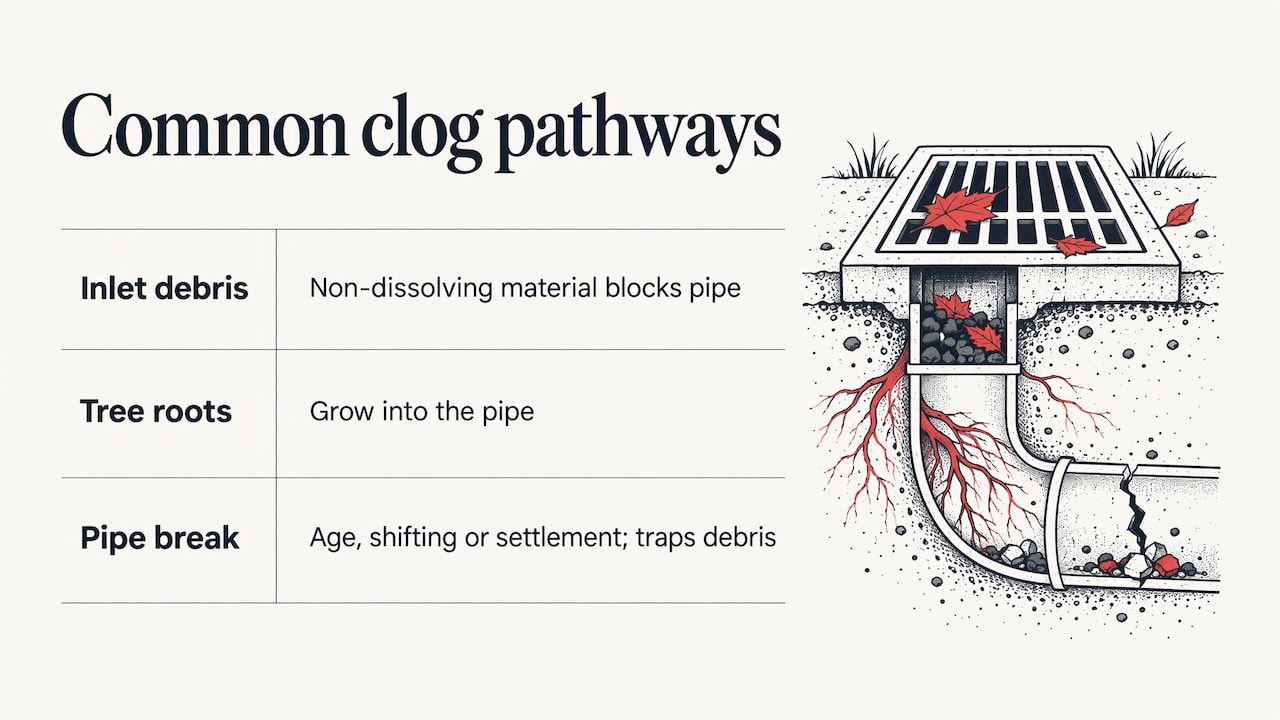
Most clogs come from material that does not dissolve in water. Cincinnati’s stormwater utility explains that clogs form when non-dissolving materials partly or fully block a pipe, with debris entering through the inlet and tree roots growing into the pipe as the two common routes. Age, ground shifting and settlement can also break pipes, and a broken pipe catches whatever washes into it.
The EPA’s list of what ends up in storm drains is longer than most owners expect: trash and debris, sediment, oil and grease, paints, cleaners, solvents, pesticides, fertilizers, animal waste and deicing materials. On a commercial site, sediment from construction and grease from loading areas are the usual culprits. On a residential lot it is more often leaves, mulch, gravel from the driveway and roots.
Colorado adds its own pattern. Fall leaf drop is the obvious peak, but spring melt carries winter grit and sand into inlets, and sudden summer storms deliver heavy loads of dirt and debris in minutes. A drain that works fine in a drizzle can fail in the first real downpour.
Why a clogged storm drain is worth fixing quickly
The damage follows the water. Pittsburgh’s water authority says clogged storm drains keep water from leaving streets in heavy rain, so it pools and floods streets and properties. The EPA adds that systems that are not routinely cleaned accumulate debris and pollutants, leading to clogging, flooding and water quality problems.
For a building, the serious part is what happens at the base of the walls. A Delaware state adaptation guide warns that pooling water at the foot of a structure could lead to foundation damage or flooding in a basement, crawlspace or ground floor. In practice that means:
- Homeowners: a wet basement, window wells that fill, a driveway that turns into a pond. Our guide to driveway flooding covers causes and fixes in more depth.
- Businesses and property managers: flooded parking areas, slip hazards, water at loading docks and liability when customers or tenants are affected.
- Developers: erosion on graded sites, failed inspections and delays when detention or inlet systems do not drain as designed.
- Municipalities: street flooding, downstream overload and complaints from residents.
A blocked drain also does not fix itself. Debris compacts, roots thicken, and each storm packs in more sediment. A clog that would have taken minutes to flush becomes a dig.
Who is responsible: your property or the street
Before you do anything, work out whose drain it is. The rule in most U.S. cities is the same, and it follows the property line. Raleigh, for example, assigns homeowners the stormwater pipes on private property and the city those in the right-of-way. Durham’s guidance likewise says the owner of the property where a drainage system sits is responsible for maintaining it, while the city maintains infrastructure in public right-of-way and on city-owned land.
That gives you a simple way to sort the problem:
| Where the clogged drain is | Usually responsible | What to do |
|---|---|---|
| Street inlet or curb grate in the public right-of-way | City or utility | Report it to your city’s public works or stormwater line |
| Area drain, trench drain or catch basin on your lot | Property owner | Arrange cleaning or repair |
| Parking lot, loading dock or site inlets on a commercial property | Property owner or manager | Schedule cleaning and inspection |
| Drain in a shared HOA or association area | Check your governing documents | Contact the association, then arrange service |
If you are unsure which side of the line a drain sits on, your city’s public works department or a property survey will tell you. When the drain is on your side and you do not want to wait on anyone, call us and we will get a crew out.
What you can safely do yourself
The scope here is narrow, and it should be. Surface debris on a grate is the one job that is reasonable for an owner, and only when conditions are safe.
Seattle’s utility advises clearing a drain only if it is safe, from the sidewalk or parking strip rather than the road, and with tools rather than hands. It also says to report the drain if you cannot clear it. In Denver terms:
- Stay out of the traffic lane and do not work during active heavy rain or lightning.
- Use a rake or similar long-handled tool to lift leaves and trash off the top of the grate.
- Bag what you remove. Calgary’s guidance is clear that you should never sweep debris into a storm drain, dump chemicals down it or use ice salt on it, because storm drains send water to rivers and streams without treatment.
- Do not lift a heavy grate or reach into the opening. Never put your hands in a drain.
- If the water still does not drop, stop. The blockage is inside the pipe.
For the surrounding area, keeping paved surfaces and runoff paths clear helps too. This overview of outdoor paving drainage shows how surface design affects where water travels. And if your gutters are discharging near a drain that keeps overflowing, a simple hose test for gutter overflow can show whether roof water is part of the problem.
What you should not do is push a hose, rod or chemical cleaner into a storm line and hope. Storm drains are larger and run differently from household drains, and chemicals leave your property and enter the waterways. Guessing is expensive: a half-cleared line fails again at the next storm.
When the clog needs a professional
Call for professional help when any of these are true:
- Water stays in the drain after you clear the grate.
- The same drain clogs again within a season.
- Water is pooling against a foundation, in a window well or at a garage door.
- You see sinkholes, sagging pavement or soil washing out near the drain.
- The drain serves a parking lot, loading area, roof or building site.
- You do not know where the pipe goes.
The EPA recommends that municipal or contracted professionals trained in the applicable regulations and in cleaning and disposal procedures inspect and clean storm drain systems. Disposal matters: what comes out of a storm line can include sediment, oil and grease that cannot simply be dumped.
How professional clearing works
The EPA describes a two-stage approach: dry cleaning by hand or with vacuums or shovels, followed by wet cleaning that typically uses jetting and flushing. That matches how a good crew works:
- Find the cause. A camera run through the line shows whether you have loose debris, packed sediment, roots or a broken section. Our video inspection service is built for exactly that question.
- Remove the bulk. Solid debris and sediment are taken out of the inlet and basin first.
- Flush the line. Hydro jetting uses pressurized water to scour the pipe walls and push remaining material out.
- Verify. A second camera pass confirms the line is clear and shows whether the pipe is damaged.
- Repair if needed. A cracked, offset or collapsed pipe will clog again no matter how often it is jetted. At that point the answer is a repair, covered in our guide to storm sewer repair in Denver, or a failing inlet, covered in catch basin repair.
Drains and systems we work on
Storm drainage comes in several forms, and each calls for slightly different equipment:
- Catch basins and inlets: the collection points that fill with silt and debris first.
- Trench drains: linear surface drains at driveways, garages, loading docks and patios. See our trench drain work.
- Storm inlets and detention systems: larger site systems that hold and release water, described on our storm inlets and detention systems page.
- Parking garage storm drainage: repair and replacement of systems under structures, covered on our parking garage storm repair page.
Preventing the next clog
Prevention is mostly a schedule. Delaware’s guidance advises checking drains for debris regularly, especially in the fall as trees start losing their leaves, and before and after precipitation events. Raleigh adds the habits that keep debris from arriving: remove branches from pipes and streams, do not litter, and keep leaves and grass clippings away from stormwater pipes. Durham’s guidance likewise says routine maintenance includes keeping leaves, branches and other debris from blocking storm drains, gutters and ditches.
A practical Denver calendar looks like this:
- Late October to November: after leaf drop, clear grates and have inlets and area drains checked.
- Before spring melt: make sure drains are open before snow turns to water.
- Late spring, before storm season: inspect basins for winter sediment, especially on commercial lots.
- After any major storm: look at every drain on your property for new debris and standing water.
Property managers and developers benefit from putting this on a recurring service schedule rather than reacting to complaints. Trees near drains deserve special attention, since roots find and enter pipe joints over time.
Our view on storm drain clogs
Most storm drain calls we hear about start the same way: someone cleared the leaves off the grate, the water still sat there, and the next storm made it worse. The grate was never the whole problem. Water that will not move usually means something in the pipe, and you cannot see inside the pipe without a camera.
That is why we start with a video inspection and treat clearing and repair as one job. If the line is simply packed with sediment, jetting restores flow. If it is cracked, offset or full of roots, jetting only buys time, and you are better off knowing that before the next storm rather than after.
Denver’s weather is hard on drainage. Fast summer downpours, freeze and thaw cycles, and winter grit all load drains in different ways, and a system that is cleaned and checked on a schedule holds up far better than one that is only addressed in an emergency. We also handle permits, excavation and cleanup when a repair needs digging, so you deal with one crew from diagnosis to finished site.
Scott
Get your drain cleared and inspected in Denver
If water is standing at a drain on your property, or you manage a site where drains are overdue for service, PipeX can clear and inspect the line, repair it if needed and restore the site. We work for homeowners, businesses, developers and municipal clients, with 24/7 emergency service when flooding will not wait.

Start with our drain cleaning and hydro jetting services, or call through our emergency services page if water is already reaching a building. For parking lots, loading areas and commercial sites, see our commercial services.
FAQ
Who do I call about a blocked storm drain in the street?
A drain in the public right-of-way is normally the city’s responsibility, so report it to your city’s public works or stormwater department. If the drain is on your own property, it is yours to maintain, and you can call PipeX to clear and inspect it.
Can a clogged storm drain damage my foundation?
Yes, if water collects against the structure. State guidance warns that pooling at the base of a building could lead to foundation damage or flooding in basements, crawlspaces and ground floors. If water is reaching a wall, treat it as urgent.
Is it normal for water to pool near a storm drain after rain?
Brief pooling in heavy rain is normal. Water that lingers for hours after the storm stops, or that does not drain at all, points to a blockage in the inlet or pipe.
What is the difference between cleaning and repairing a storm drain?
Cleaning removes debris and sediment, typically by dry removal and then jetting and flushing. Repair is needed when a camera shows broken, shifted or root-damaged pipe, because that kind of damage keeps catching debris after cleaning.
How often should storm drains be checked?
Check them in the fall after leaves drop and before and after significant storms. Commercial sites with heavy sediment or grease loads benefit from a recurring service schedule.
Sources
- EPA: Storm Drain System Cleaning best management practice
- City of Calgary: Storm drains
- Cincinnati Stormwater Management Utility brochure
- Pittsburgh Water: Storm drains
- Delaware DNREC: Clear Debris from Nearby Storm Drains
- Seattle Public Utilities: Wet weather preparation tips
- City of Raleigh: Stormwater maintenance and inspections
- City of Durham: Stormwater drainage systems