

Catch basin repair fixes the physical damage that stops a storm drain structure from collecting water: cracked walls, failed pipe joints, a sunken frame, a broken grate or soil washing in from outside. Cleaning only restores capacity. If water still ponds after the sump is emptied, or the pavement around the grate is sinking, the structure needs repair, a rebuild or a replacement. Which one depends on what an inspection finds.
This guide covers how to recognize a failing basin, what usually causes it, how repairs are done step by step, how to decide between repair and replacement, and what to line up before a crew digs. We wrote it for Denver homeowners, property managers, developers and facility teams who own the basin and need it to work again.
Key Takeaways
- Slow drainage or ponding around a grate generally points to a maintenance problem, and cracks, sinking pavement or a loose frame point to a structural one.
- Cleaning, repair, rebuilding and replacement are four different jobs. Clean first, because debris hides the damage.
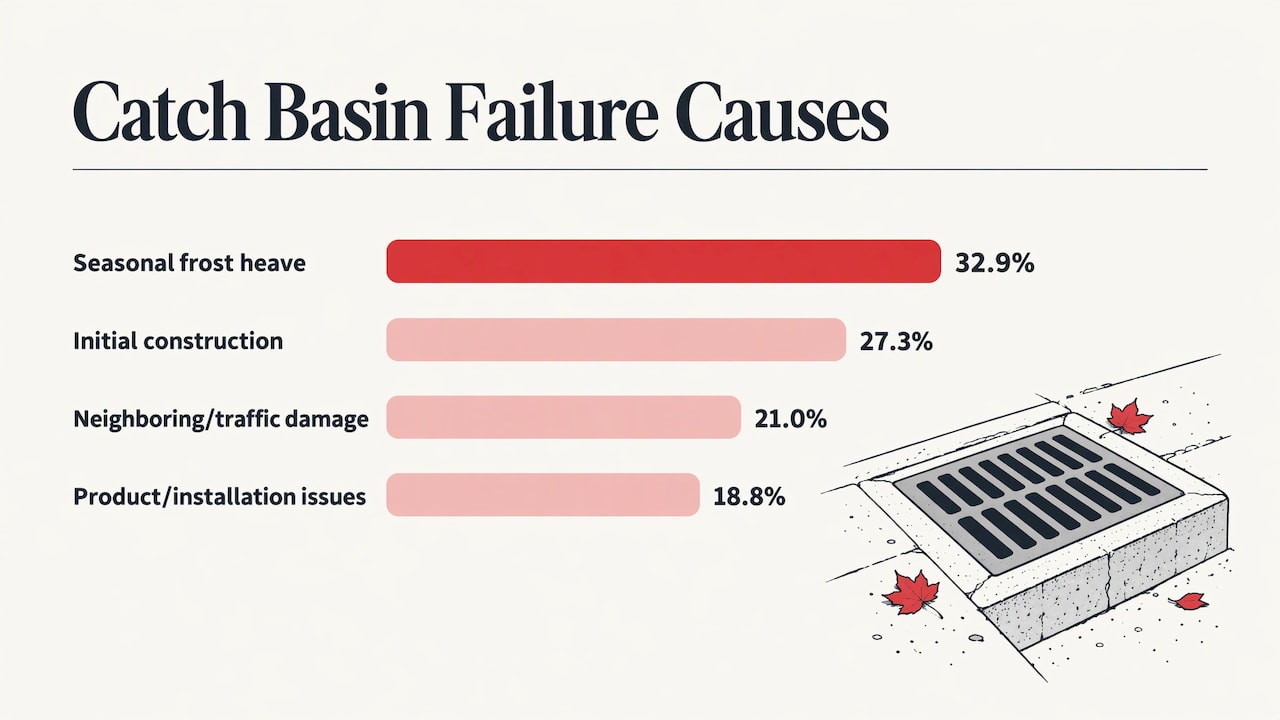
- Frost heave ranked as the leading cause of catch basin and manhole failure in a U.S. DOT-sponsored review, which matters on a freeze-thaw site like Denver.
- Digging needs utility locates, barricades and a plan for safe disposal of the sediment, so hire a crew that handles permits through cleanup.
- A video inspection of the connected pipes shows whether the basin or the line behind it is the real problem.
Table of Contents
- What a catch basin does and why it fails
- Signs your catch basin needs repair
- Cleaning, repair, rebuild or replacement
- How a catch basin repair is done
- When to replace instead of repair
- Check the pipes before blaming the basin
- What affects the cost of catch basin repair
- Safety, disposal and stormwater rules
- Keeping a repaired basin working
- Our perspective on catch basin repair
- Need a catch basin repaired in Denver?
- FAQ
- Sources
What a catch basin does and why it fails
A catch basin is a pit beneath a storm-sewer opening that collects runoff. According to Michigan’s environmental agency, the grate traps larger debris while the sump lets sediment settle below the outlet pipe. Parking lots, driveways, yards and low spots in landscaping use them to move water off the surface and into a storm system.
Because a basin sits in the ground and takes traffic, weather and constant water, every one of them deteriorates eventually. The failures fall into two groups.
Structural failures are cracked or collapsed walls, broken frames, separated joints and settlement. Operational failures are clogging, trash, blocked or damaged pipes, erosion and poor slope. U.S. DOT research on catch basins and manholes identifies frost heave, construction defects, neighboring construction, pavement and traffic loading, and product or installation problems as the structural drivers. It also lists groundwater or soil movement and freeze-thaw deterioration among the causes.
The same DOT-sponsored review reports that survey respondents ranked seasonal frost heave as the leading cause of failure at 32.9%. Initial construction issues followed at 27.3%, neighboring construction, pavement or traffic damage at 21.0%, and product or installation issues at 18.8%. Denver sees repeated freezing and thawing every winter, so a basin that was marginal at installation tends to show it within a few seasons.
Signs your catch basin needs repair
Start with what you can see from the surface. Portland’s catch basin maintenance guidance says slow drainage or ponding water around a grate generally means maintenance is needed. That is the first signal, and it may only mean a full sump. These signs go further than a cleaning problem:
- A cracked, broken or missing grate.
- Potholes or sinking pavement around the basin.
- A hole in the top slab, or a frame that has pulled away from the structure.
- Cracks in the walls or bottom.
- Soil entering through cracks at the pipe joints.
That last group matches the deficiencies Pierce County lists as requiring correction during inspections. Soil entering through a joint is especially urgent, because the soil you see in the sump came from somewhere. Voids form behind the walls and under the pavement, and the next sign is often a sunken patch of asphalt or concrete.
Other clues are less direct: standing water that lingers for days after a storm, a sewer-like odor from the grate, erosion channels leading to the basin, and water surfacing in a spot where it never did before. If you see any of these, an inspection is cheaper than waiting for the surface to collapse.
Cleaning, repair, rebuild or replacement
The four terms are used loosely, and quotes are hard to compare when contractors mean different things by them. The DOT research draws clear lines:
| Job | What it does | Typical trigger |
|---|---|---|
| Cleaning or pumping | Removes water, sediment, trash and debris to restore capacity | Slow drainage, full sump |
| Repair | Corrects localized defects: cracks, mortar, pipe joints, grates, frames, grade | Cracks, leaking joints, loose frame, settled grate |
| Rebuild | Replaces or reconstructs damaged sections of the structure | Damage too widespread for patching but the base is sound |
| Replacement | Removes the failed basin and installs a new one | Unsound, extensively cracked or collapsed structure, or one that cannot be restored economically |
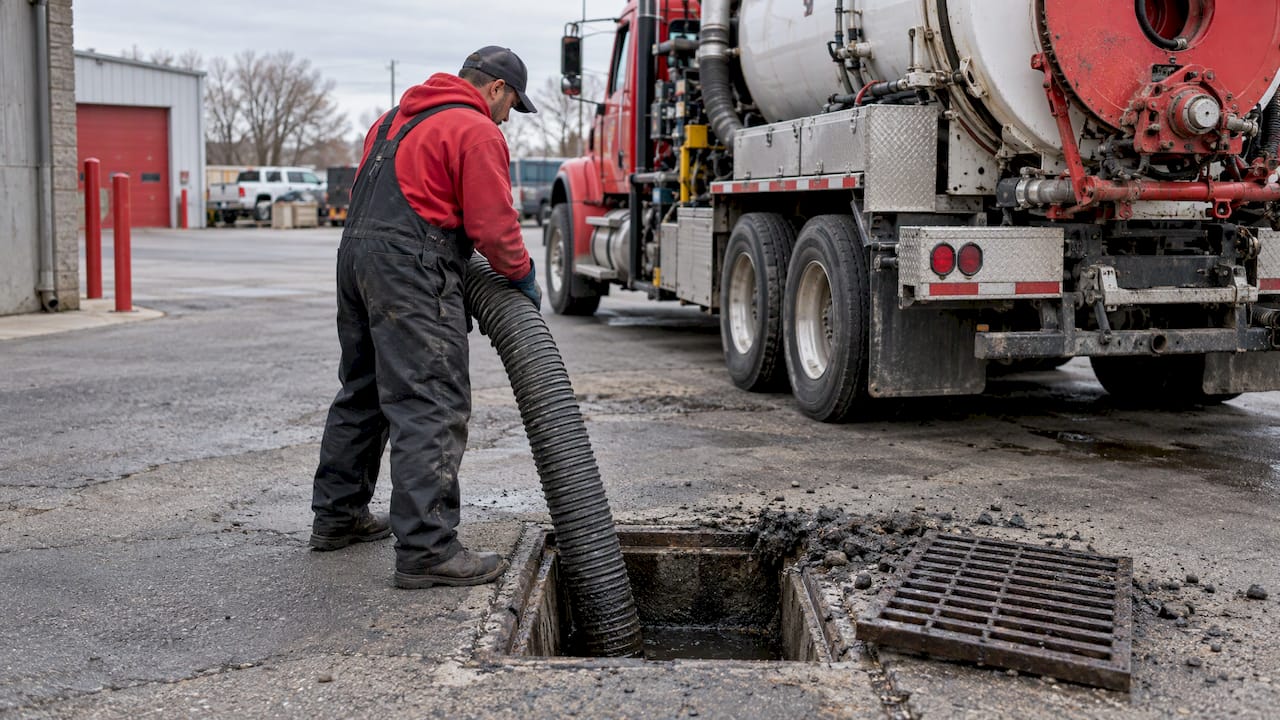
Cleaning has its own trigger. Portland recommends cleaning when solids reach one-third of the depth from the sump bottom to the lowest pipe invert. A small residential basin may be cleaned with a vacuum, pump or bucket, while larger work calls for a vactor contractor. Pierce County adds that repair or replacement to design standards is indicated when the basin is unsound or when settlement creates a safety, function or design problem.
A useful rule: clean before you judge. Sediment and debris hide cracks and joint gaps, so a basin that looks fine full of silt may look very different once vacuumed. Our drain cleaning and hydro jetting work is often the first step on a catch basin job for this reason.
How a catch basin repair is done
The sequence below follows the DOT research and a public-agency repair specification, adapted to how a crew actually works on site.
- Locate utilities and set up the site. A South Carolina school-district catch basin repair specification requires utilities to be located before excavation and barricades where people or vehicles pass. Openings must be closed and secured at the end of each workday. Those are sensible practices on any site.
- Inspect. The crew looks at the surface and grate, frame and grade, sump, walls, joints, inlet and outlet pipes, surrounding pavement, and any sign of erosion or settlement. Cleaning comes first so concealed damage shows.
- Clean the interior thoroughly. For sealant or grout to bond, the DOT review notes that power washing or air blasting may be needed.
- Repair the structure. Typical work includes patching leaks, removing and replacing deteriorated mortar or grout, and applying sealant following the manufacturer’s instructions. Frames and grates are reset, and failed pipe joints are repaired.
- Excavate when the damage is outside the box. The same school-district specification calls for excavation to expose the box and pipes, photographs and recommendations, grout repair when pipe replacement is unnecessary, and backfill compacted in 1-foot lifts.
- Restore the surface. Compacted backfill, erosion protection, repaired asphalt or concrete, and off-site disposal of excavated debris finish the job.
The last step is where a lot of repairs fail. A basin repaired properly but backfilled loosely will settle again within a season or two. If the pavement around it needs work, see our guide to hiring an asphalt repair contractor.
When to replace instead of repair
The DOT research says to replace or rebuild when the structure is unsound, extensively cracked or collapsed, unsafe under load, or unable to regain function through localized repair. In practice, replacement makes sense when:
- The walls are cracked through in several places or the base has shifted.
- The basin has collapsed or the top slab is failing under traffic.
- Repeated repairs at the same spot have not stopped settlement.
- The basin sits in the wrong place or at the wrong grade for how the site drains now.
Replacement is also the moment to fix the design. If the lot has been regraded, expanded or repaved, the old basin may be undersized or poorly placed. Our guide to catch basin installation covers placement, steps, permits and costs, and our page on storm inlets and detention systems covers larger drainage setups.
When the problem is a pipe rather than the box, the fix is a line repair. Our storm sewer repair page explains signs, methods and hiring. For the difference between patching and replacing a buried line, see sewer line repair vs. replacement.
Check the pipes before blaming the basin
A basin that drains slowly is not always the problem. A crushed, offset or root-filled outlet pipe backs water up into a perfectly sound structure. Pushing a camera through the connected lines settles it quickly. Video inspection shows the pipe condition, joint gaps and blockages, so the repair goes where the damage actually is. Our guide to sewer camera inspection explains what the camera reveals.
A crew that skips this step can rebuild a basin and still leave the site flooding. We would rather find the cause once than return to the same drain twice.
What affects the cost of catch basin repair
We do not publish set prices for catch basin work, because the range between a regrouted joint and a full excavation is wide. Every site is different. The factors that move a quote the most are:
- Depth of the basin and the soil around it. Deeper structures and difficult soil mean more excavation and shoring.
- Pipe length, material and condition. Connected pipe repairs add scope.
- Access. A basin in a landscaped yard, a parking lot with live traffic or a tight alley changes equipment and scheduling.
- Permits and utility conflicts. Work in the public right of way or near other utilities takes more coordination.
- Disposal. Sediment and excavated material must be hauled and handled properly.
- Surface restoration. Replacing asphalt, concrete, sod or pavers behind the repair is part of the real cost.
Online cost guides give broad ranges, but they average different regions and job types and cannot price your basin. A written scope after an on-site look is the only number worth budgeting from. Ask that the scope states whether it includes excavation, pipe work, backfill, and surface restoration, so quotes can be compared line by line.
Safety, disposal and stormwater rules
Treat the sump contents as something that needs a plan. Portland’s guidance says catch basin solids may contain pollutants and require a solid- and hazardous-waste determination, and that commercial or industrial sites handling chemicals or hazardous materials may face special disposal decisions. The Tacoma-Pierce County health department adds that sump contents must be disposed of properly and never flushed into the outlet pipe.
Where the water goes matters too. Portland notes that catch basins may discharge directly to rivers or streams, combined sewers, drywells or underground-injection structures, so repair and disposal methods must account for the receiving system. Before work begins on a commercial or municipal site, confirm which system your basin feeds and which local stormwater rules and permits apply. In Denver, that is a question for your contractor and the city’s permitting office, and we handle it as part of a turnkey project.
On site, keep people and vehicles away from open excavations, and do not remove a grate to free a clog and leave the opening unguarded.
Keeping a repaired basin working
Maintenance is the cheapest way to avoid the next repair. The Tacoma-Pierce County guidance recommends regular inspection of basins and grates, and removing trash and sediment when the sump is 60% full or sediment sits within 6 inches of the bottom of the outlet pipe. Frequent sweeping of the surrounding pavement and a coordinated maintenance schedule can reduce how often cleaning is needed. Michigan’s agency cites cleaning at roughly 30% to 50% of sump depth as a common reference, and cautions that basins which are not maintained can release trapped pollutants back into the flow.
A routine check should cover:
- The grate and the pavement and grade around it.
- Frame seating.
- Sump sediment depth.
- Walls and joints.
- Inlet and outlet alignment.
- Pipe blockage, odors and signs of erosion or settlement.
Keep the roof and surface water that feeds the basin under control as well. Downspouts and gutters that dump water near a basin raise its load, and well-sized seamless gutter installation helps guide roof runoff where it should go. On commercial sites, low spots in garages and lots may call for trench drains or a parking garage storm repair to share the load.
Our perspective on catch basin repair
Most catch basin calls we get start the same way: a puddle that will not drain, or a dip in the pavement that keeps getting deeper. By the time someone calls, the basin has usually been failing for a while.
We approach every one the same way. Clean it so we can see it, camera the pipes so we know whether the basin or the line is the cause, then fix what is actually broken. Guessing is expensive, and so is digging up a lot twice.
Denver’s freeze-thaw cycles are hard on buried structures, so we pay attention to how the backfill is placed and how the surface is restored. A repair is only finished when the pavement around it stays flat.
That is why we run catch basin work as one project, from permits and utility locates through excavation, repair and cleanup. One crew, one scope, one point of contact.
Scott
Need a catch basin repaired in Denver?
PipeX handles plumbing and excavation for residential, commercial and municipal properties, including storm drain installation and repair, video inspection, hydro jetting and full project management from permitting to cleanup. We can inspect the basin, camera the connected lines and give you a written scope that spells out what is repaired, what is replaced and how the surface is restored.

For a failing basin on a commercial lot, see our commercial services. For digging and grading, see our excavation services. If water is backing up now, our 24/7 emergency service is available, or start at pipexnow.com.
FAQ
How do I know if I need catch basin cleaning or repair?
If the basin drains slowly but the grate, frame and walls look intact, cleaning is the likely fix. If you see cracks, a loose or broken grate, sinking pavement or soil coming in at the pipe joints, you need repair. A cleaning followed by an inspection settles the question.
Can a cracked catch basin be repaired without replacing it?
Often, yes. Localized cracks, deteriorated mortar and leaking joints can be patched, regrouted and sealed. If the structure is unsound, extensively cracked or collapsed, or settlement keeps returning after repairs, replacement is the better route.
Why does my catch basin keep clogging or flooding after cleaning?
The problem is usually downstream or underground: a damaged, offset or blocked outlet pipe, or soil entering through a failed joint. A video inspection of the connected lines shows the cause so the repair goes to the right place.
Who is responsible for repairing a catch basin?
The owner of the property or system the basin serves. A basin on your lot is generally yours to maintain, while one in the public right of way belongs to the city or other agency. Confirm ownership with your local stormwater authority before work starts.
How often should a catch basin be cleaned?
Clean it when the sump is about 60% full or sediment is within 6 inches of the bottom of the outlet pipe, and inspect it regularly in between. Sites with heavy leaf, trash or sediment loads need more frequent attention.
Sources
- Catch Basin, Michigan EGLE
- Catch basin maintenance, City of Portland
- Catch basins help keep our water clean, Pierce County
- Catch Basins and Manholes: Products, Installation, and Maintenance, U.S. DOT
- Catch basin repairs specification, School District Five of Lexington and Richland Counties
- Catch Basin Maintenance, Tacoma-Pierce County Health Department