

A sewer cleanout is a capped pipe that gives a plumber direct access to your sewer line. Installing one means finding the lateral (the pipe running from your house toward the main), excavating to it, connecting a fitting, and bringing a capped riser up to grade. The work involves permits, buried utilities and trenching, which is why we handle it from permit to cleanup for Denver homeowners, businesses, developers and municipalities. If your line backs up and you have no cleanout, call us for an inspection and quote.
Key Takeaways
- A cleanout is usually a 4-inch capped pipe that lets a plumber clear or camera-inspect the sewer without tearing into the line.
- Model plumbing codes call for a cleanout near where the building drain meets the building sewer, and at intervals of no more than 100 feet along the run. Local rules vary, so the permit office decides the details.
- Installation usually means excavation down to the lateral, so depth, access and soil drive the price.
- A two-way cleanout averages about $2,300 nationally, with a range of roughly $1,400 to $3,500.
- A cleanout installed to code can save a future emergency from becoming a yard-wide dig.
Table of Contents
- What a Sewer Cleanout Does and Where It Sits
- What Plumbing Codes Require
- How an Outside Cleanout Is Installed
- What Sewer Cleanout Installation Costs
- When to Install or Upgrade a Cleanout
- Our Perspective
- Get a Cleanout Installed in Denver
- FAQ
- Sources
What a Sewer Cleanout Does and Where It Sits
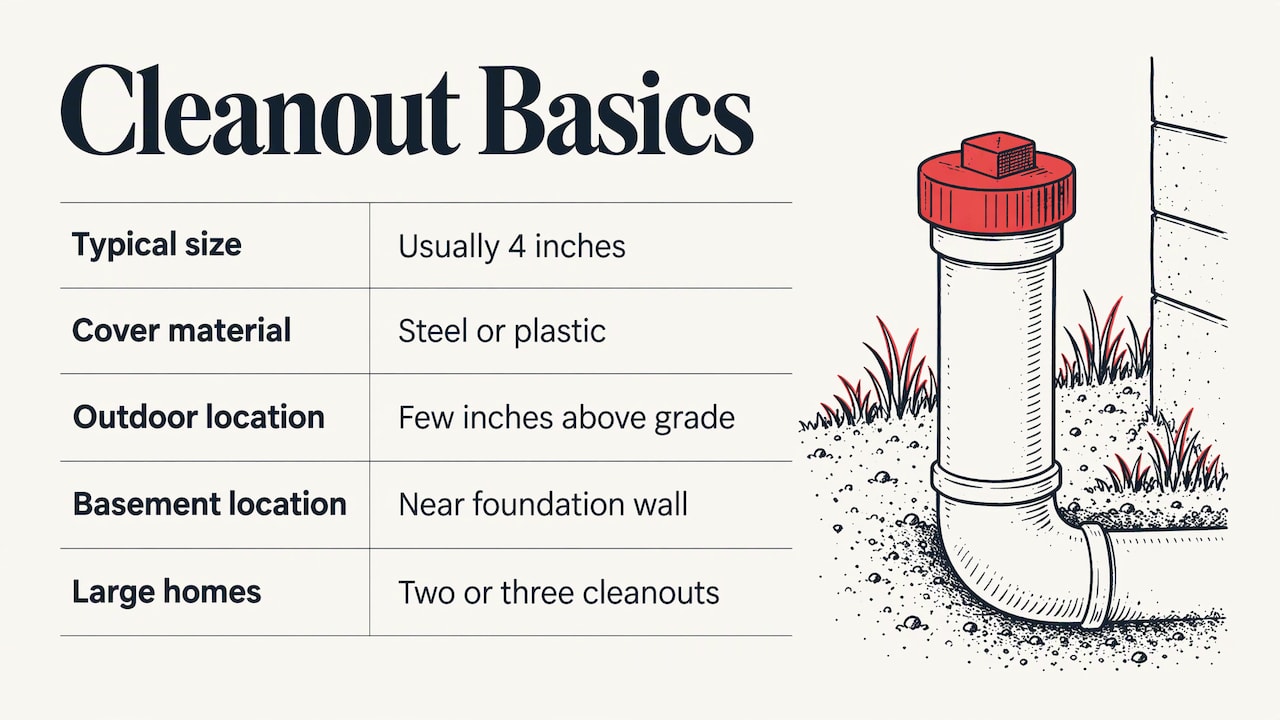
The cleanout is an access port. According to the City of Minneapolis, it is a capped pipe, usually 4 inches, with a steel or plastic cover that opens onto the sewer lateral. The same page says the cleanout belongs to the property owner, and that if you cannot find one it may be buried or you may not have one at all.
Location depends on the house. Outside cleanouts typically rise a few inches above grade in the front yard, along the side of the house or near the foundation, and landscaping, mulch or grass can hide them. Homes with basements, common in colder climates, often have the main cleanout on the basement floor near the foundation wall, on a fitting with a threaded plug. Larger homes can have two or three.
Why the cap height matters: one county public works office explains that a 4-inch riser lets crews find the cleanout quickly during a backup, keeps storm water and sediment out of the sewer, and lets the gasketed cap seal out fluid and sewer gas. Cutting it flush with the ground undoes those benefits.
What Plumbing Codes Require
Most U.S. jurisdictions adopt some version of the International Plumbing Code (IPC) or the Uniform Plumbing Code (UPC), often with local amendments. Summaries of the IPC provisions say the following:
- Cleanouts go on horizontal drains and building sewers at intervals no greater than 100 feet.
- A cleanout is required near the junction of the building drain and the building sewer, brought up to finished ground or basement-floor level.
- A cleanout is the same size as the pipe up to 4 inches, with a 4-inch minimum for larger pipes.
- Every cleanout must be accessible.
Access is not a formality. The UPC calls for 18 by 18 inches of clearance for small piping and 24 by 24 inches for larger piping, because a plumber needs room to finish a repair quickly without disrupting the occupants. If you are finishing a basement or remodeling, plan that opening before the floor goes down, as a single-contractor remodeling guide would suggest when coordinating trades around fixtures.
Many utilities also set their own standards. San José, for example, requires a property line cleanout within 5 feet of the property line, in an approved concrete box, and keeps it open for inspection before backfill. The cleanout also marks the ownership line there: you maintain it, and the city clears stoppages beyond it. Check your own city’s rules before work starts.
How an Outside Cleanout Is Installed
The sequence is straightforward on paper. Each step is where a job can go wrong.
- Locate the lateral. A camera on a locatable sonde traces the pipe. Locate errors of 6 to 18 inches are possible, so the dig point needs confirming. Our video inspection shows the pipe’s condition and path before anyone excavates.
- Pull the permit. Many cities require a plumbing permit to install a cleanout and an inspection before backfill. We handle permits as part of our turnkey approach.
- Excavate to the pipe. One sewer district describes a typical excavation area of about 4 feet by 4 feet down to the lateral. Sidewalks, curbs, trees and buried rock can force a different location. Our excavation crews work around those constraints.
- Connect the fitting. A tee or wye fitting or a saddle joins the lateral, and a riser runs to grade. A ASTM-based method cures the saddle at least 12 hours and tests it hydrostatically before the pipe is cored.
- Backfill, set the cap and restore. Proper bedding protects the pipe, and the cap and box are set so surface water cannot enter. Cleanup and site restoration finish the job.
A brief water shutoff or no-flush window may be needed while the connection is made. Sacramento’s district, for instance, mentions about half an hour.
What Sewer Cleanout Installation Costs
No single price fits every yard. Forbes Home reports a $2,300 national average for a two-way cleanout, from about $1,400 for a shallow line with budget materials to about $3,500 for a deep line. The same report lists these drivers:
- Depth: in colder climates the line can sit 4 to 8 feet down, which makes excavation deeper and costlier.
- Excavation: $50 to $200 per cubic yard.
- Permits: $400 to $1,600 in its estimate.
- Surface: concrete, asphalt or dense soil adds labor and equipment.
We do not publish set prices, because depth and access decide the job. We quote after seeing the line.
When to Install or Upgrade a Cleanout
Add a cleanout in these situations:
- No cleanout exists. Every backup then requires pulling a toilet or opening the line at the roof vent.
- Repeated slow drains or odors. An access point lets us run hydro jetting and camera work without guesswork.
- Sewer line repair or replacement. Installing the cleanout during the work is usually the most efficient time, and many cities require it. See our guide to sewer line repair versus replacement.
- Property or commercial development. Developers and property managers need cleanouts placed to code across multiple laterals.
If the yard is the concern, ask about trenchless sewer repair, which can cut the surface disruption.
Our Perspective
Most people meet their sewer cleanout for the first time during a backup, usually at night. That is the worst time to learn the line has no access point or the cap is buried under a flower bed.
We treat the cleanout as part of the line’s long-term health. Camera inspection first shows what the pipe is doing. Permits, excavation, the fitting, backfill and restoration come next, handled as one project so you are not coordinating several crews. In Denver’s climate, with cold ground and varied soils, depth and bedding deserve the extra attention.
Done well, a cleanout turns a future crisis into a short service call.
Scott
Get a Cleanout Installed in Denver
We provide sewer line repair and replacement, video inspection, hydro jetting and excavation for homes, commercial properties and municipal work, with 24/7 emergency response. Our turnkey approach covers permits through cleanup.

To start, contact us about sewer cleaning and cleanout work, or call for emergency service if a line is backing up now.
FAQ
Where is the sewer cleanout on my house?
Look for a capped pipe, often 4 inches wide, in the yard near the foundation or between the house and street. In homes with basements it is often on the basement floor near the foundation wall. It may be hidden by landscaping or covered by soil.
Do I need a permit to install one?
Often yes. Cities such as San José require a plumbing permit for a property line cleanout, and some districts inspect before backfill. Requirements vary by jurisdiction, and we handle permitting as part of the project.
How long does installation take?
Time depends on depth, access and inspection scheduling. A shallow yard install is far quicker than a deep line under concrete. We confirm the scope after locating the line.
Can a cleanout be installed without digging up my yard?
Most outside installs need a focused excavation down to the lateral, typically a few feet across. Where the pipe itself needs work, trenchless methods can reduce surface disruption.
Sources
- Sewer Cleanouts, City of Minneapolis
- What Is a Sewer Cleanout? Ben Davis Conservancy District
- Sewer Cleanouts, Anne Arundel County Government
- Code requirements for drainage system cleanouts, PHCP Pros
- IAPMO Uniform Codes Spotlight, March 2021
- Bulletin 276 Sewer Installation Requirements, City of San José
- Cleanout Installation and Repair, Sacramento Area Sewer District
- Understanding ASTM F3097-15, whitepaper
- Cost To Install Two-Way Cleanout For Sewer Lines, Forbes Home