
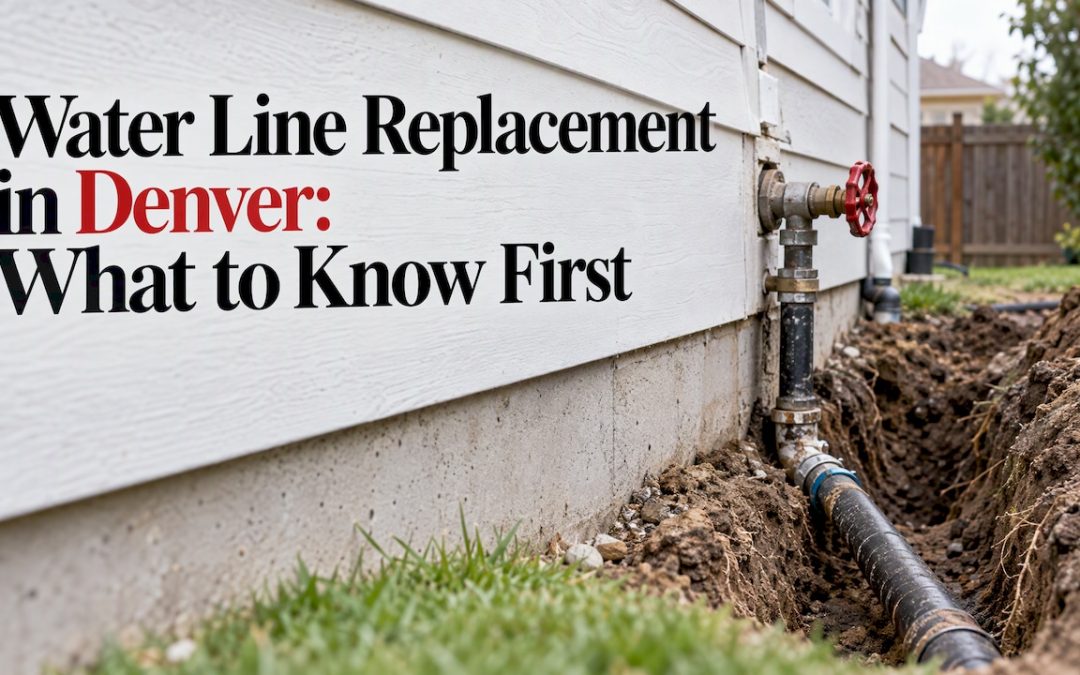
A water line replacement swaps the pipe that carries water from the main in the street to your building. In Denver, that pipe is usually yours to pay for, and the job involves a permit, excavation and cleanup. PipeX handles all of it, from permits to cleanup, with 24/7 emergency response if the line fails before you plan for it. Call us for a water line assessment before a small problem turns into a flooded yard.
Key Takeaways
- In Denver, the property owner owns the service line from the main to the building. Denver Water maintains the main.
- Lead service lines are being phased out nationally. Replacing the whole line, not a piece of it, is the standard approach.
- Length, depth, and what sits on top of the route (driveway, sidewalk, landscaping) drive the scope of the job.
- A turnkey contractor handles permits, excavation, installation and site restoration under one project.
Table of Contents
- What a water service line is
- Who is responsible in Denver
- Signs the line needs attention
- Lead service lines: what Denver owners should know
- How a replacement works
- What drives the scope of the job
- Why one contractor for the whole job matters
- Replace your water line with PipeX
- Our perspective
- FAQ
- Sources
What a water service line is
The EPA defines a service line as the pipe that connects the water main to the plumbing in a home or building. It is buried, so you rarely think about it until pressure drops, a wet patch appears in the yard, or the water bill climbs for no reason.
The pipe runs under lawns, driveways and sometimes trees. That is why replacement is as much an excavation job as a plumbing job.
Who is responsible in Denver
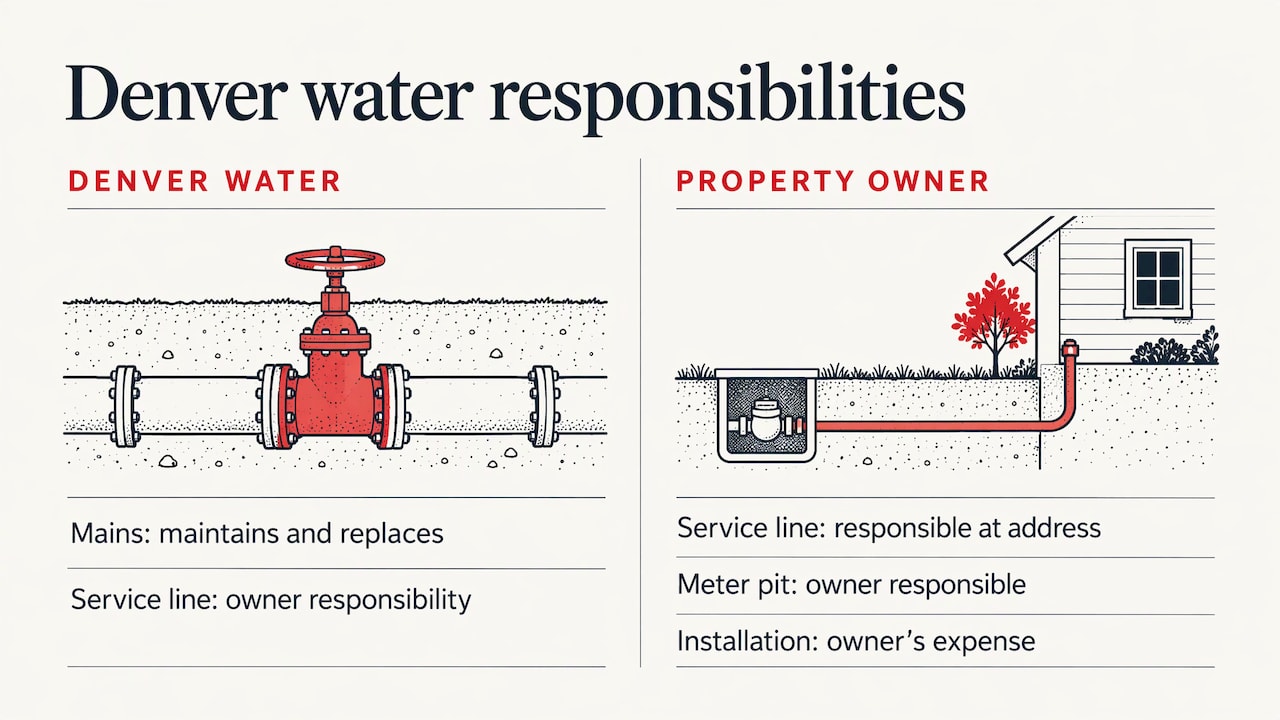
According to Denver Water, the utility maintains and replaces the water mains. Property owners are responsible for the service line and meter pit at their address. The dividing point is where the property taps into the main, or the discharge side of the valve closest to the main. The service line is owned by the property owner and installed at the owner’s expense. Denver Water is also not responsible for water damage caused by a property’s service line or internal plumbing.
For a homeowner, that means a failed line is your decision, your timeline and your cost. For a property manager or developer, it means the line belongs in the project budget from the start. A contractor who knows the connection point, the permit steps and the utility’s requirements saves real time here.
Signs the line needs attention
The common warning signs are low or fluctuating pressure, discolored water, unexplained wet or sunken ground, a meter that moves when everything is off, and a sudden jump in your bill. Interior clues matter too: the signs of water damage inside walls, floors and ceilings can point to a leak that started outside.
Before anyone digs, a leak is best located precisely. Our water line leak detection guide explains the signs and tests, and video inspection lets us see the condition of a line rather than guess. Guessing is expensive: a wrong dig costs you a trench and a patched driveway.
If the line has already broken, read what to do in the first hour of a water line break and call our emergency line.
Lead service lines: what Denver owners should know
Lead service lines were installed primarily from the late 1800s through the 1940s, and the EPA notes that there is no level of lead considered safe. Records of where they sit are often poor, so the first step is identifying what material your line is made of.
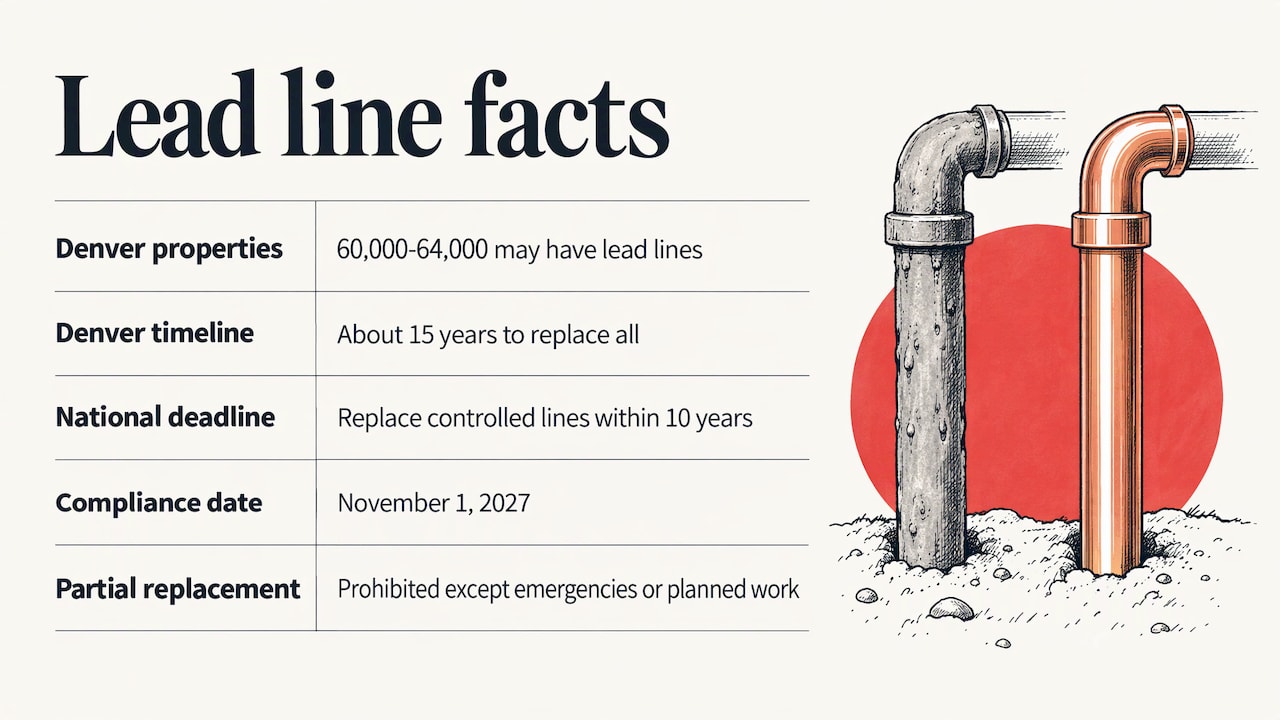
Denver Water estimates that 60,000 to 64,000 properties in its service area may have lead service lines, and projects about 15 years to replace them all. It will replace a customer-owned lead line with copper at no direct charge when the line is found during a utility project. Customers whose lines are not reached by pipe work are enrolled in its Lead Reduction Program.
Nationally, the EPA’s 2024 Lead and Copper Rule Improvements require water systems to replace lead and galvanized lines under their control within 10 years, whatever the tap lead levels. The compliance date is November 1, 2027, according to state and federal summaries of the rule.
One point matters for your timing: the rule prohibits partial lead line replacement except for emergency repairs or planned infrastructure work. Michigan’s environmental agency explains why: digging and cutting can release particulate lead, so a half-replaced line can leave water worse off. If you suspect lead, plan to replace the whole private-side line, and coordinate with the utility so the two sections match.
How a replacement works
A typical job follows the same sequence:
- Assess the line. Locate it, confirm the material and the leak point, and map the route.
- Pull the permit. Work beyond the meter generally needs a plumbing permit, and a contractor who files it keeps the schedule moving.
- Excavate or go trenchless. Open trenching exposes the full run. Pipe bursting pulls new pipe through the old path using two access pits, which can spare landscaping. According to the Plastics Pipe Institute, routine bursting depends on factors such as depth under 12 feet, compressible soil and a sufficiently wide old trench. A collapsed or heavily deteriorated line usually calls for open excavation.
- Install and test. The new line goes in at code depth, then is inspected and pressure tested before backfill.
- Restore the site. Backfill, patch and clean up.
For how we approach the work in Denver, see our water line repair and replacement page.
What drives the scope of the job
Three things shape every replacement: the length of the run, how deep the line has to sit to meet local code and Colorado’s frost conditions, and what lies on top of it. A route under a driveway, a sidewalk or mature trees needs more planning than one across open lawn. Material choice also matters, and your contractor should tell you what is being installed and why.
We do not publish a flat price because every line differs. We quote after assessing the route, so the figure reflects your property rather than a national average. Where land grading or concrete work is part of the job, our excavation team handles that under the same project.
Why one contractor for the whole job matters
A water line job passes through several hands: locating, permits, digging, plumbing, inspection, restoration. When those are split among separate companies, delays and finger-pointing follow, and your yard sits open in the meantime. PipeX runs the project from permits to cleanup, which is the turnkey approach we built the company around over more than 20 years.
The same applies to commercial and municipal properties. Our commercial water line repair page covers what to expect when a business cannot afford long downtime.
Replace your water line with PipeX
We repair and replace water lines for homeowners, businesses, developers and municipalities across Denver, with same-day service and 24/7 emergency response. Start with an assessment, get a clear scope, and let us handle permits, excavation, installation and site restoration.

See our plumbing services or contact PipeX to request a quote.
Our perspective
Most water line calls start the same way: an owner who did not know the line was theirs. Once they learn that, the next question is who can do everything, not just the digging.
We believe the right answer is one team from the first look to the last shovel of topsoil. Clear communication, regulatory compliance and minimal disruption are the standard we hold ourselves to on small and large projects alike. If your line is old, possibly lead, or already leaking, a conversation with us now is cheaper than an emergency later.
Scott
FAQ
Is the water line from the street to my Denver home my responsibility?
Yes, in most cases. Denver Water takes care of the main, while the owner is responsible for the service line and meter pit at the property. Contact us and we can help you identify exactly where your section begins and ends.
Can I replace only the lead part of my line?
Federal rules prohibit partial lead line replacement except for emergency repairs or planned infrastructure work. Replacing the entire line avoids leaving old lead sections connected to new pipe. We can inspect and scope a full replacement.
Does replacement always mean digging up the whole yard?
Not always. Some lines can be replaced through two access pits using pipe bursting, while others need an open trench because of their condition or route. A video inspection and route assessment tell us which fits your property.
What if my water line breaks suddenly?
Shut off the water at your main valve and call our 24/7 emergency line. We respond to water line failures and can handle repair or full replacement.
Sources
- EPA: Getting Started with Lead Service Line Identification and Replacement
- Denver Water: Homeowner Responsibility
- EPA Lead and Copper Rule Improvements, Federal Register
- Illinois Pollution Control Board SDWA update
- EPA: Planning and Conducting Lead Service Line Replacement
- Michigan EGLE: Partial Lead Service Line Replacement
- Plastics Pipe Institute: Pipe Bursting
- Signs of Water Damage