

A blocked culvert sends water where it was never meant to go: onto your driveway, into a neighbor’s yard or over the road. On most private property, clearing it is the owner’s job. Surface debris is a quick fix. A packed, silted or collapsed pipe is not. It calls for jetting, camera inspection or excavation, and for permits that a property owner rarely has time to chase. Our team in Denver does the work from permit to cleanup and answers emergency calls around the clock, so you can reach us through our emergency services page the moment water starts backing up.
Key Takeaways
- Driveway culverts are generally the property owner’s responsibility. Culverts under public roads belong to the local public works department or the state DOT.
- Raking leaves and debris from the pipe ends is routine. Entering the pipe is not: many culverts qualify as confined spaces with real hazards.
- Inspect culverts quarterly and before big storms, and clean when the pipe is 20% full of sediment or more.
- Heavy sediment, roots, damaged joints or a pipe under a waterway call for professional equipment and sometimes federal, state or local permits.
Table of Contents
- What a Blocked Culvert Looks Like
- Who Is Responsible for Clearing a Culvert
- Safety First: Do Not Climb Into the Pipe
- What You Can Reasonably Do From the Outside
- When the Job Needs a Contractor
- Keeping a Culvert Clear
- Where We Come In
- Our Perspective
- FAQ
- Sources
What a Blocked Culvert Looks Like
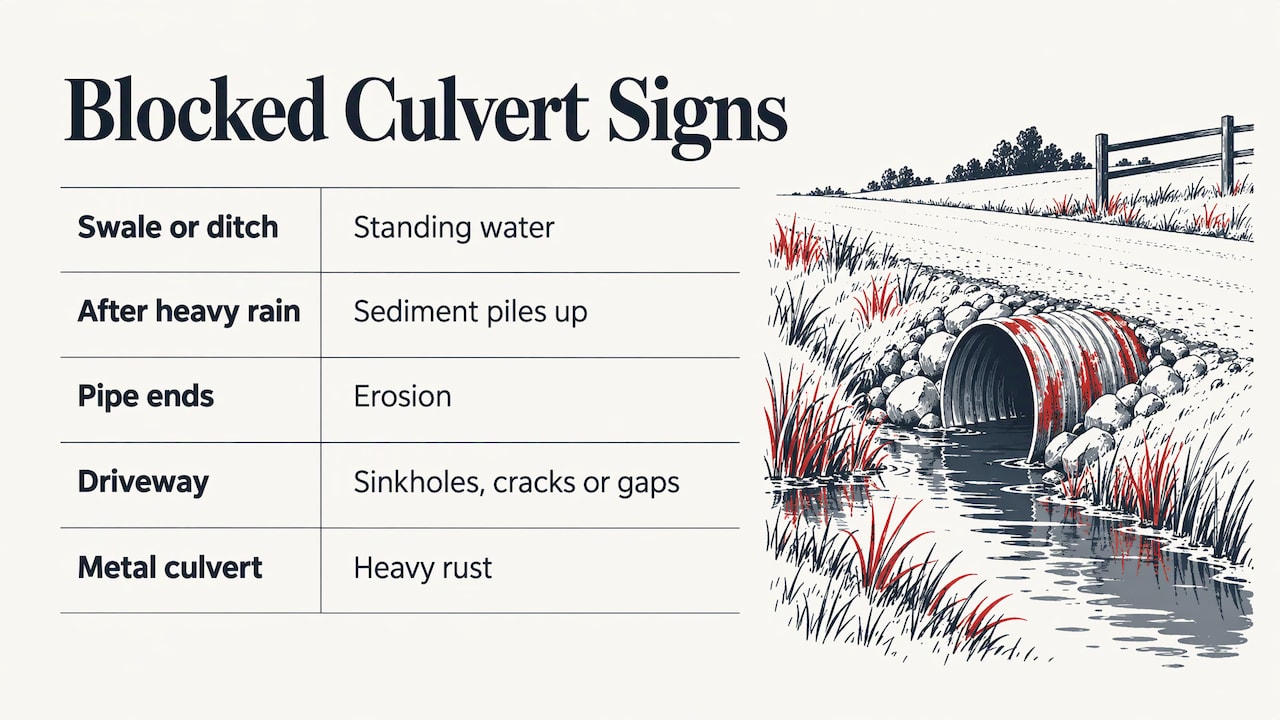
A culvert is a pipe or tunnel that carries water under a driveway, road or embankment. When it clogs, the symptoms show up around it first. Look for standing water in the swale or ditch, sediment piling up after a heavy rain, erosion at the pipe ends, sinkholes in a dirt driveway above the pipe, cracks or gaps between the driveway and the pipe, and heavy rust on metal culverts. These are the items on one water control district’s driveway culvert checklist.
The damage is not limited to the pipe. Obstructions reduce how much water a ditch can carry, which leads to flooding upstream and, on roads, water overtopping the pavement. Standing water also breeds mosquitoes.
Common causes are leaves, grass clippings, trash, silt, tree roots and, in rural settings, animal dams. Yard waste dumped into ditches is a frequent culprit: one Ohio city warns that clippings and brush form dams that lead to flooding.
Who Is Responsible for Clearing a Culvert
Rules vary by town and state, so confirm with your local public works office. The pattern across the U.S. is consistent, though:
- Driveway culverts: the owner. One Indiana county states plainly that it will not clean a plugged driveway culvert.
- Culverts under public roads: the city, county or state DOT. Carrboro, NC points to its Public Works and NCDOT, and Spotsylvania County, VA notes that VDOT maintains pipe culverts within the public right-of-way.
- Culverts under private roads: the road owner, such as a homeowners’ association.
The stakes are financial. Marin County, California, warns that owners who do not clear debris could be held responsible for property damage. A New Hampshire town describes clearing clogged culverts as one of the best ways to avoid flood damage and legal liability toward neighbors. If your culvert has failed, that liability argues for a fast, documented repair.
Property managers and developers carry the same exposure on a larger scale. A single clogged culvert on a commercial site can back water into parking areas, loading docks or neighboring lots.
Safety First: Do Not Climb Into the Pipe
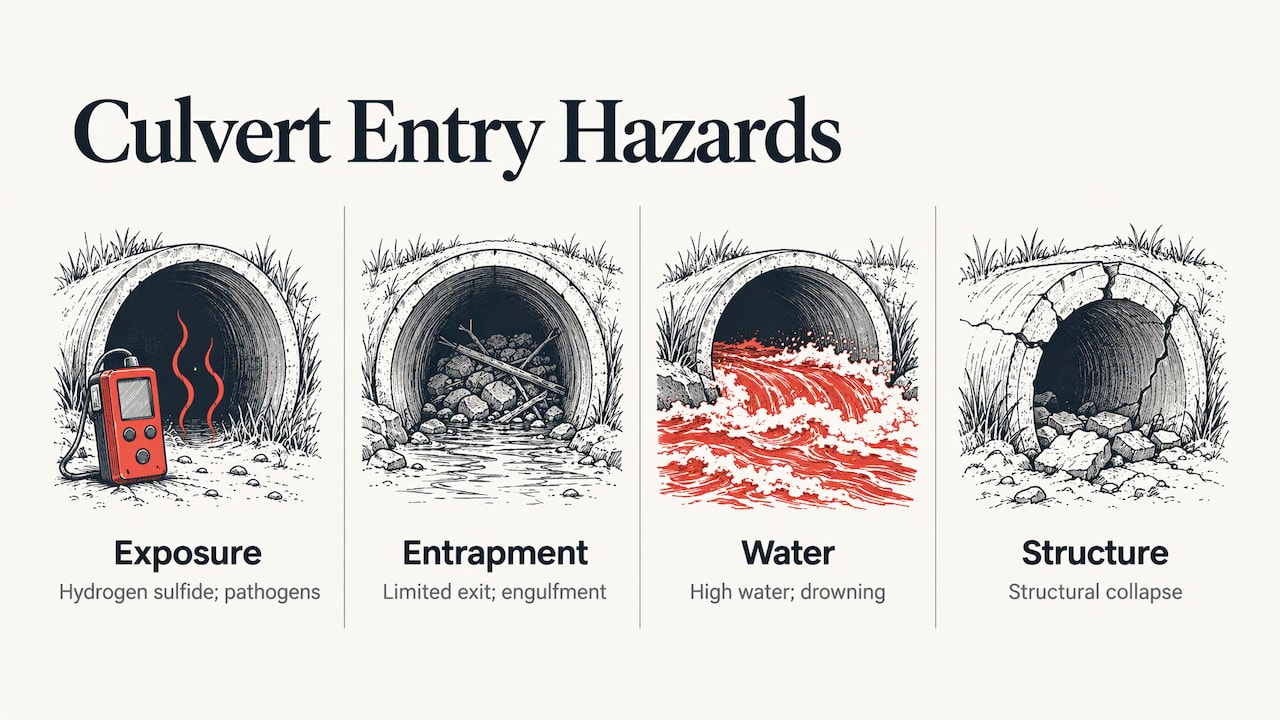
The most important rule is the simplest. Stay out of the culvert. The manufacturer’s maintenance manual from a major drainage pipe producer says many culverts qualify as permit-required confined spaces under OSHA’s rule at 29 CFR 1910.146. The listed hazards include hydrogen sulfide gas, limited exit, engulfment, high water, pathogens, drowning and structural collapse. Entries that need a permit must be done by certified confined-space professionals with an entry plan and constant monitoring.
Municipal crews follow the same logic. One city’s inspection procedure instructs crews not to enter a culvert pipe to perform a visual inspection.
Two more precautions apply before any digging near a culvert. Call 811 so utility lines are located first, as Tallmadge, Ohio advises for any backyard drainage work. And do not work in fast, high water after a storm.
What You Can Reasonably Do From the Outside
For a light clog at the pipe ends, the homeowner steps in Carrboro’s guide are a sound baseline:
- Shine a flashlight down the pipe from both ends to see how far the blockage runs.
- Use a shrub rake or shovel to pull out leaves, gravel and dirt, taking care not to damage the pipe or its joints.
- Look for offset or open joints, roots and cracks.
- Dispose of the debris away from stormwater runoff so it does not wash back into the swale and pipe.
If the blockage is out of reach, the water is moving fast, or the pipe walls look damaged, stop there. A culvert that has cracked, shifted or separated at the joints will clog again no matter how often you rake it.
When the Job Needs a Contractor
Call a professional when you see any of these:
- Sediment filling a large share of the pipe. One state DOT guide says maintenance should restore original capacity once debris blocks more than half the structure.
- Roots, packed silt or debris deep inside a long run.
- Sinkholes, settlement or a driveway that is dropping above the pipe.
- Standing water that returns days after you clear the ends.
- A culvert that crosses a waterway, where permits are likely.
Professional cleaning is a different process from hand tools. The pipe manufacturer’s manual describes a vacuum truck with a jet nozzle at no more than 2,000 psi to clear sediment, leaves and small roots, working downstream so the water pushes debris toward the truck. It also discourages bladed cutting tools because blades can damage the pipe wall. A city procedure lists a camera and a mini-excavator with a culvert cleaner attachment among the equipment for harder jobs.
That is the territory of hydro jetting, video inspection and excavation. Our crews handle drain cleaning and hydro jetting, video inspection to see what is actually inside a line, and excavation when a section has to be exposed and replaced. For a related look at who handles the street-side version of this problem, see our guide to storm drain clogs and who clears them.
Permits Are Part of the Job
Culvert work can trigger paperwork. Carrboro tells owners that when they hire a contractor, they must make sure it obtains the right permits, which may include a public works encroachment agreement, 811 locates, a zoning permit and a U.S. Army Corps of Engineers permit for waterway culverts. Requirements differ by jurisdiction, and a step the law gives to an authority is part of the process. We handle permits as part of our turnkey approach, from permitting through cleanup, so you are not coordinating it alone.
Keeping a Culvert Clear
Prevention is cheap compared with a flooded yard.
- Inspect on a schedule. Check quarterly, before big storms, whenever water stands in the swale, and when the pipe is 20% full of sediment or more.
- Keep debris out. Do not rake, blow or dump leaves or clippings into ditches, and keep fences, sheds and other structures from blocking access to the culvert.
- Clear the upstream sources. Gutters, downspouts, drain inlets and ditches all feed debris to the pipe. Marin County suggests doing this in late summer into early fall, ahead of the rainy season. In Colorado, a good rule is to do it before the spring thaw and summer storm season.
- Manage the water around it. Good drainage around structures such as retaining walls keeps soil and runoff from washing toward your culvert.
Where We Come In
If your culvert or storm drain is clogged, damaged or undersized, we handle plumbing and excavation for homeowners, businesses, developers and municipalities in Denver. That includes drain cleaning and hydro jetting, video inspection, storm drain installation and repair, trench drains, and site restoration. Start with our plumbing services or call for emergency help at any hour.

We take the project from permits to cleanup, which means one team handles the dig, the repair and the restoration of your site.
Our Perspective
Most culvert problems we hear about start as a small, ignorable pile of debris and end as a flooded driveway. The pipe is out of sight, so it gets attention only after a storm.
Our view is simple: look at it before the weather forces you to, and call early when the clog is beyond the pipe ends. A camera inspection shows whether you have a blockage or a broken pipe, and that decides whether you need cleaning or replacement. Guessing is expensive.
We build our work around Denver’s climate and infrastructure, and around handling the whole project, from permits to cleanup, so a property owner is not left managing three vendors during an emergency.
Scott
FAQ
Who is responsible for clearing a culvert?
For a driveway culvert, it is usually the property owner. Culverts under public roads belong to the local public works department or the state DOT, and those under private roads belong to the road owner, such as an HOA. Check with your local public works office for your area’s rule.
What tool can I use to clean out a culvert?
For surface debris at the pipe ends, a shovel or shrub rake works. For deeper clogs, professionals use a vacuum truck with jetting tools, a camera or a mini-excavator with a culvert cleaner attachment. Do not enter the pipe yourself.
How often should a culvert be inspected?
Quarterly, before big storms and any time water stands in the swale is a common municipal recommendation. Clean it when sediment fills about 20% of the pipe or more.
Can a blocked culvert get me in legal trouble?
It can. Local officials note that owners may be responsible for flood damage to neighbors when a private culvert is left blocked, and some towns can require repairs. Prompt cleaning and repair are the best protection.
Sources
- Driveway Culvert Maintenance, South Indian River Water Control District
- Maintaining Roadside Ditches and Driveway Culverts, Shady Shores, TX
- Drainage & Ditching: A Homeowner’s Guide, Tallmadge, OH
- Delaware County, Indiana: plugged driveway culvert
- Driveway Culvert Maintenance, Carrboro, NC (Public Works)
- Driveway Culvert Maintenance, Carrboro, NC (homeowner steps and permits)
- Homeowner Guidance & Resources, Spotsylvania County, VA
- Driveway culvert maintenance, Marin County Flood Control District
- Property Owners Are Responsible for Maintenance of Culverts, Town of Newbury, NH
- Pipe Operation & Maintenance Manual, ADS
- Appendix H, Inspection and Maintenance SOPs, City of Sebastian
- Stormwater maintenance guide, Minnesota DOT
- Retaining Wall Drainage: A Homeowner’s Installation Guide