
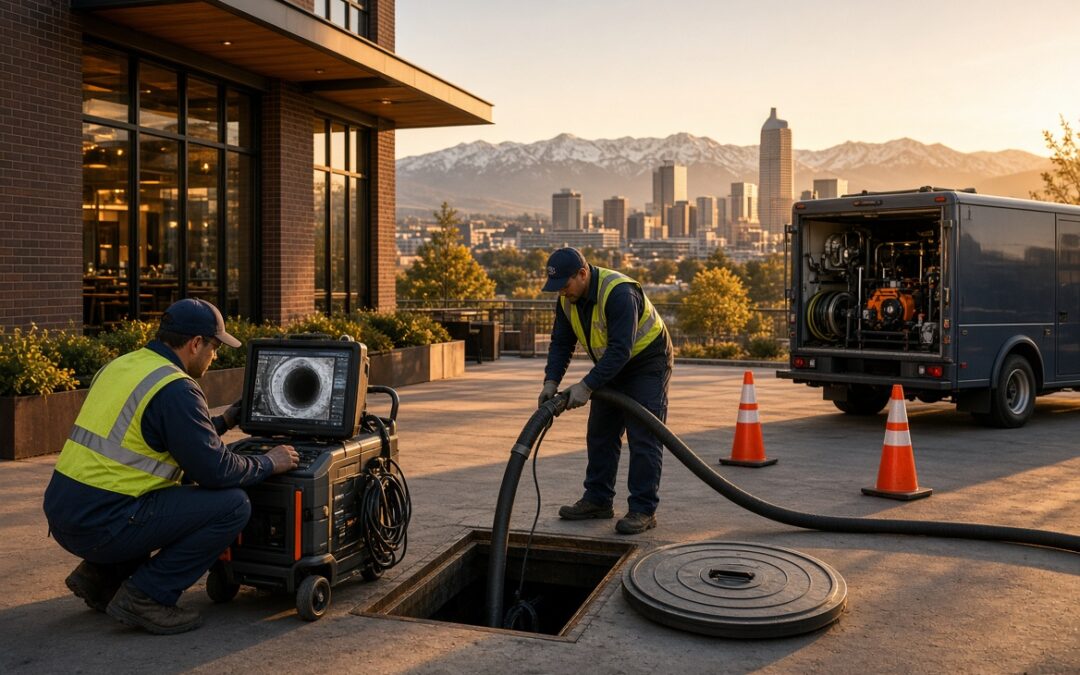
PipeX is a Denver commercial plumbing contractor that keeps restaurants, offices, healthcare facilities, multi-tenant buildings, and municipal sites operating through grease trap service, fire line work, hydro jetting, sewer and water main repair, excavation, and 24/7 emergency response. If a plumbing failure would close a kitchen, idle a floor of tenants, or fail a fire inspection, this is the work we do.
Commercial plumbing is not a larger version of a house call. Peak demand, health-department rules, fire codes, shared risers, and Denver freeze-thaw cycles all change how a system should be diagnosed and repaired. The PipeX commercial services page outlines the scope. This article explains how those services actually protect a business in Denver, Aurora, Centennial, and Parker.
What commercial plumbing covers for Denver businesses
A commercial plumbing system moves potable water in, wastewater out, and—on many properties—fire suppression water through dedicated mains and hydrants. When any of those paths fail, the building feels it immediately: a restaurant cannot plate food, a clinic cannot stay in service, a garage floods, or an inspector red-tags a fire line.
PipeX commercial work typically includes:
- Grease traps and interceptors — cleaning, repair, installation, and replacement
- Sand and oil interceptors for fleet yards, service centers, and parking structures
- Drain cleaning and hydro jetting for kitchen lines, restrooms, and mains
- Sewer lines, sanitary systems, and clearwater systems
- Water lines and water mains
- Fire lines and hydrant servicing
- Parking garage storm repair and replacement
- Interior underground repair
- Excavation, utility trenching, and site restoration
- Preventative maintenance programs built around how the property actually runs
Who PipeX commercial crews work with
The same code book applies across building types. The operating pattern does not. A downtown kitchen that fries all evening needs a different service cadence than an office tower along I-25 or a multi-tenant plaza in the Denver Tech Center.
- Restaurants and foodservice in Denver, Aurora, and Centennial — grease management, floor drains, and after-hours jetting
- Office and multi-tenant buildings — phased riser and valve work so tenants stay open
- Healthcare and medical offices — sanitary conditions, documented repairs, tight access windows
- Retail plazas and hospitality — public restrooms, storm drains, and guest-facing spaces
- Multi-family housing — shared sewer and water lines with many users on one stack
- Municipal and industrial sites — fire mains, hydrants, vaults, and larger underground utilities
Denver conditions that wear commercial pipe faster
Denver is hard on buried infrastructure. Freeze-thaw movement stresses joints. Spring storms overload drains that were never cleaned after a heavy grease season. Older neighborhoods still run on pipe that has already outlived its design life, while new growth in Aurora, Centennial, and Parker adds demand onto mixed-age networks.
That is why a generic “annual snake” is a weak commercial plan. PipeX starts with a walkthrough: peak hours, problem fixtures, past backups, interceptor size versus the actual menu, and whether work has to happen at 5 a.m. instead of noon. Recommendations follow the building, not a template.
Grease traps and interceptors: the highest-risk commercial system
For foodservice, the grease trap is a compliance device and a production device. When it is undersized, overdue for pumping, or damaged, kitchens see slow floor drains, sewer odors, and health-department findings. PipeX handles the full cycle:
- Scheduled cleaning and pumping
- Repairs when baffles, lids, or piping fail
- Installation and replacement sized to kitchen layout, menu, and local discharge rules
- Related interceptor work, including sand and oil units at car washes, fleet yards, and service centers
More detail lives on the grease traps and interceptors service page. The practical takeaway for owners: pair trap service with hydro jetting of the kitchen line. Cleaning the box and leaving the pipe coated with grease only postpones the next backup.
Hydro jetting and camera inspection before anyone digs
Snaking punches a hole through a clog. Hydro jetting scours the pipe wall with high-pressure water so grease, sludge, scale, and roots come out instead of reforming a week later. On commercial sites that is usually the difference between a one-time clear and a repeat emergency.
PipeX pairs jetting with video camera inspection. The camera shows cracks, offsets, collapsed sections, and root intrusion. The recording also gives facility managers something they can send to ownership, an insurer, or a general contractor. Digging starts only after the line has been mapped.
Sewer, water, and interior underground repair
Commercial sewer and water failures rarely stay isolated. A main-line backup can take down every restroom on a floor. A leaking domestic water line can close a corridor or damage tenant finishes. PipeX repairs and replaces sewer lines, water lines, and interior underground piping, then restores the site.
Where access and pipe condition allow, trenchless methods—pipe lining or pipe bursting—limit how much parking lot, slab, or landscaping has to open. Where the pipe has collapsed or the alignment has to change, conventional excavation is the honest answer. Crews locate existing utilities first, compact backfill, and match surfaces so the property can reopen.
Fire lines and hydrants are plumbing with a life-safety clock
Underground fire mains and hydrants are easy to ignore until an inspection or an emergency. PipeX installs, repairs, and maintains fire lines and hydrants to current Denver-area requirements and coordinates with fire protection contractors and local authorities on underground mains.
That work belongs in the same commercial conversation as grease traps and sewer mains because it lives in the same dirt, uses the same excavation skill, and carries the same need for permits and documented testing. See fire line and hydrant services for the dedicated scope.
Storm drains, parking garages, and site work
A flooded garage or plaza is a liability problem before it is a plumbing problem. PipeX repairs and replaces parking garage storm systems, clears storm lines, and handles the excavation and site restoration that come with buried work. On occupied sites the sequence matters: access routes, staging, signage, lockout around mechanical equipment, and work windows that do not collide with lunch rush or clinic hours.
How a PipeX commercial job is run
- Walkthrough and usage map. When does the building peak? Which lines have failed before? Who needs access during the work?
- Diagnosis. Camera inspection, locating, and a plain-language report that separates urgent repairs from budgeted upgrades.
- Upfront scope. Itemized pricing, timeline, permit path, and phasing so tenants can keep operating.
- Execution. Safety plan, protected finishes, coordinated shutdowns, and code-compliant materials suited to Colorado climate and soil movement.
- Closeout and maintenance. Restoration, documentation, and a service cadence that can change if the building’s use changes.
Transparency is the operating rule: no hidden extras after the quote, updates when an inspector or utility changes the schedule, and a record facility managers can file.
Preventative maintenance beats after-hours chaos
Most commercial emergencies announce themselves months earlier—slow kitchen drains, a trap that smells between pump-outs, a restroom that gurgles when the washer on another floor runs, a fire line that has never been flowed. A maintenance plan that matches the property (quarterly jetting for a busy kitchen, seasonal storm work for a garage, scheduled fire-line checks) is cheaper than a Saturday shutdown.
PipeX reviews service history with returning clients and adjusts frequency when a tenant mix changes. That is how a restaurant conversion in an old office shell avoids inheriting a trap and drain design that no longer fits.
Why Denver businesses stay with PipeX
- Serving Colorado since 2003 — more than 20 years on local soil, codes, and weather
- Licensed and insured commercial and residential crews
- True 24/7 dispatch for backups, bursts, and fire-line failures
- Same-day response on most emergencies
- Turnkey handling of permits, inspections, and site restoration
- Work planned around occupied buildings instead of against them
Reviews on the PipeX reviews page repeat the same operational points: on-time arrival, camera confirmation instead of guesswork, and crews that do not sell scare tactics.
When to call instead of waiting for the next slow drain
Call a commercial plumber when you notice any of the following:
- Repeated backups in a kitchen, restroom group, or floor drain
- Grease odors or standing water around an interceptor
- A fire line or hydrant that failed inspection or has visible leakage
- Unexplained wet spots, settlement, or sinkholes over a buried line
- Storm water ponding in a garage or plaza after ordinary rain
- A remodel or change of use that will increase grease, occupancy, or fixture count
PipeX commercial dispatch: 303-572-3478 or 720-580-9484. For non-emergency scheduling use the contact form.
Commercial plumbing FAQs
What commercial plumbing services does PipeX provide in Denver?
PipeX provides grease trap and interceptor service, hydro jetting and drain cleaning, sewer and water line repair and replacement, fire line and hydrant work, parking garage storm repair, sand and oil interceptors, excavation, site restoration, and preventative maintenance for commercial and municipal properties in the Denver metro area.
Can PipeX work after hours so my business stays open?
Yes. Commercial work is routinely phased around peak hours, and emergency crews run 24/7. Restaurants, clinics, and multi-tenant buildings can often keep operating while priority areas are handled first.
How often should a Denver restaurant clean its grease trap?
Frequency depends on trap size, menu, and how many covers you serve. High-volume fry and grill kitchens often need service every 30 to 90 days. PipeX sizes the interval after a walkthrough rather than guessing from a generic calendar.
Do you service fire lines as well as sanitary plumbing?
Yes. Underground fire mains, hydrants, and related piping are part of the commercial offering, coordinated with fire protection contractors and local fire authorities as required.
Will commercial sewer repair tear up my parking lot?
Not always. Camera inspection tells us whether trenchless lining or bursting can limit excavation. If the pipe has collapsed or must be rerouted, we open only what the repair requires and restore the surface when the work is done.
Which cities does PipeX commercial plumbing cover?
Denver, Aurora, Centennial, Parker, and surrounding metro communities.
How do I get a commercial quote?
Call 303-572-3478 or submit the contact form. Most quotes follow a site walkthrough and, when needed, a camera inspection so pricing reflects the actual line—not an estimate written from the parking lot.